






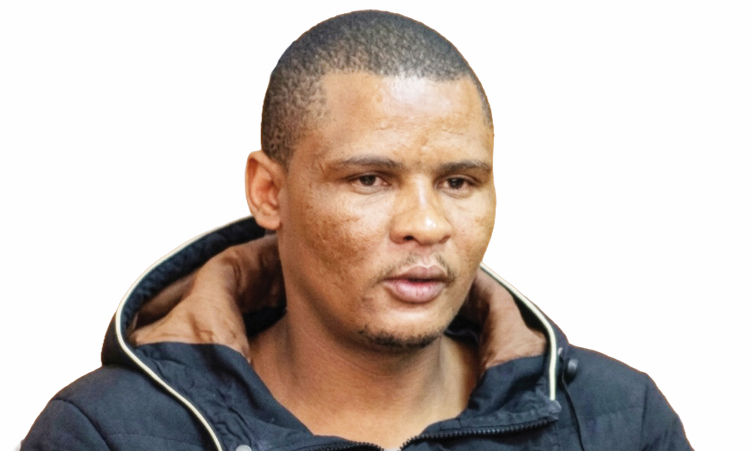
The man accused of causing a security breach when he entered the premises of State House in Windhoek, where he was found naked, near the end of April this year is to be detained in a mental hospital or prison until his release has been authorised.
Magistrate Olga Muharukua directed in the Windhoek Magistrate’s Court yesterday that Windhoek resident Giano Seibeb (29) should be detained in a mental hospital or a correctional facility with a mental facility pending a decision by the president about his future fate.
Muharukua made the order after public prosecutor Paulus Shilongo on Friday last week applied for Seibeb to be declared a president’s patient in terms of the Criminal Procedure Act.
Defence lawyer Milton Engelbrecht, representing Seibeb, did not oppose the state’s application.
Seibeb was alleged to have been found naked in State House on 30 April.
He was also alleged to have broken into the house of a senior police officer in Windhoek on 21 April.
Seibeb was charged with counts of trespassing, housebreaking with intent to commit a crime unknown to the state, and indecent exposure, which is a contravention of a section of the Combating of Immoral Practices Act of 1980.
He was referred for psychiatric observation when he made a first court appearance on 5 May.
In a psychiatric evaluation report completed in June, psychiatrist Dr Nelao Mhata said a panel of medical professionals concluded that Seibeb is not fit to stand trial and cannot be held accountable for his actions. Mhata diagnosed Seibeb as having schizophrenia and also a substance use disorder.
She said Seibeb “is not fit to stand trial, he cannot follow and understand the court proceedings, and cannot make a proper defence”.
She said at the time the alleged crimes Seibeb was charged with were committed, “he was suffering from a mental condition that could have made him incapable of appreciating and realising the wrongfulness of his act, and the consequences of his actions”.
MENTAL PATIENT
Mhata added: “His actions were influenced by a mental defect. Therefore, he is not accountable.”
She recorded in the report that Seibeb has been known at the psychiatry department of Windhoek Central Hospital as a patient diagnosed with schizophrenia since April 2022.
Seibeb’s mother and the police brought him to the hospital in early April, reporting that he had been “talking irrelevant things, speaking loudly, claiming to be a prophet, hearing voices unheard by others, being uncooperative, with background history of using cannabis and mandrax”, Mhata reported.
Seibeb managed to abscond from the hospital’s mental health ward on 16 April, after which he was brought back to the hospital on 19 April, Mhata said in her report.
He again absconded from the ward on 19 April, was brought back by the police on 22 April, absconded a third time on 28 April and was returned to the ward the next day.
On 30 April, Seibeb again left the ward by climbing over a courtyard wall, and then made his way to State House.
During his period of psychiatric evaluation following his arrest, Seibeb said he had walked all the way from Lesotho on the day he went to State House, that he jumped over a fence at the presidential property, and that he went to the second floor of a building, where he saw the president’s face, Mhata recorded.
“He does not remember where people found him, he just saw them coming saying they will beat him up,” Mhata stated.
“He also says he was naked at that time. He undressed himself because he was waiting for a woman.
During that time, he was hearing a voice telling him he is the president, and that he must go to the president’s house because they are waiting for him to become the president,” she reported as well.
Engelbrecht did not dispute the findings in the report.
In terms of the Mental Health Act of 1973 currently in force in Namibia, the justice minister may authorise the release of a person detained as a president’s patient because of being unfit to stand trial due to mental illness when the person was not accused of serious violent offences.
The minister may order the release of such a person after obtaining a report from a hospital board and from the Office of the Prosecutor, as curator of such a detainee.
The mental health bill of 2025, which has been passed by parliament and is due to replace the 1973 Mental Health Act, refers to forensic mental health patients and states they must be held in a designated mental health facility.
The bill also states that a review board established by the health minister has to decide if such a patient is to be discharged from a mental health facility.