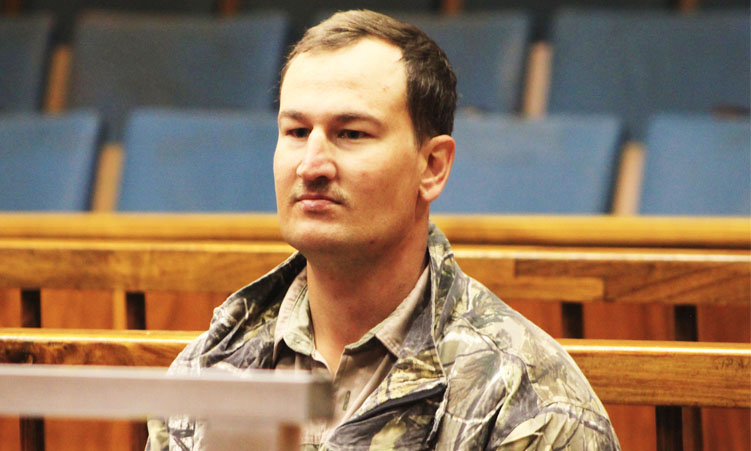
A bail appeal by a South African citizen facing criminal charges after the discovery of a cannabis plantation with an estimated value of N$52 million at a farm in the Okahandja district was refused in the Windhoek High Court yesterday.
With Armand Schultz’s appeal against being refused bail in the Okahandja Magistrate’s Court in March this year, it was not shown that the magistrate who turned down his application to be granted bail made a wrong decision, judge Claudia Claasen concluded in the High Court’s appeal judgement. “Therefore, the appeal court cannot interfere with that decision,” Claasen stated.
Schultz (28) and a co-accused, farm owner David van der Linden (43), were charged with dealing in or possessing cannabis valued at about N$52.2 million and disguising the unlawful origin of property after the police discovered a dagga plantation at farm Eendrag, situated in the Hochfeld area north-east of Okahandja, near the end of last May.
Schultz, who is a South African citizen and is married to a Namibian, was employed at Eendrag at the time of his arrest nearly 14 months ago.
According to him, he was employed as a mechanic at the farm. The state, however, is alleging that Schultz was employed as the manager of the farm.
Van der Linden was granted bail in an amount of N$260 000 in the Okahandja Magistrate’s Court at the start of June this year.
A third accused in the matter, Johannes Kamati, who is accused of possessing about 58 kilograms of cannabis valued at N$2.9 million at Okahandja on 28 May 2025, was granted bail in an amount of N$50 000 in an appeal judgement delivered in the Windhoek High Court in December.
Claasen noted in her judgement that Schultz denied during his bail hearing in the Okahandja Magistrate’s Court that he knew about the dagga plantation at farm Eendrag or was involved in the cultivation of cannabis at the farm.
According to a police investigator, though, 14 farmworkers made witness statements in which they said Schultz was a manager at the farm and that he operated an irrigation system used for the illegal plantation, Claasen noted as well.
The investigating officer also testified that the plantation was in the same camp at the farm as the house where Schultz was living, and that the house was about 500 to 600 metres from the plantation, Claasen recounted.
The direct observations that the investigator made at the farm “demonstrate that the version of [Schultz] that he could not have known or seen the plantation would be a hard pill to swallow”, Claasen remarked.
She concluded that the state presented sufficient evidence to show that it has a strong case against Schultz.
Claasen also said there is no doubt that the offences Schultz is accused of are serious, and the scale of the cultivation of the cannabis suggests that it was for commercial purposes.
The charges against Schultz “can hardly be trivialised, and the bail court cannot be faulted for putting it on the scale as one of the relevant factors in bail consideration”, Claasen added. She also said Schultz, who said he has lived in Namibia since 2020, was evasive in some of his responses to questions about his ties to South Africa, and a lack of clarity about that aspect suggests ongoing ties to South Africa.
“When these factors are considered collectively, they do not evince confidence or minimise the risk of absconding,” Claasen stated.
Judge Eileen Rakow agreed with Claasen’s decision to dismiss Schultz’s appeal against being refused bail.
Defence lawyer Wihan Brand represented Schultz in the appeal. The state was represented by Maggy Shiyagaya-Lotto.