



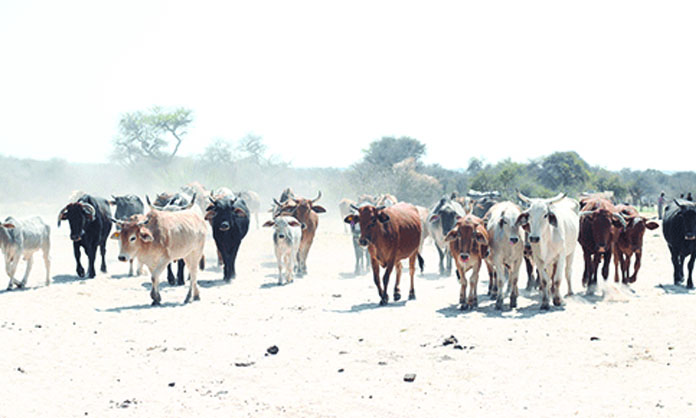
Some farmers in the floodplains of the Zambezi region say their cattle have been dying since July.
The affected areas are Ikaba, Nsundwa, Ihaha, Nakabolelwa, Ivilivinzi, Muyoyeta, Kasika, Mbalasinte, Nantungu and Nankuntwe.
The cattle present with symptoms such as weakness, which results in their inability to stand, and diarrhoea, resulting in death within days.
Affected farmer Eliot Mowa told The Namibian the trend started when they moved their cattle back from higher ground to the floodplains after the floods had subsided.
He said to date he has lost about 52 cows.
The cattle have been administered antibiotics and other medicines, which Mowa said cost around N$15 000.
“However, it did not help, as my cattle kept dying.”
He said the animals died due to suspected cases of heartwater (cowdriosis) and pasteurella (a type of bacterium).
“Other farmers who have engaged private vets have been told that it’s botulism, among others, so it seems there are a lot of ailments combined into one,” he said.
According to Mowa, the regional veterinary directorate is not proactive in assisting farmers, as they do not go out into affected areas to take various samples to determine the cause of the animals’ deaths.
“We are worried about the rate at which our cattle are dying, and the government should step in to assist us in finding a solution.
“However, the regional veterinary services directorate is acting as if they are not aware of our cattle dying in large numbers, leaving us to deal with it ourselves. If it continues like this and we lose all our cattle as a result, the government will have to subsidise us and give us drought relief,” he said.
Another affected farmer, Raphael Sikabongo, says he has lost about 33 cows.
He says the sight of carcasses on the roads in the Ihaha area is common.
So far, about 20 farmers have been affected, and a combined total of 340 cattle have died.
“It’s a dire situation, as our cattle are still dying, and it’s even worse for those who cannot afford to buy vaccines.
“Imagine that on our list of identified affected farmers, we have one farmer who has lost about 55 head of cattle. It’s really a disaster, as we don’t know what to do any more,” Sikabongo says.
Kabbe North constituency councillor Bernard Sisamu says he has lost about seven cows so far.
He has alerted the regional veterinary directorate, he said.
“I have vaccinated my cattle myself, and since then I have not lost any cattle. So, I would like to urge farmers in the floodplains to do the same.”
Regional chief veterinarian Beatrice Shikongo, when approached for comment, referred questions to the Ministry of Agriculture, Water, and Land Reform.
NO MYSTERY
Ministry spokesperson Chrispin Matongela said after receiving several reports of cattle dying in various areas of the region the ministry has taken samples and conducted tests.
This has confirmed that the involved cattle were infected with haemorrhagic septicaemia (HS) and heartwater disease.
Matongela said HS, which is caused by pasteurella multocida, is infectious and has a high mortality rate if not treated.
“Treatment includes the use of broad-spectrum antibiotics. However, it is not effective once the animal is visibly sick. Therefore, prevention should be done through vaccinations.
“Heartwater is solely caused by ticks,” he said.
Matongela said the ministry has thus far vististed farmers in the affected areas to vaccinate healthy cattle against pasteurella, black quarter, botulism and anthrax.
“Farmers were also advised to do regular internal and parasitic control, as well as to supplement their livestock during this dry season to avoid cases of protein, energy and mineral deficiency – especially lactating and pregnant cows which are the most affected.
“Unfortunately, a few decomposed carcasses were seen. Farmers were advised to destroy the carcasses,” he said.
Matongela said the ministry would continue to intensify surveillance within the entire region, adding that a team has been assigned to the Mbalasinte area, which is a foot-and-mouth hotspot.
In an age of information overload, Sunrise is The Namibian’s morning briefing, delivered at 6h00 from Monday to Friday. It offers a curated rundown of the most important stories from the past 24 hours – occasionally with a light, witty touch. It’s an essential way to stay informed. Subscribe and join our newsletter community.

The Namibian uses AI tools to assist with improved quality, accuracy and efficiency, while maintaining editorial oversight and journalistic integrity.
Stay informed with The Namibian – your source for credible journalism. Get in-depth reporting and opinions for
only N$85 a month. Invest in journalism, invest in democracy –
Subscribe Now!