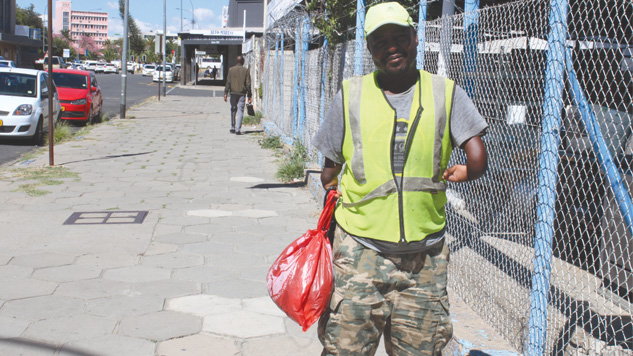
On a daily basis along Independence Avenue at the corner of Garten Street, the familiar face of a man with a physical disability is often seen guarding vehicles in a reflector jacket.
“Bread is often the goal, but I do not charge, I take it when offered,” he says.
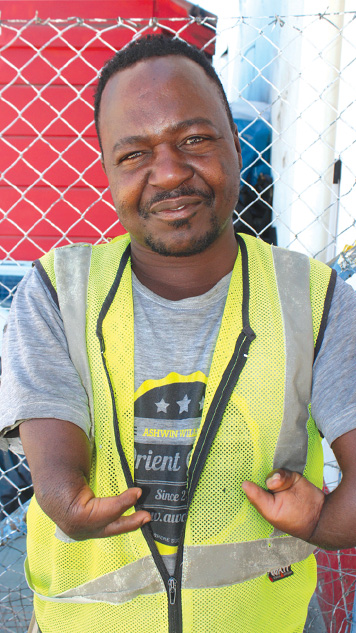
For the past 10 years, Natangwe Benhard – who was born without forearms – has been guarding cars for people visiting restaurants on that street and others running errands in the central business district.
Born at Ongha in the Ohangwena region, the 47-year-old came to Windhoek years ago to find a job to survive.
He makes a living watching over parked cars, a job built less on formal structure and more on trust and visibility.
He stands alongside the road waiting for kindness that is never guaranteed and each day is not just about earning a wage, but getting enough to eat at home.
“I take home about N$100 on an average day, and on a lucky day, sometimes I earn N$200,” Benhard says.
Despite the vulnerability, he says fear is not something he carries.
“I am not even scared of thieves that may steal from the cars I guard. In fact, no thieves even come here,” he says.
His working day stretches late into the evening often until 23h00, while others retreat to comfort and their homes.
“I stay behind to guard cars, waiting for a Samaritan to come,” Benhard says.
He depends on the goodwill of strangers, standing in the same place every day hoping someone will notice.
“I survive,” he says and for him, that is enough. He also gets a disability grant, which he says helps to sustain him.
Benhard lives alone in his shack at Oshitenda’s informal settlement, with no one to help him.
He does not have children.
Before travelling to Windhoek, he owned a fruit shop back at Ongha.
He says he has never faced discrimination because of his condition.
Moses Nghikovali, who works at a nearby restaurant, says he observed Benhard guarding cars for two years. He says he always felt pity for him at the beginning.
“When I started working here, I always wondered how he would eat, survive, and go home, until I saw him eat,” he tells
Nghikovali, who also lives at Oshitenda, says after watching Benhard for a while, the two formed a friendship and would sometimes take a taxi home together.
He says Benhard is sometimes bullied by street children, but restaurant staff help chase them away whenever it happens.
“He is dedicated. He often leaves very late, around 23h00 when the restaurant closes.
Sometimes, before opening in the morning, we already find him here,” he says.
Nghikovali adds that although some car owners refuse to pay for his service, Benhard remains a good person.
“He sometimes comes to the restaurant to ask for water.
He does not disturb anyone, and he always greets us,” he explains.
“I speak with him from time to time, and he tells me that business can be slow.
On quiet days, he leaves early to go home.”
Lizette Dausas, who has been working at the restaurant as a waitress for four years, describes Benhard as hardworking.
“He always stands there, sometimes selling Nik Naks and sweets.
We sometimes exchange his coins in the restaurant for notes.”
She says some people insult him, saying they do not want to be associated with him, but that it does not change who he is.
A driver from Pro-Ex, who spoke on condition of anonymity, describes Benhard as a disciplined individual who does not drink or smoke.
“I have never seen him being bullied as I am always on the road, but he is a good man.
He only guards cars to earn a tip,” the driver says.