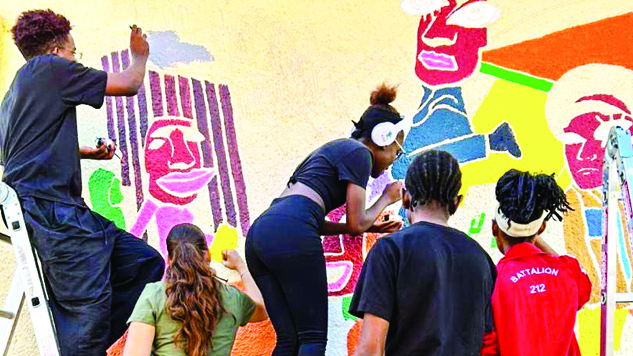
If the mural on the Bellhaus Atelier & Galerie’s street-facing wall catches your eye, four pairs of eyes may look back.
Recently painted to mark International Design Day on 27 April, the mural draws inspiration from Windhoek’s central business district (CBD) while exploring this year’s theme of ‘The Spaces In Between’.
To begin the process of mural-making, a gaggle of creatives responding to an open call went for a walk.
Their task was simple: Soak up the CBD’s sights and scenes. Notice its chaos, calm and characters and observe your emotional ebbs and flows as you make your way through the city.
“For International Design Day 2026, we wanted to create something that moved beyond a traditional exhibition or static design outcome.
Together with Turipamwe Design and our collaborators at Bellhaus Atelier & Galerie, we approached the project as a live co-creation process rooted in observation, participation, and public engagement,” says Turipamwe Design founder Tanya Stroh.
This year’s Windhoek International Design Day experience was co-created by Turipamwe Design, Bellhaus Atelier & Galerie, Creative Industry Institute Africa, for.m.all, ENK Public Art, and Neo Paints Namibia.
“The process began with a ‘Walking Design Lab’ through Windhoek’s CBD.
The route was intentionally designed to create contrast between different urban experiences: green spaces and traffic-heavy roads, pedestrian pathways and crossings, moments of calm and moments of tension,” Stroh says.
“What interested us was not simply the city as infrastructure, but the city as a lived emotional and sensory experience.
Participants were guided by a field guide developed through a design thinking lens.
The questions invited them to observe movement, behaviour, atmosphere, interaction, discomfort, safety, connection, and contradiction within the city itself.”
Stroh says one of the strongest reflections emerging from the approximately two-hour walk is that urban life as well as moving through the city is rarely neutral. In fact, it is profoundly layered.
There are moments that feel invigorating and which foster connection. Alternatively, there are instances that are overwhelming, uncertain or feel fragmented.
To illustrate this idea, Stroh invites one to consider the emotions we may feel when doing something as simple as crossing a road.
Do we feel safe or welcome when doing so? Is provision made for pedestrian crossing?
Are we hurried or anxious? In which urban spaces does one find peace or a sense of connection with nature, one another or themselves?
Armed with these observations, the second phase of the project transformed these impressions into a series of collective curatorial reflections about the city.
These reflections became creative prompts for four large, collaborative collages.
This process was guided by Bellhaus curator Marcii Magson.
Participants were also introduced to the work of eminent American collagist, Romare Bearden, whose stirring collages and photomontages considered black American urban life, experience and culture.
The mural stems from these collective collages which were digitally scanned then creatively merged to create a single composition which participants then painted on the Bellhaus’ wall.
‘MOMENTS OF CONNECTION’
“Visually, the mural depicts four central figures inspired by the movement of people observed throughout the city walk.
The figures appear to walk, lean, climb, or move in almost dance-like ways across the composition.
One figure is suspended above a ladder, suggesting transition, uncertainty, ambition, or navigation through urban life,” says Stroh.
“The background draws from the textures, structures, and emotional rhythms of the city itself.
Abstract squiggle-like forms represent the complexity and intensity of living in an urban environment – particularly in a city like Windhoek, where vastly different experiences of movement, safety, nature, infrastructure, and access exist side by side,” Stroh says.
“The mural also reflects quieter moments of connection.
During the walk, participants repeatedly reflected on the emotional contrast between heavily trafficked urban areas and moments spent in green spaces.”
While the mural is the lingering outcome of four days of co-creation by over 20 participants and facilitators, Stroh says the initiative was chiefly concerned with creating an experience through which people could collectively observe, interpret, and respond to the city around them.
“At Turipamwe, we care deeply about making design accessible and participatory.
Design is often misunderstood as something exclusive or aesthetic-only, when in reality it can be a vehicle for observation, collaboration, problem-solving, and dialogue,” says Stroh.
“We strongly believe that anyone can think like a designer, and that communities are often best positioned to help shape the understanding of challenges as well as the imagining of solutions.”
The mural is titled ‘Where design ends, the human will begin.
Connection lives in the spaces in between’. During its creation on Windhoek’s Bell Street, Stroh was heartened to hear passersby asking questions, photographing the work and engaging with the process.
“Much of our visual urban landscape is dominated by signage, advertising, and transactional messaging. Public art creates a different kind of encounter,” says Stroh.
Should someone walk or drive past the mural and pause for even a moment to observe, reflect, question, or simply feel something, Stroh says the work has already begun to do what she hoped it would.
“We intend on doing this annually with a different design output next year.
Ultimately, the project was about recognising that the most meaningful forms of connection often exist in the spaces in between,” says Stroh.
“Between people, between disciplines, between movement and stillness, observation and action, and between the city we inherit and the one we collectively shape together.”
– martha@namibian.com.na; Martha Mukaiwa on Twitter and Instagram; marthamukaiwa.com