





For collectors who like their art as magnetic, colourful and as quirky as its creator, Namibian artist Anne Lacheiner-Kuhn is a fever dream come true.
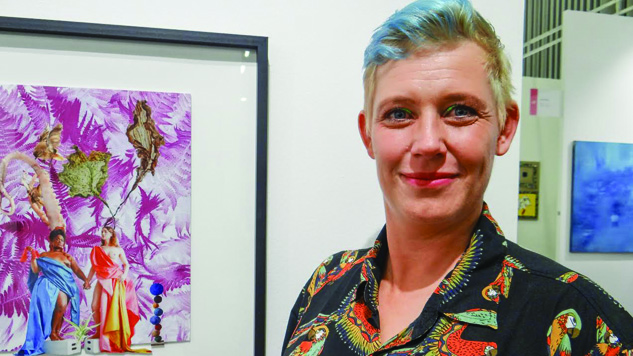
At last year’s Investec Cape Town Art Fair, the artist’s clash of blue hair, a bright, parrot shirt and prismatic pants are a prelude to what’s on the walls.
Like her bold sartorial statements, Lacheiner-Kuhn’s paper collages are somewhat out there.
Each of them a fascinating coalescence of images cut from a collection of photography magazines Lacheiner-Kuhn has been stockpiling for over a decade.
Within her feminist, queer, at times political or tongue-in-cheek frames, Lacheiner-Kuhn presents a tumble down the rabbit hole.
Surreal scenes are populated with a compelling cast of characters thrust into new seaside, architectural, urban, mountainous or dreamlike worlds of Lacheiner-Kuhn’s intuitive making.
A year after an impressive showing at the prestigious Cape Town Art Fair, Lacheiner-Kuhn returns to Namibia via the United Kingdom (UK) to present ‘BE LONGING’ at Windhoek’s The Project Room.
‘BE LONGING’ is on show at 5 Crohn Street just a month before Lacheiner-Kuhn exhibits at RMB Latitudes Art Fair in Johannesburg and subsequently returns to the UK.
This continual movement speaks to the exhibition’s titular theme.
Constantly navigating her life as an artist, a queer person and a white Namibian both at Swakopmund, her Namibian base, and in the UK, Lacheiner-Kuhn, reflects on belonging as the twin conditions of being and longing.
“The sense of ‘be longing’ is a hard one to put into words. For me, it’s similar to trying to describe love.
It is a sense of calm, an uncomplicated state of being, a sense of familiarity without feeling obligated to fit in,” says Lacheiner-Kuhn.
“Living between the UK and Namibia and as a queer person, I think each space, place and community brings its own little snippet of this self-acceptance, of being.
The longing comes in when thinking about the other space/places that give you that same sense of effortless being.”
Less explicitly political than Lacheiner-Kuhn’s ‘Re-Queering A Nation’ (2022) in which the artist juxtaposed contemporary images of Namibia’s queer community against colonial era scenes in the wake of a particularly electrified lesbian, gay, bisexual, transgender, queer/questioning, intersex and other (LGBTQI+) movement, ‘BE LONGING’ is a different kind of affirmation.
Featuring multiple images of same-sex love, people in drag or who may be transgender as well as a take on the seemingly homoerotic relationship between Homer’s Achilles and Patroclus (The Iliad), Lacheiner-Kuhn presents a body of work where often marginalised LGBTQI+ people are central and celebrated, sometimes in the nude or scarcely clad.
“Often, as a queer person, just to be seen or see other queer people being represented is an integral part of belonging and being,” says Lacheiner-Kuhn.
“Every so often, the phrase ‘you can do what you want but don’t shove it in my face’ is still used.
But queer people have heterosexuality ‘shoved’ in their faces every day of their lives. So, what’s wrong with longing for seeing something that you feel represents you?” Lacheiner Kuhn says.
“Everyone values the feeling of belonging,” says Lacheiner-Kuhn within the exhibition catalogue.
“I hope the work also encourages people to focus on just being – to push aside the longing for a moment.”
While some people have commented on the nudity in Lacheiner-Kuhn’s work, the artist is insouciant, yet does offer some clarification.
“Amusingly, a few people have pointed out the nudity in my work recently. But during the production of a work, I don’t really think about it,” says Lacheiner-Kuhn.
“I think, as an artist, especially trained in life drawing as I was, the naked human body is more about understanding the form, symmetry and details that make something unique,” Lacheiner-Kuhn says.
“Of course, there are times where one uses nudity to either express or provoke sexuality.
In my case, it also links in with queerness. There has been a big shift in queer spaces, especially in the UK, where showing skin/nudity is an act of self-love, acceptance and celebration without it being sexual.”
Compositionally, Lacheiner-Kuhn’s collages are alluring. Disparate objects and characters come together from vast and various contexts in ways that are pleasingly peculiar, evocative and often colourful.
“Colour is a funny thing. It can be carefully curated and assembled in a structured way or, in my case, it can be an absolute mismatch of prints and patterns,” says Lacheiner-Kuhn.
“While still living in the UK full-time, I used to think that my love and use of colour was because I’m African.
But the more time I spend back home in Namibia, I realise that, even for an African, I’m very colourful,” Lacheiner-Kuhn says.
“Maybe it’s my brain’s way of coping with ADHD and creativity, in that I almost need to be overstimulated.
In that sense, I think colour plays a role in my composition in that it gives my brain the feeling of balance.”
While colour brings a sense of balance to Lacheiner-Kuhn’s brain, the artist says the specific images that make it to the frame are ruled by the right side of her cerebrum.
“The majority of my studio time is spent painstakingly cutting out images with a scalpel, often spending six hours a day doing this.
It is almost a sense of meditation and activating the right (creative) side of my brain,” says Lacheiner-Kuhn.
“At the end of the day, if I’m lucky, I have this creative flow and images just start creating little conversations and stories together.
But it is in the process before, when cutting out, that my brain processes and thinks about all sorts of things that then inform or create the bases of the collage story.”
That’s on a good studio day. Lacheiner-Kuhn says she often has weeks where she can’t seem to compose anything.
At times, on the walls of her studio, semi-composed collages beg for completion and some finally get it.
But often the images are disassembled and become part of a completely different work.
“I struggled a lot with a creative block over that last year, so it’s been a real journey of endurance and pushing myself to actually produce work.
But, eventually, in the 11th hour, I reminded myself that some of the best work happens when you play and experiment,” says Lacheiner-Kuhn.
The artist made use of her own photography and additionally lifted and layered images in works such as ‘Celestial Bodies’ and ‘Transformational Truths’ which add dimension and draw attention to the meticulous work of cutting and composing a collage.
“This collection was a true test of sanity, willpower and perseverance for me. But, as a result, I’ve also experimented far more with material and three-dimensionality than I have in probably 10 years. So, from that perspective, I feel I have taken a leap forward in my practice,” says Lacheiner-Kuhn.
“As artists, we all hope for a more realistic balance of financial gain in comparison to the labour we put into our work,” Lacheiner-Kuhn says.
“But with this collection, far more rewarding was the experience of having three people from different backgrounds and age groups come up to me at the vernissage and tell me they have never felt so much like they belonged at an event or exhibition as they did at this one.”
Anne Lacheiner-Kuhn’s ‘BE LONGING’ will be on display at Windhoek’s ‘The Project Room’ until 30 May.
– martha@namibian.com.na; Martha Mukaiwa on Twitter and Instagram; marthamukaiwa.com