





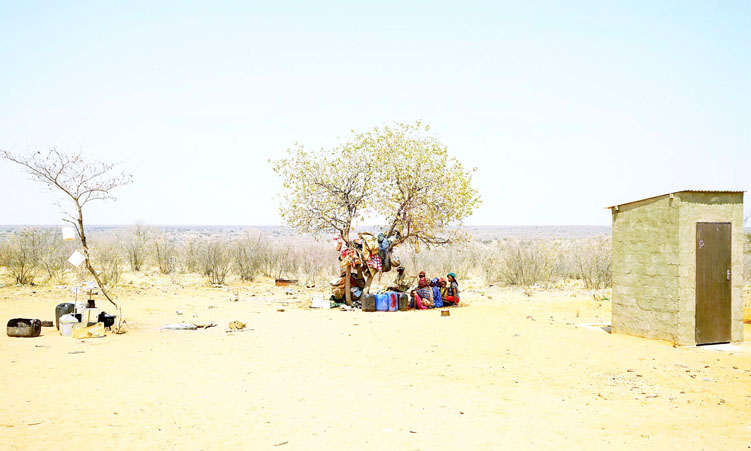
Nearly seven out of every 10 households headed by people from Namibia’s marginalised communities do not have a toilet.
This is according to the Namibia Statistics Agency’s (NSA) latest census report on marginalised communities.
NSA statistician general and chief executive Alex Shimuafeni says 68.4% of these households have no toilet facilities. This means that for every 10 households, about seven have no toilet.
Last month, prime minister Elijah Ngurare informed parliament that the government is urgently addressing the country’s sanitation and housing challenges following a N$34 million allocation.
According to NSA’s 2023 Population and Housing Census report, about 40% of households in Namibia are without adequate sanitation.
He said although 88.4% have access to safe drinking water, many still lack other basic services.
Social justice activist Lloyd Bock says the latest census findings show that marginalised communities have not received enough attention since independence.
“If we compare the conditions these residents have been facing, especially in urban areas, I believe little has been done and their needs have received insufficient attention,” he says.
Bock says the government should place greater emphasis on addressing the needs of marginalised communities.
He also calls for more research that goes beyond collecting statistics to better understand the experiences and priorities of marginalised communities.
“We often focus on what we think they want instead of asking them what they really need. More research should be done into their perceptions, how they want to be helped and what they believe is necessary to improve their lives,” he says.
The data shows that only 32.4% use electricity for lighting, while 10.3% use solar power.
The findings provide a clear picture of the living conditions of the San, Ovatue/Ovatwa and Ovatjimba communities.
The census recorded 75 569 people from these communities. They make up about 2.5% of Namibia’s population.
In 2024 Namibia’s population reached three million. Shimuafeni says most of the marginalised people live in rural areas. He says about 50 163 people live in rural communities, compared with 25 406 people in towns and cities.
The San make up more than 94% of the total marginalised population.
NSA’s data further shows that the Otjozondjupa region has the largest number of people from marginalised communities, followed by Omaheke, Kunene and Oshikoto. Meanwhile, the ||Kharas region has the smallest number.
Shimuafeni says the population is also young, adding that nearly 76% are under the age of 35.
This means about three out of every four people will need access to schools, training, jobs, housing and health services.
Human rights activist Linda Baumann says NSA’s findings point to a broader sanitation crisis in Namibia. She argues that the lack of adequate toilets is not limited to marginalised communities.
“I think sanitation is a problem in this country generally. It is not only affecting marginalised communities,” Baumann says.
She says even in formal residential areas, sanitation infrastructure is struggling to keep up with growing household sizes.
“If you look at many formal residential areas, houses that were built for one family now accommodate several households. The sanitation system was never designed to serve that many people, and that is why we continue to see sewage overflows and drainage problems,” she says.
Baumann says inadequate sanitation should be viewed as a human rights issue because access to clean water and proper sanitation are basic needs.
In 2023, deputy minister of marginalised communities, Royal /Ui/o/oo had said 68% of marginalised Namibians were living in poverty.