






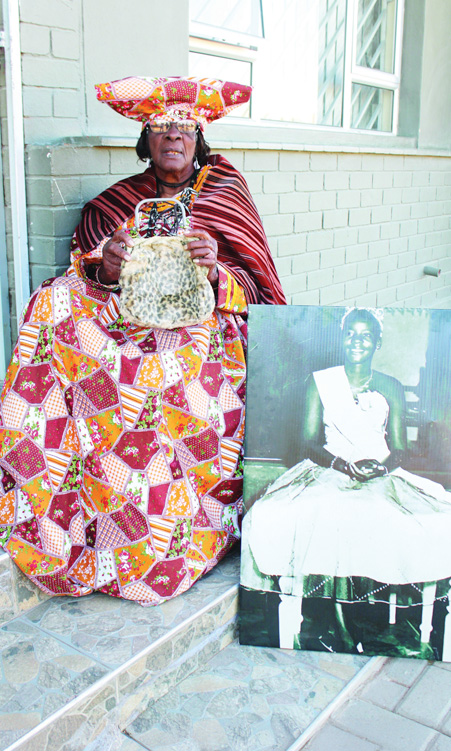
Esther Kavari’s first and last time at a beauty pageant was on 20 November 1958 at Windhoek’s Old Location.
The stage featured 10 contestants, and Kavari, 17 at the time, was armed with only confidence and a smile.
Five judges watched her parade for three rounds.
She was wearing a white gown she had bought for 50c from the N$6 salary she earned as a domestic worker in colonial Namibia, or South West Africa at the time.
Kavari (84) was a resident of the Old Location (now Pionierspark and Hochland Park), before Namibia became independent, and now lives at Epukiro in the Omaheke region.
She recalls what it felt like living in a racially segregated society.
“Times were different then. We were not treated like human beings those days.
My white bosses treated their dog better than me,” she says.
“Apartheid made us feel less than.”
But Kavari says her confidence shone through that evening, and she was crowned Miss Windhoek.
“Back then, beauty pageants were not common,” she says.
“When I first heard that Miss Namibia was coming to Gobabis this year, I had to see it for myself.”
She says if you want something, you must go for it.
Now, almost seven decades after being crowned Miss Windhoek, Kavari will attend the Miss Namibia 2026 pageant at Gobabis tomorrow.
BECOMING NUMBER ONE
Because of her love for dressing up, Kavari dropped out of St Barnabas Primary School in Katutura in Standard 5 to find a job so she could afford the clothes and jewellery she loved.
Her salary of N$6 a month was enough to buy her a dress and jewellery.
The pageant in 1958 was organised by Swanu of Namibia, the only political party in the country at the time.
“I think that was the first beauty pageant in Namibia,” she says.
“I had so much confidence in myself. I loved dressing up. I knew what I wanted and I went for it,” she says.
Prior to the pageant, Kavari says, there were no rehearsals like today.
She was surprised to hear that contestants wear more than one gown during pageants nowadays.
“We only wore one gown. We didn’t have swimwear or nightgowns the girls wear on stage today,” she says.
The former beauty queen says looking neat and well dressed made her feel confident in herself even though life offered few opportunities for black people at the time.
Kavari says she still remembers the first names of her first and second princesses, although she has lost touch with them over the years.
THE CHEETAH-PRINTED HANDBAG
She says as part of her prize, she received a cheetah-printed handbag she has treasured for nearly seven decades. It is still in shape, she says.
“I kept it in a coffer all this time.
“I’ve looked after it because it reminds me of that special day,” she says.
“When I won, one of the prizes was to go to Swakopmund.
“It was the first time I saw the ocean.”
It was also her last time taking part in a competition, as no other competitions were hosted until she was married in 1972 and had seven children. Her husband later died in 2002.
But the memories of that day in 1958 never faded.
Asked what qualities she thinks Miss Namibia contestants should have, she replies: “If I was a judge, I would judge them based on the way they walk and smile.”
She urges young women to be responsible, take care of themselves, and to listen to their parents.
“Do not be wayward.
“Work hard, leave the house and then come straight home. Nowadays, young girls leave their houses and return home very late.
It was unheard of then,” she says.
UNITING THE COMMUNITY
Angeline Kozonguizi (88) who was responsible for Swanu’s administrative work at the time, says she remembers Kavari, but not exactly as the winner of the country’s first beauty pageant.
“I remember Kavari was the first Herero to win something, but I don’t remember exactly what.
She was one of the prettiest women,” she said yesterday.
Kozonguizi said Swanu organised almost everything from concerts to other events, because most of its young leaders were exposed to other cultures outside the country, and often applied what they learned abroad locally.
“We sent our young people to South Africa.
That is how the concept of beauty pageants came about,” she said.
At the time, she said there was segregation between communities such as the Aawambo and the Herero, and that freedom of movement within one’s own country was limited as they were asked to present their ‘passes’.
“There was very big division between us,” Kozonguizi said.
However, events such as dances and pageants united the community in the Old Location.