



Windhoek, 24 February 2026.
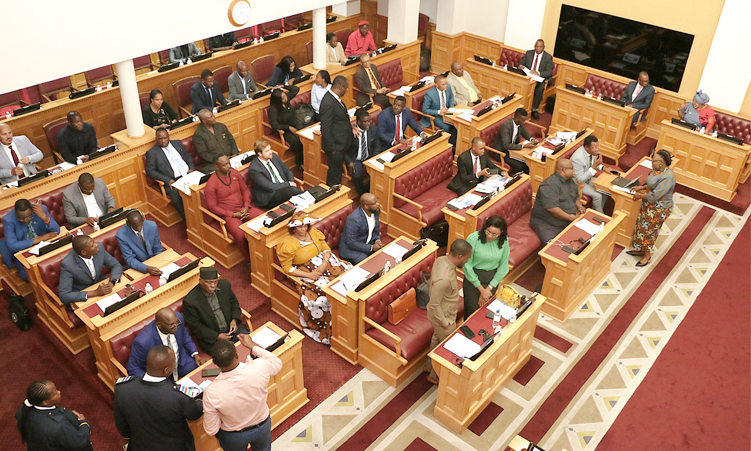
Honourable speaker, honourable members of this august House, fellow Namibians,
- I rise today to address this August House and the Namibian nation on a matter of profound national importance, social justice, and structural transformation.
- Shortly after president Netumbo Nandi-Ndaitwah ascended to the highest office in the land as the first female president of the Republic of Namibia, she issued a visionary directive: effective April 2026, civil servants shall seek healthcare services within public health facilities. This directive – now widely known as Vision April 2026 – is not merely an administrative adjustment. It is a clarion call for equity, a demand for excellence, and indeed, a necessary catalyst to radically transform our public health system.
- There has been robust public debate regarding this vision. I have heard the scepticism, the doubts, and the genuine concerns of our public servants. Today, I stand before you to provide clarity, dispel misconceptions, and outline the concrete roadmap that will ensure the successful, phased implementation of Vision April 2026.
The Current Landscape
- The government of Namibia remains the largest employer in our country, with approximately 118 936 employees covered under Psemas. This medical aid scheme commands a budget of approximately N$3.9 billion for the current financial year. Historically, a substantial portion of this funding has flowed directly into the private health sector.
- By contrast, over 85% of our population – approximately 2 567 000 Namibians – rely solely on public health services delivered by the Ministry of Health and Social Services. These services are rendered with a budget allocation of N$12.27 billion for the current financial year. While private facilities often boast world-class amenities, our public sector has faced ageing infrastructure, long waiting times, and supply chain challenges.
- For too long, we have tolerated a two-tier system – where services deemed insufficient for senior officials were considered acceptable for ordinary citizens. The paradigm shift embodied in Vision April 2026 is relevant, timely, and strategic.
- The logic is simple and powerful:
If the system is good enough for kuku in the village, it must be good enough for the executive director in Windhoek.
If public hospitals are not good enough for politicians, then they are not good enough for anyone. By bringing national leadership into the public health fold, we create the strongest possible incentive to fix and continuously improve the system.
Safety and System Strengthening
- Questions have been raised regarding the safety of state hospitals. Let me be unequivocal: the public health sector currently serves approximately 85% of our population. Through these services, Namibia has achieved significant improvements in national health indicators over the past three decades. If the system has sustained over two million Namibians, it is safe enough for senior government officials.
- That said, we do not deny the existence of gaps. Vision April 2026 is precisely the mechanism through which those gaps are being addressed. We are not asking public servants to step into a broken system – we are inviting them into a system undergoing the most aggressive strengthening programme since Independence.
Readiness Strategy: Four Key Pillars
A comprehensive readiness assessment completed in September 2025 has informed targeted investments across four strategic pillars:
1. Human Resources for Health
Buildings do not heal people – doctors and nurses do.
- Over 2 000 additional health personnel positions were funded during the 2025/26 Mid-Year Budget Review.
- As of mid-January 2026, 1 262 positions (66%) have been filled.
- Remaining vacancies are on track for completion by March 2026.
This expansion will reduce waiting times and improve clinical outcomes.
2. Medicines and Clinical Supplies
We have shifted to direct procurement from manufacturers to strengthen supply chains.
- Target: 95% stock availability level
- Between February and March 2026, 40% of outstanding deliveries are being received.
When medication is prescribed, it must be available on the shelf.
3. Medical Equipment and Technology
Accelerated procurement is underway to equip public facilities with modern diagnostic and treatment equipment comparable to private institutions. Surgical theatres and wards are being upgraded accordingly.
4. Infrastructure and Emergency Transport
In collaboration with the Ministry of Works and Transport and the Namibia Training Authority:
- Targeted maintenance projects are underway.
- Additional ambulances and emergency vehicles have been procured.
Facilities must be both functionally sound and dignified spaces of care.
Phased Implementation Approach
- Vision April 2026 will not be implemented through a rushed “big bang” approach. It will roll out in deliberate phases.
Phase I – Effective 1 April 2026
This phase targets senior public service leadership, including:
- Political office bearers
- Executive directors
- Secretary to Cabinet
- Inspector general of police
- Chief of the defence force
- Commissioner general of correctional services
- Services in Phase I will be delivered through seven strategically selected public health facilities:
- Windhoek Central Hospital
- Katutura Intermediate Hospital
- Rundu Intermediate Hospital
- Keetmanshoop District Hospital
- Oshakati Intermediate Hospital
- Walvis Bay–Swakopmund Hospital Complex
- Onandjokwe Intermediate Hospital
- As readiness improves nationwide, the rollout will expand to additional facilities and public servants.
Addressing Operational Concerns
Waiting Times
We recognise that public servants carry national responsibilities.
- Designated patient flow management systems will be introduced at vision facilities.
- A pilot will be conducted in March 2026 to refine processes before full implementation.
This is not about preferential treatment; it is about operational efficiency.
Specialist Care
No one will be denied necessary treatment.
- Where specialist services exist in the public sector, they will be utilised.
- Where specific services are not yet available, existing referral systems – including private providers – will remain operational.
Capacity-building will be progressive and pragmatic. Continuity of care remains paramount.
Conclusion: A Reform Rooted in Dignity
- Vision April 2026 is about dignity – the dignity of the patient in the queue, and the dignity of the public servant entrusted with national leadership.
- This is a multi-stakeholder reform process. We are engaging trade unions, professional bodies, and medical aid stakeholders. Funding has been ring-fenced to ensure sustainability.
- To those predicting failure: recruitment is underway. Equipment is arriving. Infrastructure is being repaired. Medicine stocks are improving to levels not previously sustained.
- We are building a healthcare system where quality is not determined by income or position.
- Vision April 2026 is our concrete step toward Universal Health Coverage – bold, necessary, and achievable with collective commitment.
I thank you.
In an age of information overload, Sunrise is The Namibian’s morning briefing, delivered at 6h00 from Monday to Friday. It offers a curated rundown of the most important stories from the past 24 hours – occasionally with a light, witty touch. It’s an essential way to stay informed. Subscribe and join our newsletter community.

The Namibian uses AI tools to assist with improved quality, accuracy and efficiency, while maintaining editorial oversight and journalistic integrity.
Stay informed with The Namibian – your source for credible journalism. Get in-depth reporting and opinions for
only N$85 a month. Invest in journalism, invest in democracy –
Subscribe Now!