



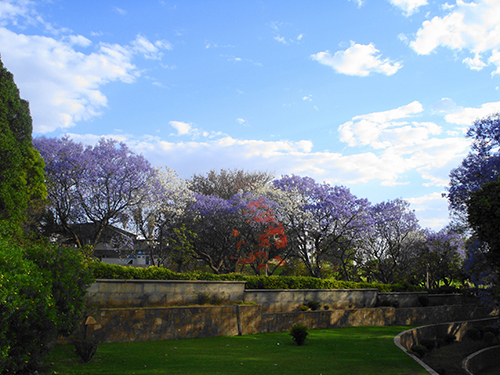
LUISE HOFFMANNTHESE often very colouful and eye-catching exotic trees and shrubs in Windhoek are grouped according to their colour.
Many of them are found on Unam campus. As early as July the bare branches of the common coral tree (Erythrina lysistemon) from South Africa, are covered in stiff sprays of orange-red flowers before coming into leaf – to be seen below the buildings of parliament, below the old State House, in Zoo Park and in many gardens. Also bright read with thousands of small bell-shaped flowers is the Australian flame tree (Brachychyton acerifolius) (photo) found along the drive to parliament. The ubiquitous Bougainvillea originating from South America and named after the French 18th century navigator Louis de Bougainville, comes in many shades of purple, brick-red, yellow and white. Another tree to be covered in spectacularly red flowers soon is the Flamboyant (Delonix regia) to be seen opposite the Heinitzburg Castle, while the tall pink flowering trees at the southern end of Ausspannplatz are Silk-floss trees (Ceiba speciosa = Chorisia speciosa).
Very visible at the moment are the many blue Jacaranda trees (Jacaranda mimosifolia) (photo) from north-western Argentina. The Syringa (Melia azedarach) from India enchants our senses with its heavy sweet scent and its millions of small pale purple flowers with dark centres. Neighbouring South Africa is the home of the Cape leadwort or plumbago (Plumbago auriculata), a very hardy shrub in spite of the fragile look of its pale blue flowers – found along Robert Mugabe Ave between Centraurus School and Olympia and in many gardens.
The Orchid tree (Bauhinia variegata), covered in fairly large variegated mauve and white flowers, can be seen on the edge of Zoo Park along Fidel Castro Street and in many gardens.
Occurring all over town we find the extremely hardy shrub from Mexico and the southern USA known as Yellow bells (Tecoma stans) with bright yellow, bell-shaped flowers. From the same area we have the Jerusalem thorn or Mexican greenhair tree (Parkinsonia aculeata), related to our indigenous greenhair tree (Parkinsonia africana), its leaves reduced to ‘green hairs’ to minimise water loss and graced by pendulous sprays of yellow flowers found in
Metje Str.
The Cat’s claw creeper (Macfadyena unguis-cati) from Central and South America covers unsightly walls, and climbs up the highest trees, holding on with its claws, bearing masses of large, brightly yellow, trumpet-shaped flowers.
An often quite large and very brightly green tree branching from close to the ground, now with pale yellow flower spikes hanging from among its feathery leaves, is the Prosopis (Prosopis spp.) hailing from North and Central America. In Namibia it is a mixed blessing providing shade, nutritious pods and good firewood, which may also be used for construction and turning, but invading local riverbeds, making them impenetrable and crowding out indigenous species such as camel-thorn trees and Ana trees.
The Silky oak or Australian silver-oak (Grevillea robusta) is a tall tree bearing characteristically shaped orange flowers revealing this tree’s relationship to the Protea family, comes from Australia. It has a very invasive root system and may cause much trouble in sewerage pipes. Consider that – depending on where you live – some of these plants may be invasive.
In an age of information overload, Sunrise is The Namibian’s morning briefing, delivered at 6h00 from Monday to Friday. It offers a curated rundown of the most important stories from the past 24 hours – occasionally with a light, witty touch. It’s an essential way to stay informed. Subscribe and join our newsletter community.

The Namibian uses AI tools to assist with improved quality, accuracy and efficiency, while maintaining editorial oversight and journalistic integrity.
Stay informed with The Namibian – your source for credible journalism. Get in-depth reporting and opinions for
only N$85 a month. Invest in journalism, invest in democracy –
Subscribe Now!