




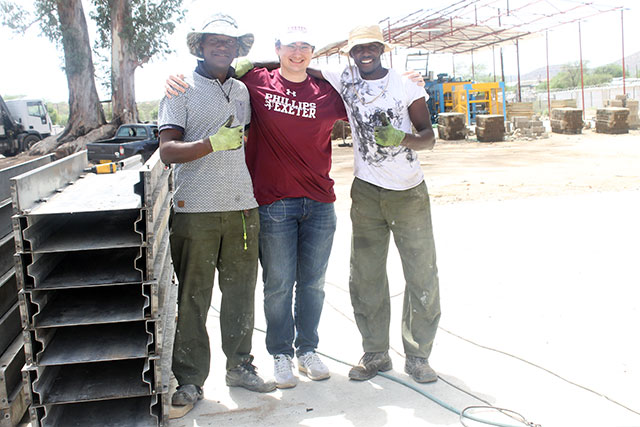
AFRICA Growth Corporation a year ago started designing Max panels, a pure concrete replacement for normal bricks, to fast pace the period it takes to complete a house, in addition to making housing more affordable in Namibia.
Given the ultra-short construction times, Max panels will reduce labour costs, and therefore house prices and allow more Namibians to be able to afford a home, hence meeting government halfway in alleviating the housing backlog.
This new technology was created by Maximillian Sugrue an 18-year-old in his final year of high school at The Phillips Exeter Academy in the United States.
Sugrue stressed that Namibia needs to provide housing for roughly 300 000 Namibians.
“I came to Namibia to work on a construction site to build low-cost houses that the company was busy with and worked with over 15 000 bricks a day. It was a very time-consuming building process.
“I thus came up with the Max Panel idea to fast pace the process of constructing a house and eliminate having to work with so many bricks per day,” Sugrue said.
He revealed that the Max panels are made out of pure concrete with 40 megapascals (MPa) strength as opposed to the normal bricks that only have 7 MPa strength. This means the Max panels are more than five times stronger than normal bricks and much faster to use as a construction product.
Africa Growth Corporation has its local factory at Okahandja’s Five Rand informal settlement, where production of the Max panels kicked off at the company’s factory situated there.
Sugrue said while driving in Okahandja towards the Five Rand informal settlement; he was inspired to improve the living conditions for a large number of families living in corrugated iron houses nearby.
“Using Max panels, a house can be fully completed in a month compared to the usual 4-6-months that it takes to complete a brick one.
“The wall structure of the house is completed in just two days, which means we would cut costs, and consumers would, in turn, pay less to have their house constructed.
“Housing prices could go down by as much as a third with the use of the Max panels,” he said.
In addition to affordability, those interested may enter into a contract with Africa Growth Corporation of which individuals would need to put down 40% of the house price, while Africa Growth Corporation invests 60%.
Individuals would then pay back Africa Growth Corporation its 60% investment over a maximum period of 25 years.
The initiative targets anyone who would like to purchase an affordable house instead of just focusing on those who live in corrugated iron houses.
Despite Sugrue being an American, the Max panel concept was originally born in Namibia and is being developed in Namibia, for Namibians, by Namibians.
“This technology is a first of its kind in Namibia. Even though it is bigger, better, faster and cheaper than the current building methods, culturally we could never compromise on quality, strength and durability for Namibian families,” he said.
The intention is to stock up on the Max panels now, and early next year the company will kick off with the construction of houses using Max panels.
Sugrue spent eight years at a boarding school called Le Rosey in Switzerland, then the last couple of years at The Phillips Exeter Academy in the United States (where Mark Zuckerberg who founded Facebook also went to high school). He credits these schools with teaching him that his work must have a significant positive impact on society.
Even though his workload at school has been very significant, Sugrue still found time during school and on his holidays to work on Max panels.
Adam Boois, one of the employees working on the Max panels production line, said it is easier working with the Max panels than working with normal bricks.
“Max panels will make a lot of people happy, in addition to getting rid of the shacks. These panels allow for incredibly fast construction and allows for cheaper housing for Namibians,” Boois said.
Another employee, Germaine Mwambwa, said the panels allow for teamwork and teamwork makes dream work.
He said a Max panels could be made within three minutes, so it is easy to stock up on them.
“It took us a while to learn how to produce the panels, but now we know how it’s done. We want this product to be nationwide, worldwide and it is Namibian. We intend to become businessmen with the skills we acquired,” Mwambwa said.
In an age of information overload, Sunrise is The Namibian’s morning briefing, delivered at 6h00 from Monday to Friday. It offers a curated rundown of the most important stories from the past 24 hours – occasionally with a light, witty touch. It’s an essential way to stay informed. Subscribe and join our newsletter community.

The Namibian uses AI tools to assist with improved quality, accuracy and efficiency, while maintaining editorial oversight and journalistic integrity.
Stay informed with The Namibian – your source for credible journalism. Get in-depth reporting and opinions for
only N$85 a month. Invest in journalism, invest in democracy –
Subscribe Now!