





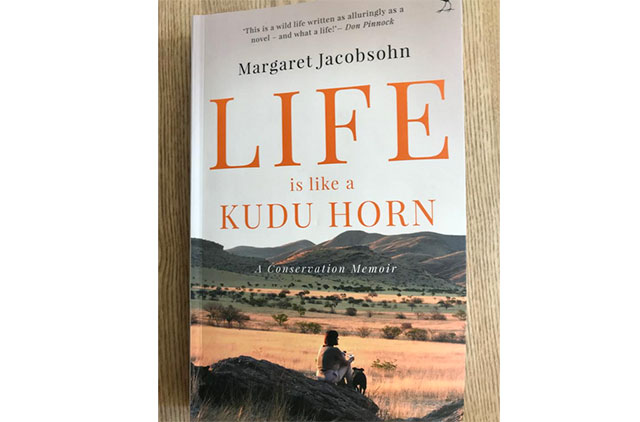
MARGARET Jacobsohn chose the title of her memoir with great caution. Derived from an Ovahimba saying which details life’s ups and downs, ‘Life is Like a Kudu Horn’ greatly re ects the author’s six-decade- long history of journalism, underwater documentary lm-making, academics and archaeology.
However, the heart of Jacobsohn’s tale is in conservation, which she describes as a ‘lunatic fringe’ in the 1980s. Born in South Africa but now Namibian, the author spent a lifetime with black people in Africa, and aptly recognises her privilege in that regard. However, Jacobsohn recalls moments from her childhood which shaped her mindset in terms of discrimination.
Drawing lessons from Karen Blixen’s 1937 read ‘Out of Africa’, which is ‘vilified’ and seen as racist, Jacobsohn justifies that her childlike mindset simply brought an awakening rather than an isolation against black South Africans. And this led her into journalism with an aim to create awareness around the evils of apartheid, which played a role in distancing her from her own mother.
Well-travelled before the age of 20, a love for adventure sparked in Mozambique, however, politics and a brewing coup forced her to ee and settle in Cape Town. Firmly holding onto the desire to film all things wildlife, Jacobsohn almost went broke, but quickly built herself back up by securing two degrees and working as a foreign cor- respondent for a Dutch newspaper.
Through her occupation, she was ex- posed to even more in the then-South West Africa, such as researching life in Kaokoveld where war zones from the liberation struggle still lingered. It was there where she became more involved with Save The Rhino Trust’s Blythe Loutit and Gareth Owen-Smith, who were nature conservationists fighting for the rights of rural people as well as wildlife.“The people and landscapes I encoun- tered made relocating to Namibia feel inevitable,” Jacobsohn writes, finding the need to do something other than discuss politics over glasses of fine wine. And this is where the real story begins.
Idealistic and hopeful for creating a better nation, Jacobsohn dedicated a majority of her life to conservation and warding off the wealthy who have illegally fenced off areas for exclusive use, while sustaining a viable lifestyle for both minorities and animals in the area – a field she notes as community conservation. But this story is just the prelude of a warm tale that the author affectionately pours out to her readers through tales about the threat of food scarcity as a young researcher in Namibia to setting up camp in Windhoek for the sake of environmental projects.
One particularly interesting story is that of Jacobsohn’s time with the San people in the Nyae Nyae Conservancy, or the then- East Bushmanland, where she participated in a survey about the government and conservation while listening to frustrated communities and an old man named Bobo, whose powerful words resonated with her for years after. The adventures Jacobsohn and Owen-Smith have experienced in the country are plenty and powerful, enough to pique any reader’s interests over 260+ pages.
Copies are available via jacana.co.za.
– @MickeyNekomba on social media