



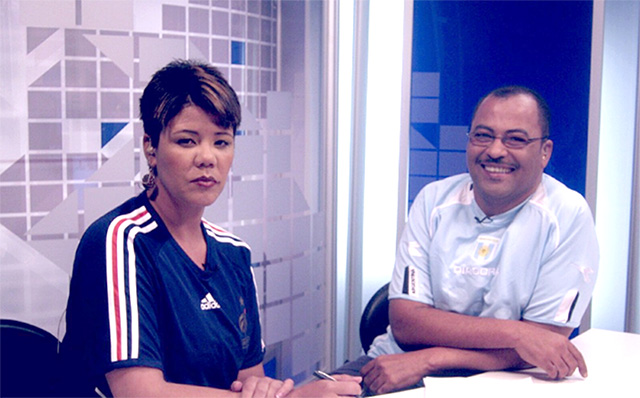
Well-known presenter Franlin Thomas has a wealth of experience spanning over 20 years in the radio and TV broadcasting industry, which has earned her that special something that keeps viewers and listeners tuned in.
The remarkable media maven has a certain aura which has endeared her to audiences over the years, who look to her to break down the news of the day.
On screen, she comes across as no-nonsense, but meeting her in person is a whole other story. Not only is she dynamic and smart, she’s filled with such infectious, vibrant energy. Just by talking to her, you will gain new inspiration to fight whatever battles you are currently faced with.
Not giving up on your dreams is something Thomas lives by. She learnt to be determined at a very early stage in her career and admits that getting where she is today has not been easy.
When she first started out in the industry, she had to fight to have her voice heard in the newsroom, a feat made more challenging as a young female journalist and producer in an often male-dominated space.
“Certain workshops, especially outside the country, were reserved only for the male folk. Being as opinionated as I am, my resistance to how things were done earned me the reputation of being a bitch, which was very unfair because a male journalist would have just been regarded as determined,” she narrates.
“So, if being called a bitch back then got me where I am today, so be it. I earned my stripes and I won’t apologise for it, ever.”
Thomas says the Namibian Broadcasting Corporation (NBC) has come a long way in terms of female representation, so much so that today they have many women at top and middle management level, something she is very happy about.
Thomas started her career as an NBC reporter at her hometown, Keetmanshoop. This position offered her the opportunity to travel the//Kharas region and tell the stories of her people.
“I realised back then the power of the media and how through storytelling, I can give perspective on people’s lives so that development reaches them or empowers them to demand more.”
She particularly loved travelling to the rural areas, villages and settlements like Warmbad, Aus, Bethanie and Tses.
“It gave me a renewed and proud sense of belonging.”
A couple of years later, Thomas was transferred to Windhoek where she joined the radio current affairs desk as an assistant producer and host.
“I moved up the ranks quite fast, so much that I ended up as an executive producer. I made my debut on TV as the first female host with my late colleague and friend Moses Kandjoze on NBC’s breakfast show, ‘Good Morning Namibia’, and NBC TV News,” she says.
“I then expanded my experience to live productions such as national events, elections and conferences until I moved to head the Afrikaans radio station Hartklop FM, and now to manage National FM. It’s been quite a journey for me.”
Reflecting on this new leadership position during an especially fraught time financially for the media, Thomas maintains that she is ready for all the good and bad that may be in store.
“To be honest, it’s not new as I previously served in managerial positions. The only difference this time around is that I am now tasked to manage the flagship English radio service.”
She says thus far, her new position has been exciting and challenging. Not wanting to give too much away, she mentioned that she will continue to focus on good presentation, “vigorously aim to improve multi-media saliency to optimally compete and widen reach throughout the country” and to become truly representative by expanding their presence to all 14 regions in the country.
She decided on a career in media broadcasting because she finds it incredibly interesting and rewarding.
“I like being the first to know and breaking that to listeners. I like to ask questions and make sure I get answers for the public. I like working under pressure as I find I perform at my best when I do. I find it rewarding to listen to or view an end product, knowing the planning and hard work that went into it, especially if it results in positive change. I also like teaching and training up-and-coming broadcast journalists. I enjoy transferring my skills to others,” Thomas says.
One thing Thomas is particularly proud of in her career so far is the fact that she first learnt the art of presenting, interviewing, research and writing on radio for many years before appearing on TV.
“I always advise media students to do that because TV brings with it its own pressures, such as your life constantly being in the limelight and under scrutiny. That is why radio is my first love,” she says.
One of the biggest challenges currently faced in the industry, says Thomas, is that of traditional media versus new media.
“How to make traditional media such as radio and print more relevant in today’s technology. The challenge is what has caused many newspapers to close down and journalists to lose their jobs. It’s commendable, though, how the print media in Namibia has adapted to multimedia journalism, by being visible on social media.”
She says in terms of radio broadcasting, at NBC radio, they have adopted a strategy to compete and aim to stay relevant in these ever-changing times, which requires a concerted effort to educate, inform and entertain au-diences via social media and online.
Another challenge, says Thomas, is the perception of the industry, especially amongst the youth. She has found in her interaction with young people that they are more focused on becoming famous by appearing on radio and TV than on being quality journalists. Journalism does not seem to appeal to young people because it is not deemed financially rewarding.
“That is why most of them choose public relations or marketing. Not many enter the field of journalism, where what should drive you is passion. Investigative journalism is not encouraged or respected in the industry, which is very unfortunate. I hope to see a journalism school being opened in Namibia one day, similar to College of the Arts, where writing for print and broadcast media and investigative journalism will actually be taught,” she says.
The 43-year-old mother of two – a daughter and a son – says she values family time. “Family is important and I always make time for them. I don’t always attend social events as much as I am invited but this is a choice I made since I became a mother,” she says.
In an age of information overload, Sunrise is The Namibian’s morning briefing, delivered at 6h00 from Monday to Friday. It offers a curated rundown of the most important stories from the past 24 hours – occasionally with a light, witty touch. It’s an essential way to stay informed. Subscribe and join our newsletter community.

The Namibian uses AI tools to assist with improved quality, accuracy and efficiency, while maintaining editorial oversight and journalistic integrity.
Stay informed with The Namibian – your source for credible journalism. Get in-depth reporting and opinions for
only N$85 a month. Invest in journalism, invest in democracy –
Subscribe Now!