ALEXIS AKWAGYIRAMSEVERAL African countries have enjoyed economic growth in recent years – but there are fears that a failure to develop manufacturing could prove costly.
‘Made in China’ is a stamp that is ubiquitous and can be found on a wide range of objects – anything from T-shirts and shoes, to watches and televisions – worldwide.
The same is true of labels showing that an object originated in Taiwan or Vietnam.
But it is rare to find an object which has a mark that points to origins in African country – ‘Made in Nigeria’ or ‘Made in Chad’, for example.
Despite experiencing regional economic growth in recent years, Africa commands a meagre 1,5% share of the world’s total manufacturing output, according to the United Nations Industrial Development Organisation.
That compares with a 21,7% share for the Asia Pacific region, 17,2% for East Asia and North America’s 22,4% share.
“Economies that have sustained high growth over the long term have typically gone through a process of economic diversification, the spread of new technologies, rising productivity in agriculture, the expansion of the manufacturing sector, and the development of a skilled workforce,” write the authors of a recently published Africa Progress Panel report.
“These have not been characteristics of growth in Africa, even in sectors that are attracting foreign investment. Put differently, there has been a lot of growth but little structural transformation,” they conclude.
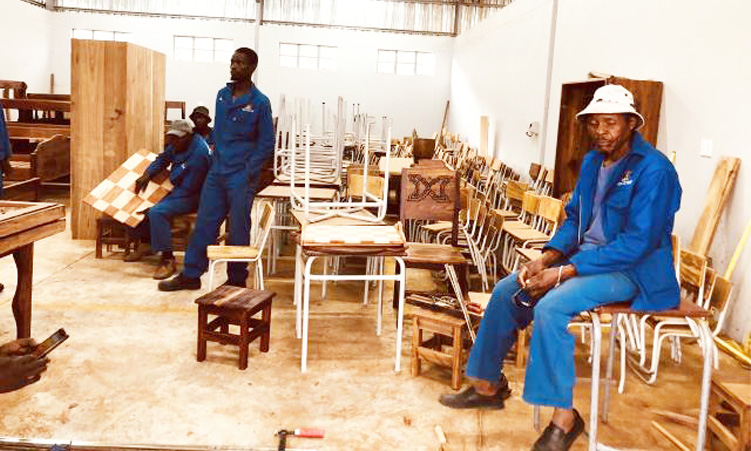
A small wood factory in a town around 20km outside Mozambique’s capital, Maputo, is just one of the many manufacturing sites across the continent trying to buck that trend.
The company – Sociedade Comercial Colosso – employs 26 people and processes timber from 25 different species of Mozambican trees to make various wooden objects, such as furniture, flooring, beams and stairs.
Two of the employees – Bartomoeu Zandamela and Angela Macobela – say the jobs have improved their lives.
“The work helps me put food on the table at home. I’m the bread winner of eight children,” says Zandamela , who works on the maintenance of timber-processing machines.
Macobela, who is learning to make floorings and ceilings, says: “I’m a single mother. The money I get helps me bring up my two children. My dream is to progress in my professional career.”
Despite having one of the fastest-growing economies in the world, more than 20% of Mozambique’s population remains unemployed.
That dichotomy, which can be found in other African countries, has led some economists to question whether the growth seen across the continent will ever be translated into more jobs and a greater distribution of wealth.
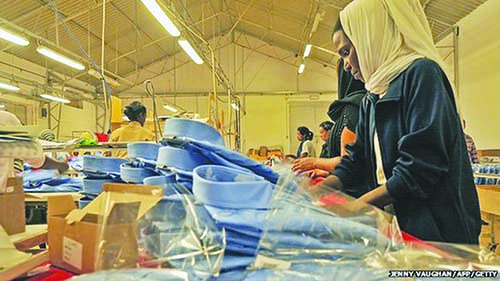
Asian economies have seen their economies grow in recent decades by becoming manufacturing hubs for the world. In countries like Taiwan, Bangladesh and China, factories have produced everyday goods – from clothing to furniture – on a large scale.
The benefit is that the largely unskilled work creates jobs – helping to spread wealth and bolstering the country’s economy.
Mozambique’s government says it is in the process of implementing policies of this variety.
“We introduced an initiative of bringing cement factories into the country. With this, we managed to stabilise the price levels of cement in Mozambique,” says Armando Inroga, the country’s trade and industry minister.
“We intend to have market competitive prices in the coming two years so that Mozambicans can have adequate low-cost housing using high-quality material produced in Mozambique.
“We also need to have a highly Mozambican food-processing industry which results from national produce.”
Traditionally, foreign investment has poured into Asia thanks to this model. But production costs in Asia are rising, as are salaries, encouraging firms to look elsewhere.
Some experts say the current dearth of vibrant manufacturing sectors in Africa is among the biggest factors preventing countries on the continent from cutting unemployment and spreading wealth.
The recent Africa Progress Panel report states that fewer than one in 10 African workers find jobs in manufacturing.
It quotes Nkosazana Dlamini-Zuma, chairwoman of the African Union Commission, as saying: “We believe we cannot achieve development unless we industrialise. We are looking at agriculture as one of the important drivers for industrialisation.
“We have the land, the people and the products. But we need to process more of our products in order to create jobs for the young people.”
Despite having Africa’s biggest economy, a large proportion of the country’s population is unemployed.
The problem of joblessness came to the fore earlier this year when a stampede among job-seekers taking a recruitment test in the national stadium in the capital, Abuja, left several people dead and injured.
High numbers of young, unemployed people means a cheap labour force is readily available in many African countries – not just Nigeria.