The police in Madagascar have fired tear gas as hundreds of young protesters returned to the streets of the capital, despite the president agreeing to dissolve his government.
The so-called Gen-Z protests have seen thousands demonstrate in cities across Madagascar since Thursday, demanding an end to repeated water and power cuts.
President Andry Rajoelina sacked his government on Monday, but protesters responded to calls on social media for a fresh rally on Tuesday.
A message on the protest movement’s Facebook page expressed disappointment with the president’s speech, calling for him to apologise and take responsibility after protesters were killed by the security forces.
United Nations (UN) human rights chief Volke Türk previously said security forces had used “unnecessary force” to end the unrest, adding that at least 22 people were killed and 100 others injured.
Madagascar’s foreign ministry has rejected the UN’s figures, alleging the data is “based on rumours or misinformation”.
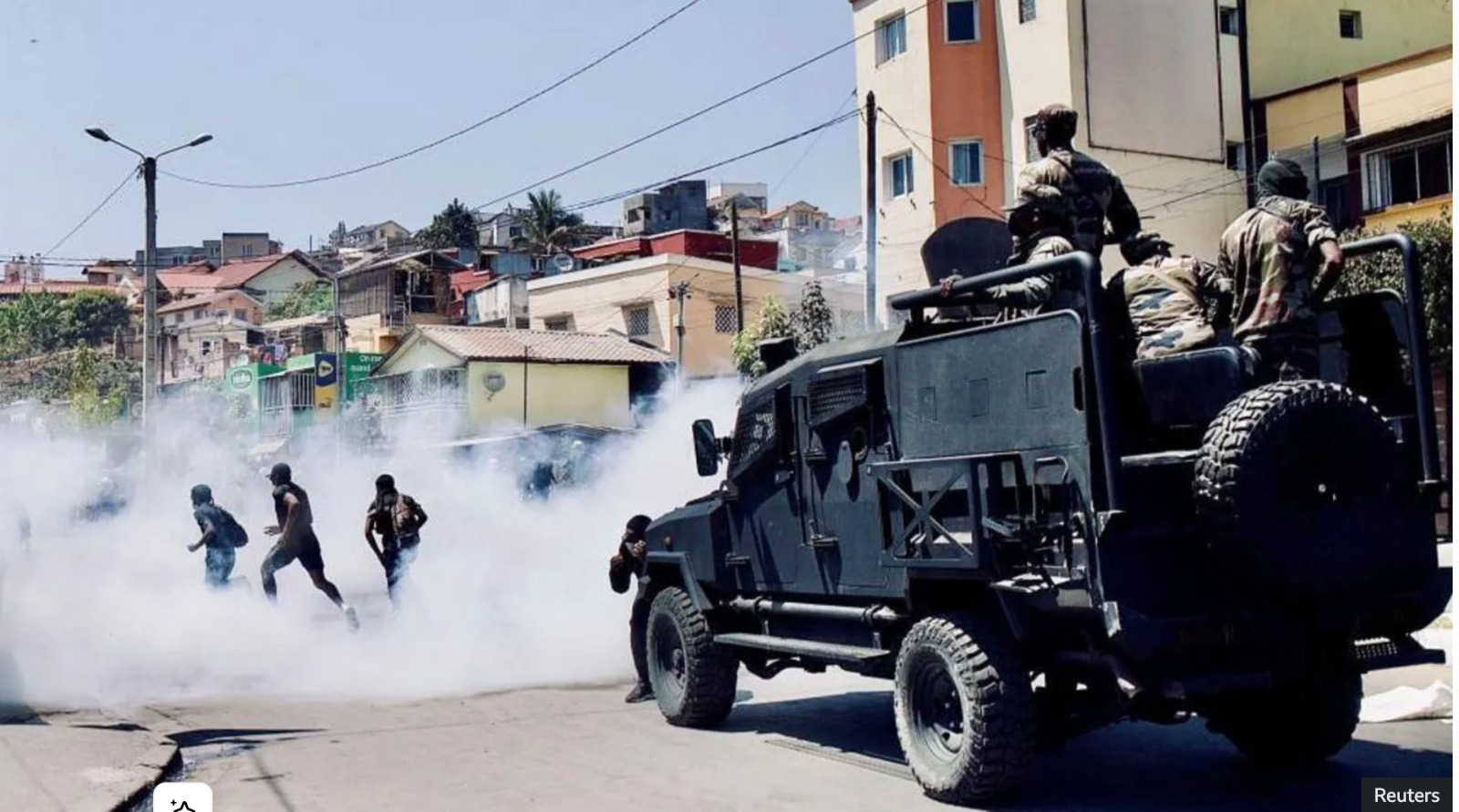
The police were deployed in and around Antananarivo on Tuesday. At one roadblock, they fired tear gas to scatter a small crowd that had begun to gather, the AFP news agency reported.
Protests first started in Antananarivo, but have since spread to eight cities across the country.
A dusk-to-dawn curfew was imposed in Antananarivo after reports of violence and looting, with the police firing rubber bullets and tear gas to disperse the crowds.
Türk said he was “shocked” by the security forces’ violent crackdown on demonstrators, which included arrests, beatings and the use of live bullets.
“I urge the security forces to desist from the use of unnecessary and disproportionate force and to immediately release all arbitrarily detained protesters,” Türk said in a statement on Monday.
According to the UN, the dead “include protesters and bystanders killed by members of the security forces, but also others killed in subsequent widespread violence and looting by individuals and gangs not associated with the protesters”.
Last week, Madagascar’s president announced that he had sacked the energy minister for failing to do his job properly, but protesters demanded that the president and the rest of his government step down too.
Thousands took to the streets once again on Monday.
“I understand the anger, the sadness, and the difficulties caused by power cuts and water supply problems,” Rajoelina said during his address on state broadcaster Televiziona Malagasy.
He said he had “terminated the functions of the prime minister and the government” and applications for a new premier would be received over the next three days before a new government is formed.
However, those currently in office would act as interim ministers pending the formation of a new government, he noted.
Rajoelina added that he wanted to hold talks with young people.
A banner at one of last week’s demonstrations in Antananarivo read: “We don’t want trouble, we just want our rights”.
But some reports last week suggested protesters had damaged – possibly by setting fire to – the homes of at least two legislators.
The “Gen Z” movement alleges, however, that paid goons had looted various buildings in order to undermine their cause.
Madagascar has been rocked by multiple uprisings since its independence in 1960, including mass protests in 2009 that forced former president Marc Ravalomanana to step down and saw Rajoelina come to power.
The protests mark the most significant challenge the president has faced since his third re-election in 2023.
– BBC
*Additional reporting by Danny Aeberhard