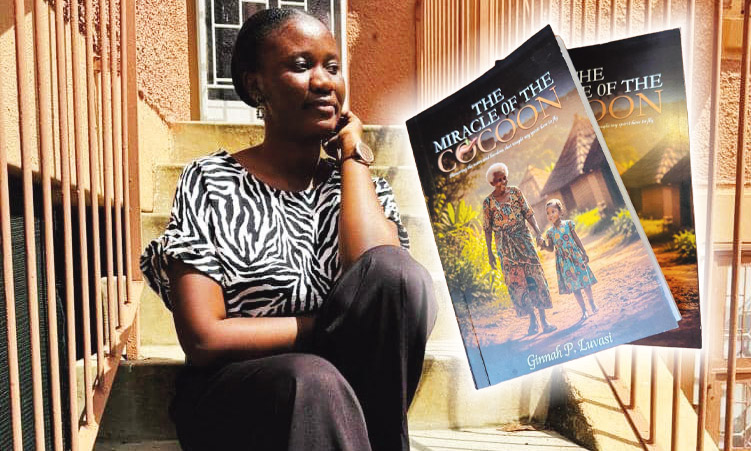
Author Ginnah Luvasi has documented her family’s history and the childhood experiences that shaped her identity in her debut memoir, ‘The Miracle of the Cocoon: Honouring the Scars and Burdens that Taught my Spirit How to Fly’.
The book explores how poverty, illness, family separation and personal loss can influence a person’s development, while examining the role of family relationships, resilience and healing across generations.
Luvasi says her interest in writing developed from reading Judy Blume novels during high school and her passion for scriptwriting.
She eventually decided to document her own family’s story, particularly to honour her late grandmother, who cared for her during infancy when her health was deteriorating.
Her mother joined the Namibian Defence Force less than a year after giving birth to her to provide for the family, leaving Luvasi in her grandmother’s care.
“My grandmother means a lot to me, and that is why I wanted to document the life I had with her and her children, including my own mother because I had a chance to live with them all, and each home gave me a lesson,” she says.
The memoir follows Luvasi’s experiences growing up between rented homes and living with different relatives.
It introduces family members Maria, James, Margaret, Mary, Bruce, Prudence, Christopher and Naledi, whose experiences and decisions influenced her upbringing.
From the age of five, Luvasi lived with different aunts and uncles during school holidays after her grandmother arranged for her to stay with an aunt so she could attend school in town.
She said documenting their experiences was important because each relative contributed to raising her.
“I did not just visit them, I lived with each of them. I ate at their tables, I learned their rules, I saw their struggles and their love. This book is important because it is not just my story, it is the story of the village that raised me,” she says.
The book also reflects on childhood poverty, instability and the effects of unaddressed family wounds.
Luvasi says these experiences taught her resilience and strengthened her determination to improve her family’s circumstances.
“I was taught resilience at a very young age. I am a fighter at heart and I am very determined to contribute to changing my family’s situation back home,” she says.
The title draws on the transformation of a caterpillar inside a cocoon. Luvasi uses the process as a metaphor for the difficult experiences that can shape people before they move forward.
‘UNCOMFORTABLE, TIGHT, DARK’
“For me, the cocoon symbolises every burden and every shortcoming I carried from the time I was a baby until I became independent. A cocoon is uncomfortable. It is tight, it is dark, and you cannot stay there forever. But it is also where growth and transformation happen,” she says.
She says experiences of sickness, rejection, displacement and heartbreak became part of her own process of change.
“Part of my life felt like I was in a cocoon. And that is why I called it ‘The Miracle of the Cocoon’, because what felt like being trapped was actually God preparing me to fly, and for something vulnerable to break in order to harden up and grow wings to fly, is a miracle by itself,” she says.
Luvasi says writing the memoir was difficult, particularly when revisiting memories of her grandmother, whose death she said she had not yet come to terms with.
She credits her younger sister, Cindy Liyali, and brother, Masule Lubasi, with encouraging her to continue writing.
Publisher Webby Chisakama also encouraged her to pursue the project after recognising her writing ability, she says.
Luvasi says her grandmother’s legacy was one of unconditional love, compassion and hope, and that it continued to influence her understanding of healing.
The memoir examines how beliefs formed during childhood can shape adult decisions and how unresolved pain can be carried between generations.
Luvasi hopes readers will reflect on their own experiences rather than allow difficult circumstances to define their futures.
In the book’s prologue, she writes: “A cocoon is not a place of comfort. It is a place of breaking, stretching, waiting, and becoming.”
She says the book also seeks to encourage families to discuss experiences and problems that are often left unspoken.
“It encourages families to talk about where they come from, about the pain they have never spoken about, about childhood wounds, about why certain patterns keep repeating, and about how to break them,” she says.
Luvasi says such conversations should address family history, sacrifice, forgiveness and the legacy passed to younger generations.
“Above all, it encourages families to talk about the truth, because healing only begins when we start talking.”