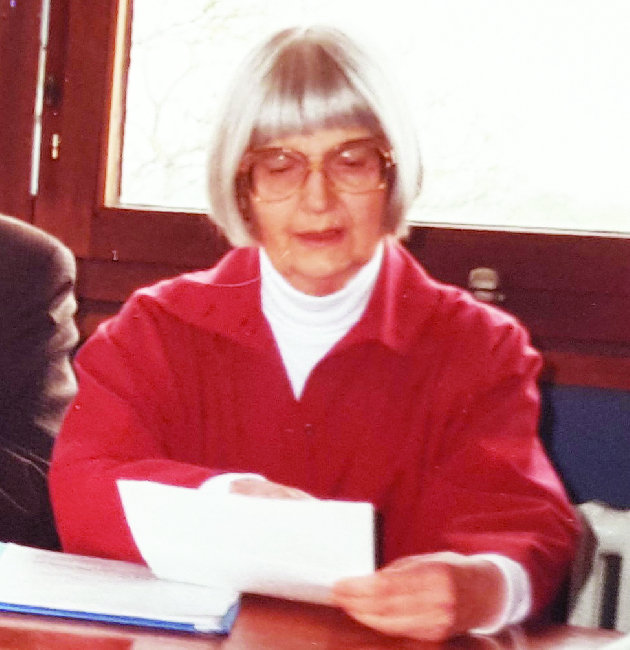
DAG HENRICHSENTHE cosmopolitan Norwegian social anthropologist and writer, Kirsten Alnæs (Alnaes), who has died in Oslo at the age of 93, was an astounding academic.
She was instrumental for Namibian studies and, especially, Ovaherero diaspora histories.
Her crucial, unassumingly titled essay ‘Living with the Past: The Songs of the Herero in Botswana’ (published in Africa, 1989) rooted Namibian genocide history firmly in Ovaherero orality studies.
Kirsten Alnaes presented and analysed, in particular, women’s memorialisations of German colonial violence and the Ovaherero’s survival and flight in 1904 to neighbouring Bechuanaland, and as such the poetic ‘omatjina’ and ‘omihiva’ genres and other praise poetry.
No scholar had done so before and it still took some time until her essay and her few other papers made an impact.
Already in 1981, she had presented a paper on ‘Going through the War: Herero Women in Botswana’. In 1987, she framed the pivotal issue about ‘When the Body Switches Off’ with reference to memory studies and the experiences of colonial atrocity victims, a perspective which is only now regarded as essential.
At the 1994 Hanover conference ‘Writing History. Interdisciplinary Research on Namibia’, one in a series of workshops moving post-independence Namibian studies into new directions, she impressed with her insights about ‘The Herero in Exile in Botswana: History and Social Conditions’.
Her research, and her sensitive empathy, were rooted in long-term personal relations with the exiled Ovaherero community, beautifully recalled now by her London partner of the 1970s, Peter Katjavivi, in his obituary in New Era (17 February 2021). Katjavivi and a whole network of Namibian exiles were crucial for her 1978/79 Botswana research.
Initially, she had embarked in the 1950s on research in Uganda, Zimbabwe and Tanzania. Afterwards, she taught at the University of London, obtaining her PhD (in 1995!) on ‘Singing with the Spirits’ and BaKonzo rituals in the Uganda-Congo border region.
However, Kirsten Alnaes’ warm hospitality at her London home to young researchers like me opened up much more: I also listened to her personal, critical yet soft-spoken reflections about her struggles as a female scholar in academic institutions. In her own words and with reference to the Hanover conference: “Concern and kindness without the underlying tensions and hidden (or open) competitions which so often mar a gathering of this sort, are crucial.”
Indeed, the subject of Namibian studies has not only lost an inspirational scholar but a concerned, most kind and very generous colleague. It is with much appreciation that her and Peter’s son, Patji Alnaes-Katjavivi, has taken care of the substantial legacy entrusted to her by the Ovaherero women to whom she listened with a deep sense of compassion.
The Kirsten Alnaes collections are accessible at the archives of Senate House, University of London.
* Dag Henrichsen is attached to Basler Afrika Bibliographien and the Namibia Resource Centre and Southern Africa Library in Switzerland.
In an age of information overload, Sunrise is The Namibian’s morning briefing, delivered at 6h00 from Monday to Friday. It offers a curated rundown of the most important stories from the past 24 hours – occasionally with a light, witty touch. It’s an essential way to stay informed. Subscribe and join our newsletter community.

The Namibian uses AI tools to assist with improved quality, accuracy and efficiency, while maintaining editorial oversight and journalistic integrity.
Stay informed with The Namibian – your source for credible journalism. Get in-depth reporting and opinions for
only N$85 a month. Invest in journalism, invest in democracy –
Subscribe Now!