



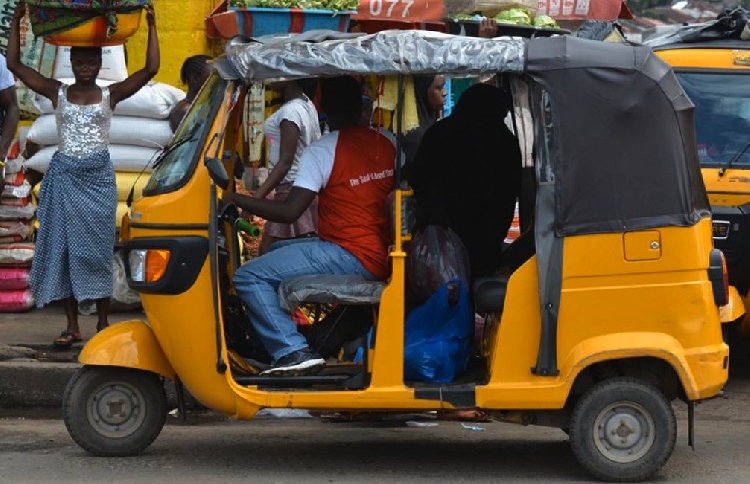
MONROVIA – Omnipresent on the chaotic streets of Mumbai, Jakarta and Bangkok, Asia’s three-wheeled “tuk-tuk” has now come to Africa – and with a two-fold bonus: providing much-needed jobs and slashing accidents.
Cheap to run and safer than the traditional motorcycle taxi, the auto-rickshaw is an increasingly common sight trundling along the traffic-choked streets of the continent’s sprawling capitals.
Known in Tanzania and Ethiopia as “bajaj”, in Egypt as “toktok”, in Nigeria as “keke-marwa” and in Sudan as “raksha”, the tuk-tuk has now hit Liberia, where delighted locals have christened their own version the “kekeh”.
Motorcycle taxis, known locally as “two-tyres”, were the go-to means of public transport in Liberia’s capital Monrovia until lawmakers outlawed them in 2013 amid concerns over reckless riding and the high toll of accidents. The ban paved the way for the kekeh, imported from India and China by numerous operators, mostly Nigerian and Guinean, who employ young Liberians.
“What’s making the kekeh very important… is (that) we are looking at a huge transport challenge in our country,” said Jenkins Zayzay, secretary general of the Liberia Motorcycle and Tricycle Association (LIMTCA).
“You had the two-tyres that were running in the city centre before, but because of government regulations, we had to introduce another form or some level of job employment for the young people.
“So it was decided that we had to introduce the kekeh.”
India produces around 800 000 motorised rickshaws a year, more than a third of which end up in foreign cities. The country’s TVS King – which has a presence in 30 African countries – has a four-stroke, single cylinder 200cc engine which runs on petrol, or the more environmentally friendly compressed natural gas.
Huasha, based in the southern Chinese city of Jiangmen, is producing its own version which looks more like the front end of a motorbike towing a two-wheel passenger trailer.
LIMTCA says kekehs have generated 5 000 jobs for Monrovians, many of whom were made unemployed by the motorcycle taxi ban. – Nampa-AFP
In an age of information overload, Sunrise is The Namibian’s morning briefing, delivered at 6h00 from Monday to Friday. It offers a curated rundown of the most important stories from the past 24 hours – occasionally with a light, witty touch. It’s an essential way to stay informed. Subscribe and join our newsletter community.

The Namibian uses AI tools to assist with improved quality, accuracy and efficiency, while maintaining editorial oversight and journalistic integrity.
Stay informed with The Namibian – your source for credible journalism. Get in-depth reporting and opinions for
only N$85 a month. Invest in journalism, invest in democracy –
Subscribe Now!