






More landless farmers want livestock kept in towns
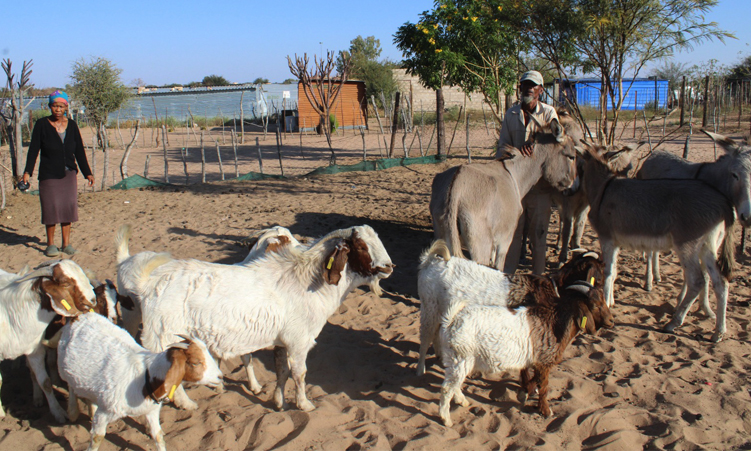
Farmer Markus Aoxamub (58) says if the Gobabis municipality does not want him to keep his goats and donkeys in town, the government needs to give him a piece of land to farm.
“I am willing to leave town, but the municipality must give me a place to stay,” he says.
Namibian municipal laws prohibit keeping livestock within urban boundaries unless the animals are kept in a well-fenced area.
Aoxamub keeps his five donkeys and eight goats locked inside the kraal next to his shack so they do not bother other residents in the municipal area of Gobabis.
He leads them daily to a grazing area near the town and ensures they drink water at one of the community taps.
Aoxamub keeps his animals in town despite authorities in the Omaheke region warning that livestock in urban areas are contributing towards accidents on the road.
However, farmers like Aoxamub say they are aware of the bylaws, but have no choice.
“I keep my animals here (in town) because I don’t have land,” he says.
He says he has nowhere else to keep his donkeys and goats, which he brought from a farm he worked at 30 years ago.
Aoxamub says he applied for a resettlement farm about 20 years ago, but he was unsuccessful.
TRANSPORT MODE
He says his animals also help him transport water over long distances between his home and community water points in the Kanaan informal settlement.
Another farmer, Lesley Pienaar, who farms within the Gobabis municipal land says requests for farming land from the government have fallen on deaf ears.
“Waiting on the government to give you a piece of land while they could not give those that were before us, it won’t be,” Pienaar says in an interview with the Ministry of Information and Communication Technology at Omaheke.
He farms with more than 60 goats and 112 pigs at his house in Road Camp, and has cattle at a different site at Gobabis.
He says he would rather have his livestock closer for security purposes.
CAUSING ACCIDENTS
The Omaheke police have warned that donkeys, horses and cattle roaming on roads pose a road safety hazard.
Gobanin Traditional Authority councillor Cynthia Araes has called for fences to be erected near roads to prevent livestock from straying onto highways and causing crashes.
The police have repeatedly urged livestock owners to keep their animals off public roads and warned that those who fail to do so could face legal action.
Gobabis constituency councillor Liberius Kalili says they are aware that a lot of farmers are keeping livestock in residential areas, although he could not provide a number.
He tells The Namibian that some animal owners have refused resettlement by the Office of the Governor because they claim the land is too small.
“They are a lot. It is strange. There are even people farming with pigs,” he says.
A MOUNTING PROBLEM
Kalili says some farmers are doing it on purpose because they keep bringing new animals into their kraals.
“Some people only had goats but later on brought in cattle. What is that?” he asks.
Various livestock are roaming the streets of Gobabis.
Residents at Grootfontein, Tsumeb, Rundu and other towns have also recorded a number of livestock roaming the streets.
The Otjiwarongo and Grootfontein municipalities last year announced that they would begin impounding livestock found roaming the streets, saying the animals pose a traffic hazard and damage gardens and crops in residential areas.
Otjiwarongo recorded about 3 000 livestock animals within the town since August 2024.
Grootfontein municipality chief executive Indileni Lungameni this week said the town does not have farming land to allocate to farmers keeping livestock in town.
He said all livestock found within the boundary of the town will be impounded.
Rundu Town Counccil spokesperson Benjamin Makayi says the town has a kraal where it keeps animals found roaming the streets.
Makayi says owners of impounded animals are required to pay a N$2 000 fine before they can reclaim their livestock.