Reminiscing about my happiest childhood memories, I can’t help but think of the place nearest to my heart – Koës.
Nights under the stars, the streets a hive of activity, langarm music in the distance, the reprimanding of loud pastors in the churches not far away, dogs howling at horse-drawn carriages – these are the memories of Plaatjiesheuwel, and not much has changed.
The place where my grandparents lived and where their house still stands to this day, Koës is a small village in the heart of the Kalahari Desert which offers respite from the hustle and bustle of everyday life. As the saying goes: “Suide maak vrede”.
Koës consists of three parts, namely, the ‘dorp’ where the post office, police station, service station, Agra and a general store can be found, as well as a school. Plaatjiesheuwel makes up the location while Soek-en-Kry is more of a shanty town.
Thanks to the landscape, Koës is also famous for the ‘Koës Pan Rally’, which takes place on the pan on the borders of the town surrounded by beautiful white, sandy dunes.
Although low rainfall plagues the area, this year showers have filled up parts of the pan and surrounding dams.
Despite poverty and alcoholism taking over the lives of many of the younger residents, you can’t look past the respectable elders who have lived there since the birth of the village.
Paul Rooi (81) has either been living in Koës or in surrounding areas for almost his entire life, and to the best of his abilities, took me through the early years of the village over a cup of truly southern ‘tjeel tee’.
Rooi explained that the colourful Plaatjiesheuwel didn’t exist until a few years later when the first Lutheran church was built, and that the early residents lived in the part which is now considered ‘uptown’.
“Those years it was only Willem Goliath, Jan Both, Albert Plaatjie, Mina Camm and George Scott, and the Dien family also lived that side,” Rooi remembered.
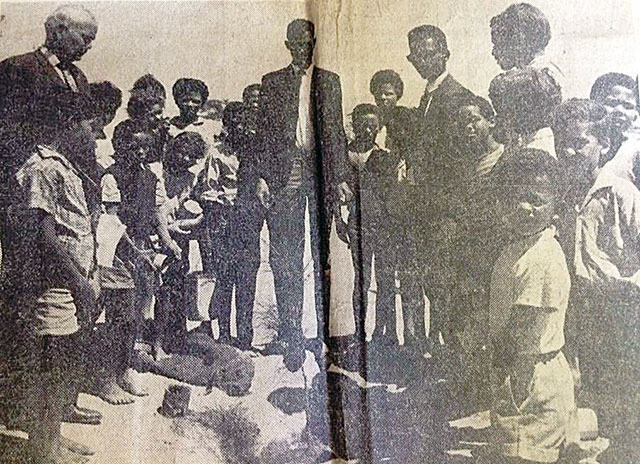
“In 1952, Isaak Beukes and I laid the first brick of the church. In 1953, one of the rooms was used as a small school, thereafter a waterhole was dug and people started moving to this location.”
Rooi noted that in those years, the Nama people could only go to school until Grade 4 while the coloureds often reached Grade 8.
“Standard two (Grade 4) was my matric,” he joked. Despite Rooi’s short education, nobility and wisdom oozes from the older man. Rooi noted that my grandfather, Edward Camm, alongside Adam Steve and Adolf Kisting, were the first teachers in Koës.
With the growth of Koës, Rooi mentioned that Ernst Nitschke and his family also later moved there, and their family home still stands close to the entrance of Plaatjiesheuwel.
“And that’s how the town grew,” he said.
Asked to describe how life was back then in Koës, Rooi said: “Bordering on primitive, but we could get by”.
Ouma Hansina Witbooi, also a lifelong resident of the quaint farming village, remembers how their parents worked well with the white people, despite the era. Witbooi mentioned that back then, the post office consisted of a single room, whereas today it has been downgraded to a mere stoep.
Witbooi says Dawid Adams was the first pastor of the church, who would come from Keetmanshoop to assist Scott and handle some of the formalities of the church.
She says not many white people lived in the village, until the first white school of the town, Chris Lötter Primary School, was established.
“My mother worked at the school while she was pregnant with me,” she said, adding her father also worked on the schoolgrounds and she herself followed in their footsteps.
“I was born here, I went to school here, I got married here. I am happy,” Witbooi concluded.
In an age of information overload, Sunrise is The Namibian’s morning briefing, delivered at 6h00 from Monday to Friday. It offers a curated rundown of the most important stories from the past 24 hours – occasionally with a light, witty touch. It’s an essential way to stay informed. Subscribe and join our newsletter community.

The Namibian uses AI tools to assist with improved quality, accuracy and efficiency, while maintaining editorial oversight and journalistic integrity.
Stay informed with The Namibian – your source for credible journalism. Get in-depth reporting and opinions for
only N$85 a month. Invest in journalism, invest in democracy –
Subscribe Now!