One of the oldest groups living in Namibia – the Nama people – are the only true descendants of the Khoikhoi living in the country.
With a rich and vibrant history, this tribe has withstood the test of time, developing in culture and keeping their traditions, storytelling, music and poetry safeguarded in collective memory. One particular evolution of the Nama culture is their traditional attire.
The Khoikhoi, originally part of a pastoral culture and language group to be found across southern Africa, originated in the northern area of modern Botswana. This ethnic group steadily migrated southward, eventually reaching the Cape approximately 2 000 years ago.
Rapper Leeroy ‘S-Man’ Pieters recently educated youth in the south about the origins of the Nama people on a cultural roadshow and touched on the lifestyle and development of this tribe.
“The early Nama people didn’t dress the way we do today,” he says. “They wore clothing made from animal skin. In summer, they would wear the robes of skin with the fur on the outside, and in winter, they would turn the clothes inside-out to keep warm,” the rapper notes.
As these things go under colonialism, the Nama people lost many aspects of their culture, as German imperialists imposed societal standards on local ethnic groups. The attire was one of the first to be changed.
The traditional Nama dress, like the Damara and Herero dresses, are styled after Victorian traditional fashion, with the dresses being mid-length to long and formal. The flowing dresses were developed from the style of the missionaries in the 1800s, and today, this traditional clothing is an integral part of the Nama culture.
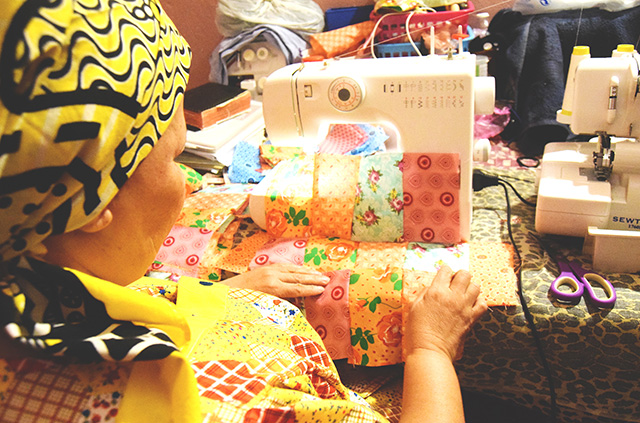
Tessa Pieter, a Keetmanshoop native, is a custodian of her culture and keeps it alive through her traditional fashion. Walking into a huge erf at Keetmanshoop’s Tseiblaagte neighbourhood, the yard is neatly raked, the house is spotless and Pieter welcomes us into her humble home. She’s a mother, a grandmother, the rock of the household, and for the past three decades, a traditional dressmaker.
Down the hall, the last door you find is where Pieter does her business. Her designs are placed across the walls, displayed on a coffee table and hung from rails in front of the windows. She’s at home here.
Sitting on the ground with her legs crossed and primarily speaking Khoekoegowab, she talks about the Nama dress, how it is worn and what it means to the Nama woman. “What our ancestors first wore, it all has changed,” she says.
Speaking on how the colonial period had an impact on the culture, Pieter notes: “That’s when we started wearing these traditional clothes”.
The embroidery skills of the Nama people and their appliqué designs are widely regarded as a traditional artform and consist of brightly coloured motifs, representative of the tribe’s lifestyle and vibrant nature. The traditional patchwork dresses that Nama women wear are testament to this.
Pieter talks about how her elders wore what is now known as the traditional Nama dress.
“Our grandmothers wore the Nama dresses with this patched design. They had their little bags nestled around their waists where they kept their tobacco or money,” she says.
Pieter’s nephew, Benediktus ‘Dikbones’ Witbooi mentions that Nama people are not only skilled in needlework, but also in various crafts. Pieter is also talented in this. She not only makes dresses, but also specialises in men’s shirts, shorts, children’s skirts, satchels and bags to keep your washing pegs or hand towels.
The veteran dressmaker notes the distinction of a young woman in the Nama culture, and another who is betrothed. “When a young woman gets married, she wears her Nama dress, puts on her traditional jewellery, and her cloth around her shoulders. She also has to wear her Nama shoes (). That’s how a Nama woman should be dressed. But the girls nowadays just wear the skirts with T-shirts, their and the . That is the difference between a youth and married women.”
These artforms in the Nama culture are held in high regard, and the southern communities strive to protect their heritage at all costs. To preserve the art and tradition of sewing and embroidery in the south, local entrepreneurs have initiated projects including Gibeon Folk Art and Empowering People in Need at Keetmanshoop. The latter is a non-profit organisation that employs the Nama people’s traditional skills of sewing and embroidery. The Wake Centre, where these crafts are produced and are available for purchase, is situated at Tseiblaagte.
Pieter says her work is important to her, and by producing these items, she contributes to the culture. Keeping her items affordable, she says she gives everyone an equal opportunity to have quality Nama traditional items in their wardrobe.