



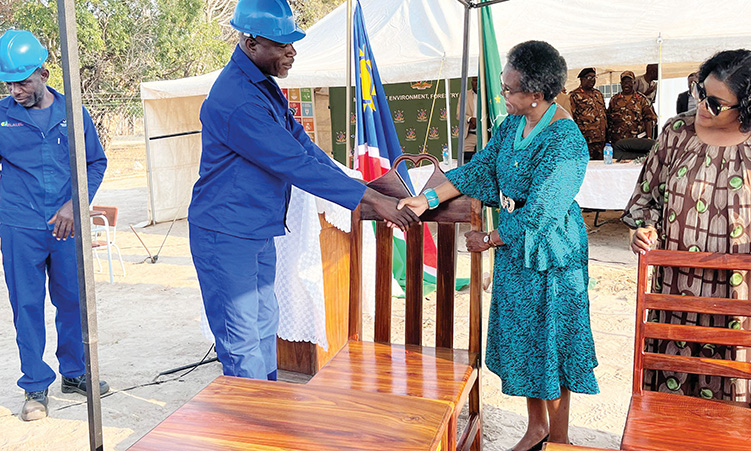
The Ministry of Environment and Tourism has launched a N$6-million cooperative that turns local timber into high-value furniture in the Kavango West region.
At the recent opening of the Mutjimagumwe Woodwork Cooperative, minister of environment and tourism Indileni Daniel said it would be a game changer for rural jobs, skills, and sustainable development.
The cooperative, supported by the Nilaleg Project in partnership with the United Nations Development Programme and the Global Environment Facility, aims to move communities away from raw timber exports towards high-value wood products.
“Today we are not merely opening a workshop. We are unveiling a new chapter in Namibia’s development story, a chapter where our people are not only resource users, but value creators; not only timber harvesters, but skilled artisans and entrepreneurs,” Daniel said.
So far, 18 artisans have been employed and the workshop has generated N$144 000.
“The training opportunities are restoring what officials described as dignity, pride, and self-reliance in artisanal work,” the minister said.
Beyond Mpungu, the Nilaleg Project has created more than 2 600 jobs countrywide, including 600 for young people. Nearly 62 000 Namibians have benefited, almost half of them women.
The project has restored over 17 000 hectares of degraded land and increased household incomes by nearly 50%.
“These are not just statistics.
They represent jobs, families, ecosystems, and futures. They prove that when we invest in people and in nature, we unlock lasting prosperity,” said Daniel.
In the Mpungu constituency, 900 hectares have been cleared through bush-thinning, creating local jobs and fodder for livestock.
Grassland has been restored on 35 hectares, and three boreholes and two earth dams have been rehabilitated, benefiting 48 households and more than 700 livestock.
The project has also distributed 215 goats to local families, trained over 300 people in sustainable devil’s claw harvesting, and generated more than N$318 000 from sales between 2022 and 2025.
Daniel said more work is needed, with a key priority being establishing a regional forest reserve in the Kavango West’s Nkulivere landscape, which covers more than 198 000 hectares.
“Establishing a reserve here is not just about trees, it is about protecting biodiversity, securing livelihoods, and strengthening resilience against climate change. For this vision to succeed, we need the steadfast action of traditional authorities and regional councils,” she said.
In an age of information overload, Sunrise is The Namibian’s morning briefing, delivered at 6h00 from Monday to Friday. It offers a curated rundown of the most important stories from the past 24 hours – occasionally with a light, witty touch. It’s an essential way to stay informed. Subscribe and join our newsletter community.

The Namibian uses AI tools to assist with improved quality, accuracy and efficiency, while maintaining editorial oversight and journalistic integrity.
Stay informed with The Namibian – your source for credible journalism. Get in-depth reporting and opinions for
only N$85 a month. Invest in journalism, invest in democracy –
Subscribe Now!