







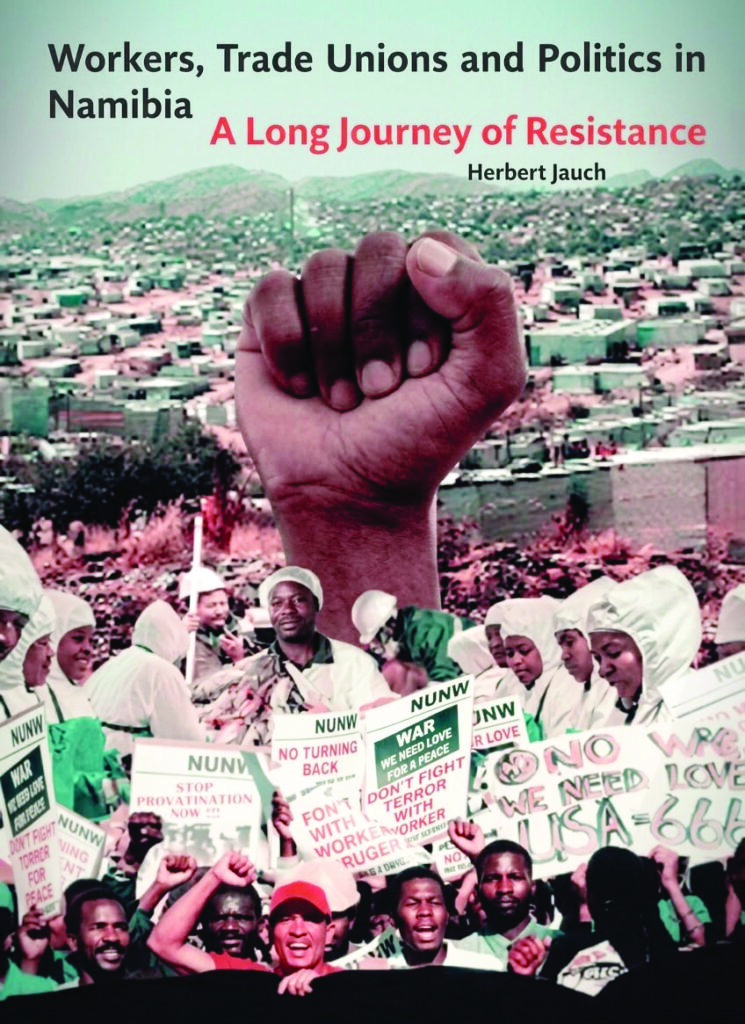
Veteran trade unionist Herbert Jauch has launched a new book documenting the history, triumphs, and modern challenges of Namibia’s workers’ movement.
The book focuses on the experiences of workers under colonial rule, the rise of trade unions and the role of the National Union of Namibian Workers (NUNW) in both the liberation struggle and workplace battles.
Jauch says the book was motivated by a concern that many of the experiences of Namibian trade unionists have never been documented.
“A key consideration for writing this book was the fact that hardly any of the Namibian trade unionists have documented their experiences,” he says.
He says the absence of such records has left an important gap in the country’s historical memory.
“This deprives future generations of workers and unionists of the opportunity to learn from past experiences and to understand from a critical, historical perspective the current situation the Namibian labour movement finds itself in,” he says.
“It is tragic that many of these experiences and insights were lost,” he says.
The book begins with an overview of Namibia’s colonial history and the exploitation of workers, particularly migrant labourers who were subjected to the contract labour system under German and South African rule.
“Namibian workers bore the brunt of colonial rule and conquest since its earliest days,” Jauch says.
He says workers were forced into harsh conditions after losing access to land and traditional livelihoods.
“Being deprived of their land and livelihoods, they were forced into wage labour and had to endure the most dehumanising and exploitative conditions,” he says.
The publication highlights that workers were not passive victims of oppression, but active participants in resistance movements.
“However, workers were not just victims, they fought back and their resistance pre-dates the formation of trade unions,” Jauch says.
A central focus of the book is the 1971/72 general strike, widely regarded as one of the most significant labour actions in Namibia’s history.
The book also examines the emergence of trade unions during the 1970s and 1980s, a period marked by growing political mobilisation and resistance to apartheid rule.
It explores how the NUNW became a key force in linking workplace struggles with broader demands for political freedom and social justice.
Jauch says many hopes for economic transformation after independence were not fully realised.
The book analyses factors that contributed to the decline of union influence, including neoliberal economic policies, internal divisions, bureaucratisation and declining membership levels.
The final chapter looks ahead, examining challenges facing organised labour today, including declining unionisation, informal employment and restrictions to the right to strike.
Jauch says organised labour must adapt to remain relevant.
“This book hopes to make a contribution to filling that gap,” he says.
As a former founding director of the Labour Resource and Research Institute, Jauch spent 30 years working with Namibian trade unions and remains active in social and economic justice advocacy.