




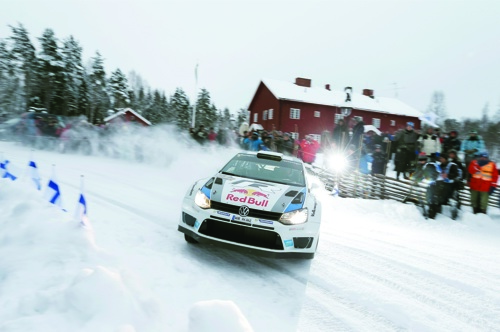
The Finn, who claimed his maiden victory in 2008, beat Volkswagenteam-mate Andreas Mikkelsen by 53.6sec after a tight battle throughsnowy forests in Sweden and Norway. Mikkelsen, who twice led the rally,secured his first WRC podium.
Third went to Mads Ostberg who finished just 5.9sec behind his fellow Norwegian to secure his fourth consecutive podium in the championship’s only true winter round.
“It’s my third win here and I’ve never won the same rally three times,” said Latvala, who was embraced at the finish of the final stage by father Jari. “It feels amazing to win here, it’s something very, very special.
“It’s a long time since my win in Greece last year. That was more about tactics and saving the car, but this is a high-speed event so it gives me confidence that I can also win high-speed rallies. I really needed a good result here,” he added.
World champion Sebastien Ogier, Mikkelsen and Latvala dominated the opening leg in their Polo R cars. When Ogier dropped more than four minutes recently after crashing into a snowbank, Mikkelsen moved to the front.
Two stages later Mikkelsen did the same and Latvala was ahead. Mikkelsen remained in close contact and they started the longest leg separated by 3.6sec. But when Mikkelsen plunged into the snow for a second time, Latvala could relax.
“This is absolutely fantastic,” said Mikkelsen. “I really hoped for this at my home event with all my friends and family here and second is more than I could ever have dreamed of. We were maybe fighting for a win but I made a small mistake and after that it was about keeping Ostberg behind us.”
Ostberg struggled for confidence initially in his first loose surface rally in a DS3, but came to terms with the car and saw off the Ford Fiesta RS cars of Mikko Hirvonen and Ott Tanak.
Hirvonen finished 1min 27.4sec behind with Tanak delivering possibly the drive of the rally to take fifth after more than a year away from the championship. He was 33.6sec behind Hirvonen.
Ogier recovered from 20th to finish sixth, overhauling Henning Solberg in the penultimate stage. Pontus Tidemand, Craig Breen and Kris Meeke completed the leaderboard, Meeke bouncing back after losing seven minutes and sixth place when he slid into the snow.
Elfyn Evans was on course for ninth until rolling his Fiesta RS in the final stage, while Martin Prokop retired when he went off and got stuck in the snow.
Hyundai duo Juho Hanninen and Thierry Neuville finished down the order after respectively damaging a wheel and breaking the front right suspension on their i20 cars and Robert Kubica was 24th after three lengthy spells in the snow.
Not for the faint hearted
Rallye Sweden featured in the inaugural championship in 1973 and has been dominated by Scandinavians, who won every year until 2004 when Sébastien Loeb broke the mould. Sébastien Ogier is the only other ‘outsider’ to win. Scandinavians have long been revered as excellent drivers and much of this skill is due to the harsh conditions in which they grow up driving and what the Finnish call Sisu. Sisu is a Finnish term loosely translated into English as strength of will, determination, perseverance, and acting rationally in the face of adversity. It has become synonymous with the legendary bravado and lack of fear many great Scandinavian drivers have displayed over the years.
It’s know as the only true winter round and a classic Rally Sweden is characterised by frozen roads lined with snow banks. Drivers ‘lean’ their cars against the banks to guide them around corners. But in warmer temperatures the banks disintegrate on impact and cars become stuck in the snow.
Studded tyres are essential and provide remarkable grip but drivers must acclimatise to the ‘floating’ feeling and different braking points. Skinny tyres are fitted with about 380 tungsten-tipped steel studs to bite into the frozen roads. Each stud is 20mm long and weighs 4g. However, just 7mm is exposed, with the rest inserted into the rubber to provide a strong anchor. When temperatures hover around freezing, the studs tear up the road surface and the exposed gravel rips them from the tyres leaving little traction.
Outdoor servicing in temperatures as low as -25°C makes normally routine jobs slower and tricky for gloved mechanics.
Shovels are mandatory in case competitors have to dig their cars out of snow.
Round three is Rally Mexico which is based in Leon on 6 – 9 March.
The Finn, who claimed his maiden victory in 2008, beat Volkswagenteam-mate Andreas Mikkelsen by 53.6sec after a tight battle throughsnowy forests in Sweden and Norway. Mikkelsen, who twice led the rally,secured his first WRC podium.
Third went to Mads Ostberg who finished just 5.9sec behind his fellow Norwegian to secure his fourth consecutive podium in the championship’s only true winter round.
“It’s my third win here and I’ve never won the same rally three times,” said Latvala, who was embraced at the finish of the final stage by father Jari. “It feels amazing to win here, it’s something very, very special.
“It’s a long time since my win in Greece last year. That was more about tactics and saving the car, but this is a high-speed event so it gives me confidence that I can also win high-speed rallies. I really needed a good result here,” he added.
World champion Sebastien Ogier, Mikkelsen and Latvala dominated the opening leg in their Polo R cars. When Ogier dropped more than four minutes recently after crashing into a snowbank, Mikkelsen moved to the front.
Two stages later Mikkelsen did the same and Latvala was ahead. Mikkelsen remained in close contact and they started the longest leg separated by 3.6sec. But when Mikkelsen plunged into the snow for a second time, Latvala could relax.
“This is absolutely fantastic,” said Mikkelsen. “I really hoped for this at my home event with all my friends and family here and second is more than I could ever have dreamed of. We were maybe fighting for a win but I made a small mistake and after that it was about keeping Ostberg behind us.”
Ostberg struggled for confidence initially in his first loose surface rally in a DS3, but came to terms with the car and saw off the Ford Fiesta RS cars of Mikko Hirvonen and Ott Tanak.
Hirvonen finished 1min 27.4sec behind with Tanak delivering possibly the drive of the rally to take fifth after more than a year away from the championship. He was 33.6sec behind Hirvonen.
Ogier recovered from 20th to finish sixth, overhauling Henning Solberg in the penultimate stage. Pontus Tidemand, Craig Breen and Kris Meeke completed the leaderboard, Meeke bouncing back after losing seven minutes and sixth place when he slid into the snow.
Elfyn Evans was on course for ninth until rolling his Fiesta RS in the final stage, while Martin Prokop retired when he went off and got stuck in the snow.
Hyundai duo Juho Hanninen and Thierry Neuville finished down the order after respectively damaging a wheel and breaking the front right suspension on their i20 cars and Robert Kubica was 24th after three lengthy spells in the snow.
Not for the faint hearted
Rallye Sweden featured in the inaugural championship in 1973 and has been dominated by Scandinavians, who won every year until 2004 when Sébastien Loeb broke the mould. Sébastien Ogier is the only other ‘outsider’ to win. Scandinavians have long been revered as excellent drivers and much of this skill is due to the harsh conditions in which they grow up driving and what the Finnish call Sisu. Sisu is a Finnish term loosely translated into English as strength of will, determination, perseverance, and acting rationally in the face of adversity. It has become synonymous with the legendary bravado and lack of fear many great Scandinavian drivers have displayed over the years.
It’s know as the only true winter round and a classic Rally Sweden is characterised by frozen roads lined with snow banks. Drivers ‘lean’ their cars against the banks to guide them around corners. But in warmer temperatures the banks disintegrate on impact and cars become stuck in the snow.
Studded tyres are essential and provide remarkable grip but drivers must acclimatise to the ‘floating’ feeling and different braking points. Skinny tyres are fitted with about 380 tungsten-tipped steel studs to bite into the frozen roads. Each stud is 20mm long and weighs 4g. However, just 7mm is exposed, with the rest inserted into the rubber to provide a strong anchor. When temperatures hover around freezing, the studs tear up the road surface and the exposed gravel rips them from the tyres leaving little traction.
Outdoor servicing in temperatures as low as -25°C makes normally routine jobs slower and tricky for gloved mechanics.
Shovels are mandatory in case competitors have to dig their cars out of snow.
Round three is Rally Mexico which is based in Leon on 6 – 9 March.
In an age of information overload, Sunrise is The Namibian’s morning briefing, delivered at 6h00 from Monday to Friday. It offers a curated rundown of the most important stories from the past 24 hours – occasionally with a light, witty touch. It’s an essential way to stay informed. Subscribe and join our newsletter community.

The Namibian uses AI tools to assist with improved quality, accuracy and efficiency, while maintaining editorial oversight and journalistic integrity.
Stay informed with The Namibian – your source for credible journalism. Get in-depth reporting and opinions for
only N$85 a month. Invest in journalism, invest in democracy –
Subscribe Now!