





I have a great interest in the origins of things; where they come from and how they got to where they are today. Sometimes, I also have an interest in the future of things, but that is a discussion for another day.
I am currently reading about the early food culture of the Cape Colony, which had such a profound influence on our own. I have to admit I know very little about the early food and emerging cuisine of the Cape Colony, so I thought I had better get to know it a little better.
There is much to learn about not just food but also life and business from the years after Jan van Riebeeck arrived to establish a refreshment station at the Cape of Good Hope.
Initially life was tough, and it was often a daily struggle to get enough food for everyone to eat. Rations came by ship, and often very infrequently. Two staples that arrived by ship were rice and (dried) bread, also called beskuit.
Ships also brought seeds that would enable Van Riebeeck to establish a garden with fresh produce that included a wide variety of fruits and vegetables from not only Jan’s country of origin, Holland, but from elsewhere in Europe and across the globe.
Van Riebeeck’s own records show that in 1652 and 1653 he sowed and planted the following crops: Various grains including wheat, carrots, turnips, cabbage and cauliflower, beans, broccoli, beetroot, peas, watermelon, asparagus, onions, leeks, artichokes, radishes, spring onions, cucumbers and a whole lot more. Fruits included Spanish oranges, apples, cherries, raspberries, plums, peaches, guavas, bananas, grapes, pomegranates and apricots. Old Jan must also have been a bit of a gourmand as he planted a wide variety of herbs: Origanum, aniseed, sage, rosemary, fennel, parsley, bay leaves and a few more. Sounds a lot like a modern-day fresh produce shop, does it not?
In addition to establishing a world-class garden, Van Riebeeck also had to start a livestock farm consisting mainly of local sheep and cattle and some imported breeds such as pigs, farmed rabbits (konyne) and Bengal sheep from Asia, used for wool. Van Riebeeck relied heavily on trade with the local Khoikhoi people to build and maintain his livestock numbers.
The local Khoi sheep were indigenous fat-tailed sheep whose most direct ancestors most likely originated in eastern Africa, and from stock that was brought to the African continent long before any European presence, through the Horn of Africa.
Van Riebeeck and the rest of the settlers soon (in 1657 already) learned from the local Khoi population to cook and render the fat from these fat-tailed sheep and to use the sheep fat as a substitute for butter. Not only did they eat it on bread, but they also used it as a general cooking fat when preparing meat and vegetable dishes and included it in their baking recipes. According to some sources, the tails were so big that they touched the ground and it is estimated that these tails would have weighed upward of three kilograms. Some European travellers found the meat was too fatty to eat.
Compared to the local Khoikhoi, the Europeans were terrible hunters. Unskilled and inexperienced they even tried hunting hippopotamus with a ship’s canon. They were more successful with smaller quarry and local dassies (rock hyrax or rock badger) were a well-loved delicacy. So much so that they ate the entire dassie population of Dassen Island into extinction. Rabbits were also popular and venison if they could hunt successfully.
They regularly harvested local fish such as kob, klipvis, harders, steenbras and snoek, and like the local Khoi consumed shellfish such as mussels and periwinkles. Seals and penguins were harvested for oil and meat. The Khoi also taught the Europeans a lot about the local veldkos such as wild mustard, Cape sorrel (also known as African wood-sorrel and suring), broodboom (Encephalartos longifolius) and seekoraal (Sarcocornia natalensis).
Van Riebeeck also brought the cast iron pot that we still use and love today, as well as the Amsterdam measurement system of pounds (lbs). One pound was equal to roughly 450 grams, and the system remained in use until 1973, when it was replaced by the metric system of grams and kilograms.
Van Riebeeck’s endeavours at the Cape of Good Hope show that even at that early stage, the emerging cuisine of the Cape of Good Hope was shaped and formed by many more sources than just the Dutch. From the very beginning it involved local, as well as imported, ingredients. The latter came from just about everywhere: Asia, South and Central America, the Middle East, Europe and the Mediterranean, and the African continent.
Those who found a foothold at the southernmost tip of Africa were just as diverse. In addition to the local Khoikhoi and Dutch employees of the Dutch East India Company (VOC), the European population also included Scandinavian and German vrijburgers and French Huguenot refugees that fled to the Netherlands. The VOC also imported a large number of slaves from Asia and Africa that further added to the diversity of the colony’s emerging food culture and local cuisine.
As more and more people started moving north away from the Cape Colony and into Greater Namaqualand, they brought with them the ingredients, tools, customs and culinary knowledge and skills. For example, it is quite possible that the cast iron pot arrived with the Oorlam migrants or the traders that followed them from the Cape Colony. It is also possible that fat cakes, ash bread and roosterkoek arrived here in similar fashion.
Naturally, there is much more to our food culture than what meets the casual eye. To understand our food culture, we need to understand its origins. Dutch colonialism of the Cape Colony was much more multi-cultured than what is often believed, and it had a much bigger influence on our local food culture than many would care to admit. Of course there is much, much more to investigate, but I’ll leave that for another day.
Happy birthday, Namibia. Be safe.
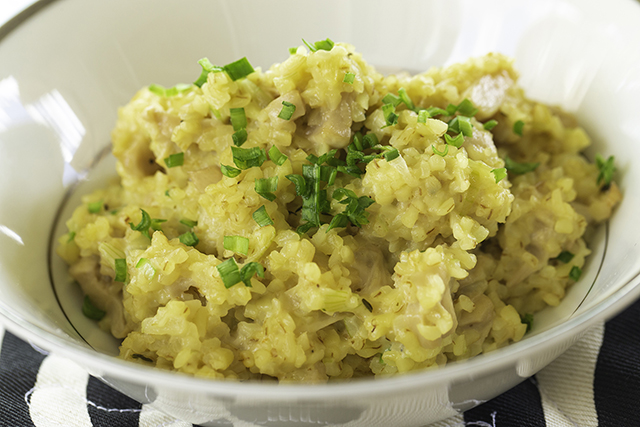
Bulgar Wheat Risotto with Omajova Mushrooms
Ingredients:
• 4 tablespoons butter
• 1 large onion, chopped
• 3 cloves garlic, minced
• 1 1⁄2 cups bulgur wheat
• 4 cups chicken stock
• 500 grams omajova mushroom, cleaned and
cut into 1 cm squares
• 2 tablespoons cream cheese
• 2 tablespoons chopped fresh chives
• Additional freshly grated parmesan cheese