



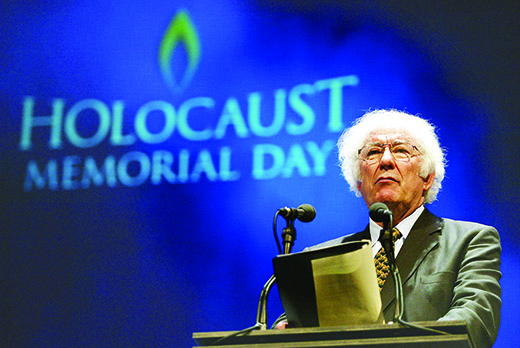
Seamus Heaney, one of the world’s best- known poets and winner of the 1995 Nobel Prize for literature, died last Friday. He was 74.The Northern Ireland- born Heaney’s poems evoke an Irish country childhood, with images of potato diggers and peat bog cutters, and echo the deep political splits that have divided the island.
• SAM CAGE
His works include the 1966 debut ‘Death of a Naturalist’, ‘The Spirit Level’, ‘District and Circle’ and an ac- claimed translation of the old English epic poem ‘Beowulf ’.
“For us, Seamus Heaney was the keeper of language, our codes, our essence as a people,” Irish Prime Minister Enda Kenny said. “He be- longs with Joyce, Yeats, Shaw and Beckett in the pantheon of our greatest literary exponents.”
Heaney was a rar- ity among poets, having wonacclaimfromcritics while producing best- sellers. Born on a farm in Mossbawn, County
Londonderry in Northern Ireland in 1939, his po- ems nostalgically recall the sights and smells of a country childhood.
The weaving of rural roots and modern realism helped him to become the most acclaimed Irish poet since William Butler Yeats, who was awarded the Nobel prize in 1923. Heaney was born in the year that Yeats died, and died in Dublin near the house where Yeats was born.
A tousle-haired figure with a shy and subtle manner, he hated media hype and publishers’ publicity caravans even as he became one of Ireland’s most famous figures. It once took him three hours to walk down Dublin’s main street, pursued by autograph hunters.
He found recognition in academic circles, be- coming Professor of Po- etry at Oxford University and lecturing at Harvard University, and won the Nobel prize for his ‘worksoflyricalbeauty and ethical depth’.
The news sparked im- mediate sorrow among poets, academics and politicians and was the main story on Irish news bulletins north and south of the border.
“I have described Sea- mus Heaney as a national treasure, but he was an international treasure, a colossus of literature,” said Northern Ireland’s deputy first minister, Martin McGuinness. “We’re all much poorer as a result of his passing and I feel it very deeply.”
A Split Ireland Heaney’s life was a cultural juggling act that beganwithhischildhood in a Northern Ireland riven by sectarian ten- sions between Protes-
tants and Catholics. He left at the height of the conflict in 1972, his departure hailed by one Belfast Protestant paper which called him ‘the well-known Papist propagandist.’
Settling first in the Wicklow Mountains and then in Dublin, his move to the Irish Republic made the headlines and those experiences al- lowed Heaney to bring a new sense of both the pain and passion of be- ing Irish at a time when the island was torn apart by the Northern Ireland conflict.
“There are tens of thou- sands of people today who will be feeling per- sonally bereaved because he had great presence,” said prominent Belfast poet Michael Longley. “Just as his presence filled a room his marvel- lous poetry has filled the heads of a generations of readers.”
Heaney always felt the tug of language between English and Irish and
acknowledged the di- chotomy in his acclaimed 1987 volume ‘The Haw Lantern’, writing, “Two buckets were easier car- ried than one / I grew up in between”.
He was acutely aware of the dilemma of being a ‘Green’ Irish nationalist in a province ruled by the red, white and blue flag of the British monarchy and was once spotted in the bar on the Dublin- Belfast railway switch- ing diplomatically from the Powers southern Irish whiskey to the northern brand Bushmills as the train crossed the border.
When a London pub- lisher sought to put his work in an anthology of British poetry, he swiftly replied:
“Don’t be surprised if I demur, for, be advised / My passport’s green. No glass of ours was ever raised to toast the queen.”
– Nampa-Reuters