



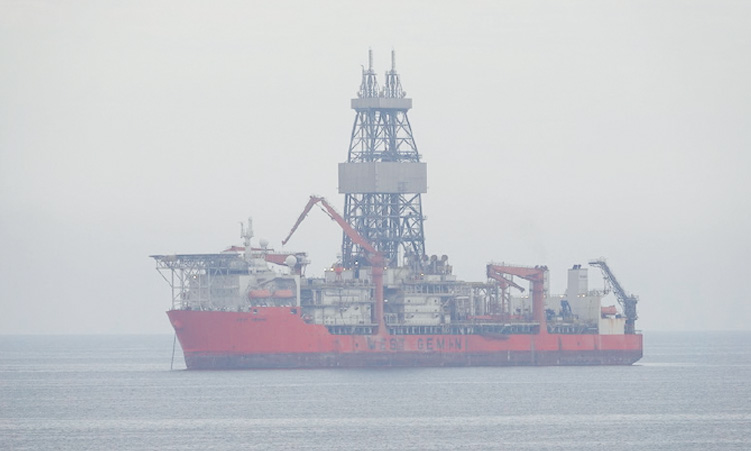
A lack of technical expertise and a legal vacuum in the form of a complete lack of gas-related legislation caused by elite capture of the National Petroleum Corporation of Namibia (Namcor) and the directorate of energy at the Ministry of Industries, Mines and Energy for the past decade are raising fundamental questions over Namibia’s not-too-distant future as a major African oil producer.
Over the past 12 months, off-shore exploration has not only confirmed a proven resource of 21-billion barrels of light sweet crude, but also widespread deposits of high-grade wet condensate gas that could be a complete game-changer for the long-stalled Kudu Gas Field project as the central feature of Namibia’s industrialisation policies.
But even though Kudu is central to Namibia’s Vision2030 and liquid natural gas (LNG) has been a prominent feature of the country’s efforts to meet rising electricity demands since 2015, there exists a legal gap that has not been addressed for 30 years.
When the Petroleum (Exploration & Production) Act 1 of 1991 and its 1992 amendment were promulgated, they repealed but not replaced all pre-independence laws and regulations governing the commercial trade in liquid petroleum gas and all related derivatives.
The expectation was that this would be addressed in a separate law specific to the Kudu gas field in due course.
This legal vacuum has become even more obvious since the introduction of LNG technology, developed by the oil industry as its solution to greenhouse gas (GHG) emissions restrictions imposed by the 2015 Paris climate change agreement.
It is not just the Petroleum Act amendment that is missing in legal action: the tabling of the Namibia energy regulator bill and new gas bill has been repeatedly delayed since 2018 in the political tussle for control of the future of the country’s nascent oil industry.
POWER STRUGGLE
This power struggle was about to come to a head in parliament after speaker Saara Kuugongelwa-Amadhila last year postponed an urgently required amendment to the Petroleum Act to February, in what was widely seen as an effort to frustrate president Netumbo Nandi-Ndaithwah’s efforts to gain full control over an increasingly corruption-prone industry.
Broadly speaking, the power struggle was between the resource-nationalist camp and a more business-minded faction with vested interests in the local shareholding of petroleum exploration licences (PELs) that emerged in the speculative deals of the oil exploration era of 2012-2015.
Those battle lines were largely drawn by former president Hage Geingob when he appointed former (2005-2015) Namcor managing director Obeth Kandjoze as minister of mines and energy, and moved former (2005-2015) petroleum commissioner Imms Mulunga into Kandjoze’s former position, while rising Namcor star Maggy Shino was appointed as petroleum commissioner.
But after Geingob’s death in February 2024, Namcor management descended into shambles as open war broke out between Mulunga and the Namcor chair Jennifer Comalie, whom he allegedly tried to have framed for possession of drugs for trying to get him fired. The case was struck off the court roll in 2023.
In August 2024, Mulunga and his chief financial officer were suspended over unauthorised transactions in Angola, and last July Mulunga was arrested with six other suspects, including two other senior Namcor managers and four businessmen, in connection with a fraudulent R500-million military fuel supply contract. They were all denied bail and remain in custody, pending a trial date later this year.
BATTLE LINES
When in March 2025 incoming Nandi-Ndaitwah, the directorate of energy and Namcor assumed direct control of Namibia’s future upstream oil industry, no one, including senior ministerial officials were very surprised that the battle lines were being drawn.
“What we are seeing now emerging in parliament is a contest of political positions with an eye on the run-up to the 2027 Swapo Congress,” Institute of Public Policy Research executive director Graham Hopwood said
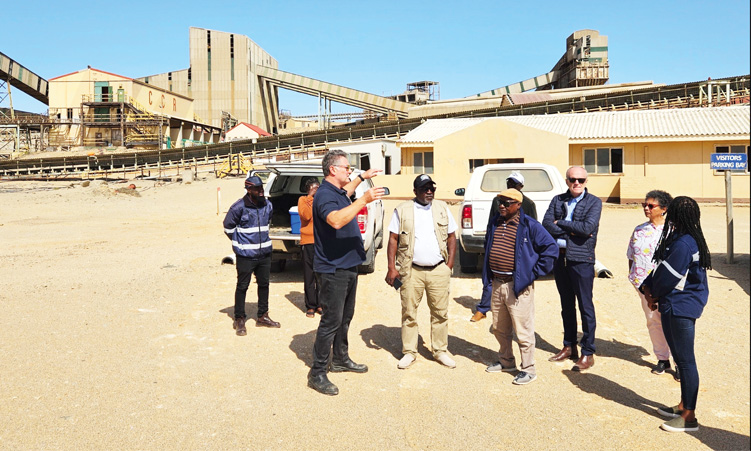
Upon her appointment on 21 March 2025, Namibia’s first woman president in her re-organising of her new slimmed-down Cabinet, nominated noted resource nationalist Natangwe Ithete as her deputy prime minister and minister of the now-renamed Ministry of Industries, Mines and Energy.
She also stripped the former Ministry of Mines and Energy and Namcor of all upstream functions, moving those into a new upstream petroleum unit in the Office of the President.
This was widely criticised by the political opposition as a regressive concentration of power that undermined political transparency and accountability, but seemed justified when in July the Anti-Corruption Commission arrested Mulunga, two senior managers and the owners of three fuel distribution companies for the alleged corrupt mismanagement of a military fuel supply contract.
EXPLORATION RIGHTS
The president also issued an informal moratorium on the issuance or alteration of ownership of oil exploration rights (PELs). When Ithete defied her by extending a lapsed PEL on behalf of a company whose owners were closely associated with her predecessor, Geingob, she immediately fired Ithete from both his Cabinet positions.
Despite the moratorium, international oil companies have been snapping up any available shares in the Orange Basin licences, according to the latest available Namcor data of August 2025.
Over the past few months, the Orange Oil Basin discoveries of 21-billion barrels of oil triggered a scramble for oil exploration rights at the Walvis Bay and Namibe Basin, with exploration set to expand further north up the coast, where ExxonMobil now holds four blocks adjacent to the Angolan maritime border.
Super-majors like Chevron and Qatar Energy, the world’s largest exporter of LNG, now hold shares in at least five prime offshore Namibian oil blocks, but this is not visible from the publicly available data. Read the rest of the story at: https://oxpeckers.org/
*John Grobler is a Namibia-based associate at Oxpeckers Investigative Environmental Journalism.
This is the fourth in a series of #PowerTracker transnational investigations that interrogate the environmental, socio-economic and political impacts that the Orange Basin Corridor oil and gas developments could potentially bring.
In an age of information overload, Sunrise is The Namibian’s morning briefing, delivered at 6h00 from Monday to Friday. It offers a curated rundown of the most important stories from the past 24 hours – occasionally with a light, witty touch. It’s an essential way to stay informed. Subscribe and join our newsletter community.

The Namibian uses AI tools to assist with improved quality, accuracy and efficiency, while maintaining editorial oversight and journalistic integrity.
Stay informed with The Namibian – your source for credible journalism. Get in-depth reporting and opinions for
only N$85 a month. Invest in journalism, invest in democracy –
Subscribe Now!