


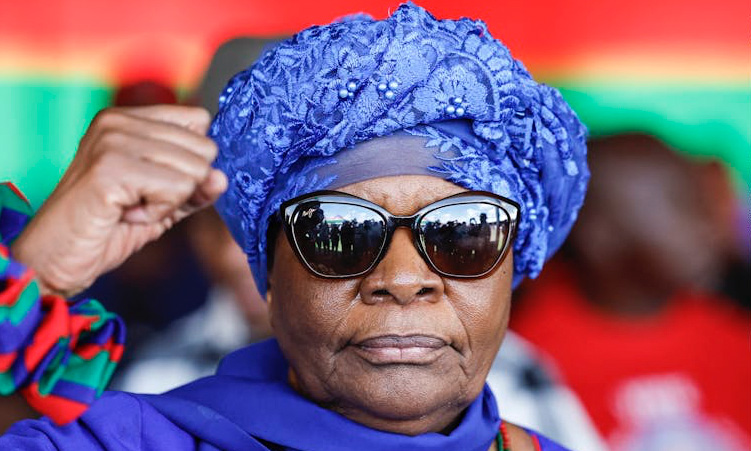
In the days after she was sworn in, president Netumbo Nandi-Ndaitwah slept with a list of ministerial appointments under her pillow and “prayed over it”.
She recounted this at a State House meeting earlier this year when she admitted there was intense debate within Swapo over her eight key appointments.
“Some Swapo members were not happy, but she spoke to them about her decision,” says an official familiar with the president’s decision.
Three months later, Nandi-Ndaitwah held another meeting at State House with her ministers and senior officials and established one rule: No discussion about work.
The gathering, officials say, was meant to give a fatigued Cabinet space to unwind three months into her presidency.
This was where she acknowledged how difficult the process had been for her and the Cabinet, and she therefore just wanted her team to relax and enjoy a meal.
“Today we will just sit and laugh and talk,” she told them.
These softer moments stand in contrast with a presidency increasingly defined by firm control, secrecy and in some cases, raw power.
This comes as the president faces criticism for assembling what has been perceived as an inexperienced leadership team, personalising power, and the emerging influence of a clique of politically connected individuals.
Her administration also continues to face criticism for not supporting the business sector.
The Namibian’s investigative unit spoke to several people with direct knowledge of the president’s first year in office, all of whom spoke on condition of anonymity.
Presidential spokesperson Jonas Mbambo yesterday said he was not aware of any prayers over appointments.
“But speaking generally, there’s nothing unusual about a leader seeking clarity when faced with decisions of national consequence,” he said.
EMPOWERMENT
Nandi-Ndaitwah made history this year by being elected as Namibia’s first woman president.
She reduced the Cabinet from 21 ministries to 14, with 57% of ministers being women.
MEETING DISMISSED
Nandi-Ndaitwah is widely described as stern.
Earlier this year, some Namibia Investment Promotion and Development Board (NIPDB) board members scheduled a meeting with her – allegedly without informing their line minister, Selma Ashipala-Musavyi, beforehand.
The president reportedly did not appreciate the move, viewing it as disrespectful.
“I was not briefed about this meeting,” she allegedly said, before dismissing the meeting.
To some, that is the blueprint of the president.
Last year, as vice president, she refused to preside over a groundbreaking ceremony for the Nkurenkuru Civic Affairs regional office in the Kavango West region.
After delivering her speech, Nandi-Ndaitwah left without taking part in the ceremonial groundbreaking, saying there was no sign of progress at the site.
She said she would return only once construction had genuinely begun.
BAPTISM OF FIRE
The president’s tenure started off with calls to fire the newly appointed health minister after several medical doctors accused Esperance Luvindao of professional misconduct, alleging that she maintained questionable medical records of operations that never took place.
The doctors wrote to the president requesting an investigation shortly after the appointment.
Nandi-Ndaitwah opted not to fire her health minister, saying there was no evidence to support the claims.
A few months later, allegations emerged that agriculture minister Mac Hengari was facing a rape case.
According to a source close to the matter, the president was unhappy by what she believed was misleading information provided to her at the time of his appointment.
Hengari’s dismissal came a few days after the president was briefed by police inspector general Joseph Shikongo, who reportedly described the matter as “too big to ignore” during a visit to State House.
SAME PATTERN
Institute for Public Policy Research (IPPR) associate Frederico Links says Nandi-Ndaitwah’s leadership is a repetition of what former presidents, including Hage Geingob and Hifikepunye Pohamba have done in the past.
“There is a strong message on good governance, tackling corruption, and promoting ethics and integrity – all of which come out early,” he says.
Links says there is little that distinguishes the current administration from previous ones.
“All of them made early moves to reorganise the executive, shifting around positions and individuals,” he says.
“I am not seeing anything out of the ordinary.”
Swapo Party Youth League (SPYL) secretary Ephraim Nekongo describes the president as decisive and principled.
“Her leadership reflects a readiness to make tough calls when the country’s interests demand it,” he says.
Nekongo describes Nandi-Ndaitwah as an inclusive and consultative leader engaging across sectors, seeking input from diverse stakeholders, and emphasising unity to advance national goals.
National Assembly official opposition leader Imms Nashinge says the first year of the current administration has been marked by strong announcements but weak delivery.
He says the reduction of the Cabinet was a positive step long advocated by the Independent Patriots for Change (IPC), but warns that structural changes mean little without efficiency and results across the government.
Nashinge criticises the rollout of free tertiary education, saying the policy was poorly implemented after funding and admission requirements were announced only after pupils had written their final examinations, creating uncertainty and exclusion.
He says conditions at public health facilities have worsened.
“Medicine shortages persist, patients leave without medication, and healthcare workers are forced to operate under crisis conditions.”
Nashinge says the administration has yet to present a clear plan to tackle unemployment, particularly among the youth, while small businesses remain under pressure.
THE POWERS THAT BE
On 23 October, the Namibia Public-Private Forum opened in Windhoek, bringing together about 200 business leaders to discuss industrialisation and mining.
The president attended without several key ministers, who were instead in the parliament – which senior officials say annoyed her.
Natangwe Ithete, then deputy prime minister and minister of industries, mines and energy, did not attend the second day of that forum.
He was at Rundu overseeing the handover of classrooms and water tanks at rural schools in the Kavango West region.
While still there, Ithete was summoned that weekend to get back to Windhoek as soon as possible.
He went to State House upon his return to the capital.
There, the president told the minister that she viewed his conduct as insubordination and that she was doing it with a “heavy heart”.
Ithete, sources claim, asked the president: “Is this why you fired me?”
The president then appointed herself as mines and energy minister, prompting concerns about not trusting her team.
Ithete has not publicly set out his account of the events leading to his removal, and the absence of a detailed official explanation has fuelled speculation.
Some officials and political figures have suggested that members of the president’s inner circle may have influenced the decision after he resisted a proposed business transaction, a claim that could not be independently verified.
Not everyone has been comfortable with Nandi-Ndaitwah’s reliance on a small circle of advisers.
Since taking office, she has made more than 100 appointments across the government.
Some senior figures in government say many of these decisions were taken without broader consultation.
Several officials claim only a handful of individuals close to the president are aware of appointments before they are announced, leaving others to learn of key decisions through official notices or media reports.
Similar concerns have been raised about the handling of high-profile changes within Cabinet, including the dismissal of former agriculture minister Mac Hengari and the subsequent appointments of his successor, Inge Zaamwani-Kamwi, and the new minister of mines.
THE POWER CIRCLE
Before becoming head of state, Nandi-Ndaitwah observed power largely from the sidelines.
That experience, officials say, has shaped her own reliance on a small circle of trusted lieutenants.
Among them is the minister of international relations and trade, Selma Ashipala-Musavyi, with whom Nandi-Ndaitwah worked closely when she previously headed the foreign affairs portfolio.
Ashipala-Musavyi did not respond to questions sent to her this week.
Another key confidante is the director general of the National Planning Commission, Kaire Mbuende, who has also served alongside her at the international relations ministry.
Sources say he is the key figure behind most of Nandi-Ndaitwah’s appointments, including those of the health and infrastructure development task forces.
Sources say health minister Luvindao was initially not informed nor given the chance to decide on health task force appointments.
Mbuende told The Namibian this week that his role is cross-cutting.
“Also, constitutionally being the principal adviser to the president in economic and social development you get involved with whatever is happening in the government, because everything is related,” he said.
Mbuende has worked with Nandi-Ndaitwah for 50 years.
He said he understands her and believes she trusts her ministers.
Another influential figure is Mathew Hamutenya, an oil sector businessman who, according to senior officials, is regarded as having close access to the president.
When approached for comment, Hamutenya hinted about possible conflicts and asked questions to be sent to him to avoid being misquoted.
He, however, chose not to comment when questions were sent to him.
“I have no knowledge of what you are talking about. Thank you very much,” he said.
Officials say the president holds the minister of home affairs, immigration, safety and security, Lucia Iipumbu, in high regard.
Another key Swapo businessman who has become influential in the president’s administration is Joseph Andreas, who is largely aligned with Swapo secretary general Sophia Shaningwa.
The president appointed Andreas as a commissioner of the National Planning Commission.
Namibian investigative website The Issue earlier this year reported that Andreas’ comrades claim he appears to have the power to overrule some of the party’s national structures, like its think tank and finance department.
At government level, senior government officials told The Issue that Andreas is referred to as “Elon Musk” by a number of executive directors and parastatal bosses.
Andreas this week said the president does not appoint people merely because of referrals.
“She won’t appoint you just because, for example, your father was a military general or close family member. Even if people complain, she will appoint a person based on merit,” he said.
He said Nandi-Ndaitwah wants the country to move forward.
“There is no one safe from the president, not even herself. She makes decisions not based on her personal interests but based on what’s correct,” he said.
HITS AND MISSES
Nandi-Ndaitwah’s administration has moved to align government programmes with Swapo’s 2025–2030 manifesto through the sixth National Development Plan.
Measures include free public tertiary education from 2026, youth and small and medium enterprises (SME) loan schemes worth about N$250 million, the visa on arrival, and steps towards reviving the national airline.
However, several targets set for December this year remain unmet, including the delivery of 10 000 houses, progress on economic diversification, and the construction or upgrading of sport stadiums to host international football matches.
Presidential spokesperson Mbambo says the president values good working relationships, open communication and the well-being of those entrusted with public responsibility.
On whether she consults before making decisions, he says public opinion varies.
“Whether those views are always accurate is another matter . . . Consultation is important, but so is decisiveness,” he says.
Looking ahead, Mbambo says the administration is focused on implementation.
“The groundwork has been laid, but there is still a lot to do. The focus now is turning plans into results that people can feel.”
Nekongo says the administration has shown tangible progress in several manifesto-aligned areas.
“We have seen movement in social development programmes, infrastructure planning, and governance reforms,” he says.
He also highlighted challenges.
“Bureaucratic bottlenecks and resistance to change by some senior administrators are slowing progress. There is a need for tighter project management, clear timelines, robust monitoring, and alignment of resources with manifesto priorities.”
Nekongo also calls for stronger accountability.
Analyst Herbert Jauch says Nandi-Ndaitwah’s leadership is hands-on.
She engages directly in many issues and relies on a tight-knit group of Cabinet members.
“She reduced the number of ministries and consolidated tasks,” he says, “lowering costs and increasing ministerial power.”
Jauch says the president seems driven to deliver on promises.
“She relies less on structures and more on direct action.”
In an age of information overload, Sunrise is The Namibian’s morning briefing, delivered at 6h00 from Monday to Friday. It offers a curated rundown of the most important stories from the past 24 hours – occasionally with a light, witty touch. It’s an essential way to stay informed. Subscribe and join our newsletter community.

The Namibian uses AI tools to assist with improved quality, accuracy and efficiency, while maintaining editorial oversight and journalistic integrity.
Stay informed with The Namibian – your source for credible journalism. Get in-depth reporting and opinions for
only N$85 a month. Invest in journalism, invest in democracy –
Subscribe Now!