HARARE – Michael Tichafa is a commuter omnibus driver. He charges a fare of 50 US cents per passenger on his city-suburban route, but on many occasions, passengers have overwhelmed him demanding change after giving him higher denominations.
• TICHAONA CHIFAMBA
On previous occasions, he would pair some passengers and give them higher denominations which they had to split after disembarking from his kombi.
Zimbabwe, without a currency of its own and using predominantly the US dollar as its unit of exchange, has been grappling with change problems as small denomination coins are hardly available. Generally, any change below a dollar is given in South African rand, even though arguments may erupt over the exchange rates.
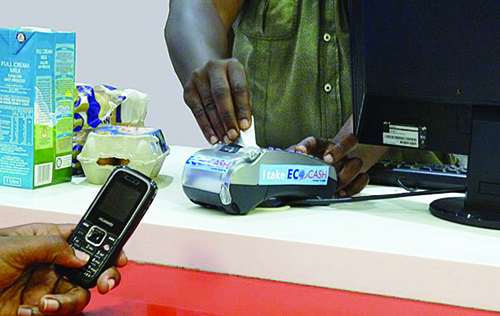
But with the coming in of mobile banking, thanks to innovations by mobile phone companies and a building society, the problem of change has eased while the mobile phone handset has greatly empowered ordinary people by not only being a communication device, but also a tool that has given them access to banking.
Mobile phone service providers Econet Wireless, NetOne and Telecel, together with building society CABS, have come up with facilities that have enabled people in even remote areas to take care of their financial matters in the comfort of their homes.
Tichafa uses Econet’s Ecocash and says the service has brought a lot of convenience to his business.
“In the past I used to worry over change because very few people came with the exact fares. But now, many of them are on Ecocash and they can transfer the fare from their phones to mine at no cost to them and to me,” he said.
He added that as a result of the facility, he no longer carried huge sums of cash with him and no longer worried about being robbed.
So popular has EcoCash been that the conventional banks, through the Bankers Association of Zimbabwe, have cried foul over its introduction and want monetary authorities to regulate it.
Econet Wireless chief executive officer Douglas Mboweni said recently that the company wanted to speed up innovations aimed at creating new sources of revenue growth as voice revenues were maturing.
“We have been aware of this for a long time and we are addressing it by investing in and developing new sources of revenue. Whilst this takes time, we are now seeing very encouraging signs that our strategy is beginning to bear fruit,” Mboweni said while presenting the 2013 financial results recently.
Revenue for the period grew by 11 percent compared to the same period the previous year to US$376,6 million.
Ecocash, which started in September 2011, now has three million subscribers and has helped those in South Africa to send money to their relatives and friends back home. For six months up to August 2013, EcoCash had processed transactions to the tune of US$1,2 billion.
Econet also announced that integration with most of the country’ s banks was progressing well, and account holders with international banks would be able to transact their businesses from anywhere in the world.
Econet has even gone a step further in charting into the territory of conventional bankers by introducing the EcoCashSave, a banking facility that is supported by Econet’s subsidiary Steward Bank and which, just like ordinary banks, offers savings, investment deposit and loan accounts.
Account holders can deposit or withdraw within a maximum of US$20 000, and all this is done via the mobile phone. Subscribers can also apply for emergency loans.
Econet had also launched a payroll which allows subscribers to receive their salaries via their phones.
This, according to the company, enhances security for both businesses and staff as hard cash will no longer move from one place to another.
Armed robbers have in the past targeted cash-in-transit vehicles and robbed the occupants, the latest being the one that took place in Nyanga where they posed as the police and robbed a security van of US$125 000 and left the guards stranded.
Building society CABS has also launched its banking and money transfer service ‘Textacash’ to provide service to both banked and unbanked Zimbabweans.
The building society’s account holders can link their CABS card to their cell phones, which allows them to conduct banking transactions such as checking their account balance, viewing a mini-statement or transferring cash between accounts.
Non-CABS customers, upon registering, are issued with Textacash bank cards that are linked to their phones.
The bank card requires no minimum balance and has no monthly service charge. It works like an ordinary bank card and can be used at any swipe machine to make purchases and receive cash back, removing the need to carry large amounts of cash, and resolving the issue of supermarket credit notes.
Textacash benefits unbanked Zimbabweans who are now able to receive money without having a bank account.
Customers can now pay utility and phone bills and make health insurance and satellite television subscriptions through Textacash.
The second biggest mobile phone operator in the country, Telecel, will soon launch TeleCash, which will operate on the same lines with EcoCash, while the smallest network operator, NetOne, has its One Wallet package.
About 80% of Zimbabwe’s population is unbanked, providing the way for phone subscribers to opt for mobile banking where stringent conditions such as provision of payslips, proof of income and proof of residence are required.
In an age of information overload, Sunrise is The Namibian’s morning briefing, delivered at 6h00 from Monday to Friday. It offers a curated rundown of the most important stories from the past 24 hours – occasionally with a light, witty touch. It’s an essential way to stay informed. Subscribe and join our newsletter community.

The Namibian uses AI tools to assist with improved quality, accuracy and efficiency, while maintaining editorial oversight and journalistic integrity.
Stay informed with The Namibian – your source for credible journalism. Get in-depth reporting and opinions for
only N$85 a month. Invest in journalism, invest in democracy –
Subscribe Now!