







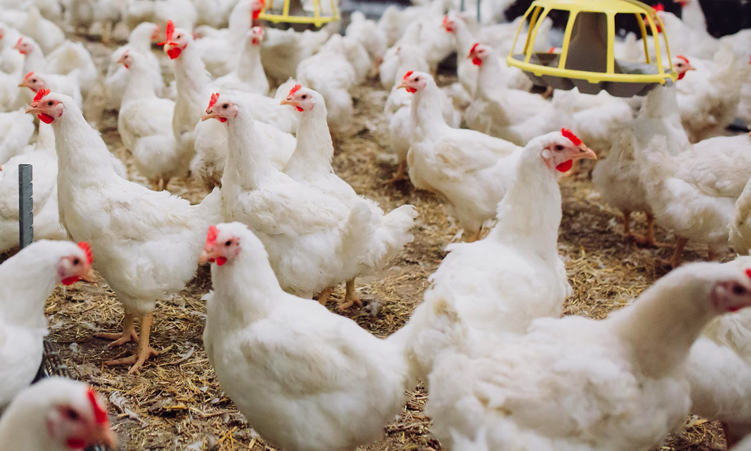
Industrial chicken farming is accelerating the spread of the world’s most common bacterial cause of diarrhoea, scientists have found.
The study found a dramatic increase in the exchange of campylobacter strains between wild birds and chickens as farming has intensified, creating ideal conditions for the bacteria to mix, spread and acquire new traits.
There has also been a rise in antimicrobial resistance traits in circulating strains, raising concerns that serious illness in people will be more difficult to treat.
“As the chicken population has exploded, they’ve increasingly picked up strains from different wild birds and become a cauldron of bacterial evolution,” says Sam Sheppard of the University of Oxford and senior author of the paper.
“Lots of strains come together and hybridise. We do not want that, because that’s where new Frankenstein monster bugs emerge.”
Campylobacter is the most common bacterial cause of diarrhoea worldwide. An estimated 60 to 80% of campylobacter infections are caught from raw chicken.
“Cooking kills pathogens, but just a tiny splash and it’s on your lettuce leaves or your hands or your knife,” says Sheppard.
Most people will get better without treatment, but sometimes antibiotics are required and infection also raises the risk of irritable bowel syndrome.
Rising rates of antimicrobial resistance, which occurs when bacteria resist drugs designed to kill them, mean that some antibiotics that were previously used to treat campylobacter infections are no longer effective.
The latest work suggests that the evolution of the infection is being fuelled by the unprecedented scale of chicken production.
Since the 1960s, global chicken numbers have increased seven-fold to approximately 27 billion birds, accounting for about 70% of all bird biomass on earth.
Intensive breeding has led to ‘super growing’ chickens that reach adult size and are slaughtered at around five weeks old.
The industrialisation of chicken farming has led to affordable animal protein at scale, but also presents new health risks.
The latest work, published in the journal Proceedings of the National Academy of Sciences, analysed nearly 2 800 bacterial genomes collected from chickens and wild birds in 30 countries, including the United Kingdom, United States and China, between 1979 and 2024.