



TWO people charged with cultivating and dealing in cannabis in two separate cases at Swakopmund and Henties Bay were granted bail last Friday.
Their cases are of particular interest because they involve growing cannabis for the production of cannabis oil, which they claim is solely for medical reasons and to save their own, or their partners’ lives, and not for sale.
The police raided the Swakopmund home of Cheryl Green (57) over a week ago after a tip-off that she was growing cannabis in her courtyard.
They discovered 71 cannabis plants with a street value of about N$21 000, as well as cannabis seed and oil.
Green made her first appearance in the Swakopmund Magistrate’s Court last Monday, but was denied bail because the state argued that she was facing a serious offence, and it was not in the interest of justice because the value of the cannabis involved was high.
This caused an outcry over social media and even among legal circles, with people arguing that what she was doing should not be illegal.
Last Friday, however, the court granted Green N$5 000 bail.
While Green was in custody, Henties Bay resident Thillo Tietz (38) was also arrested for growing four cannabis plants at his home – also with the intent to produce oil.
Tietz also appeared in the Swakopmund Magistrate’s Court last Friday, and was granted N$3 000 bail.
Both are expected back in the same court within the next two weeks. Green has secured legal representation, while Tietz indicated that he would defend himself.
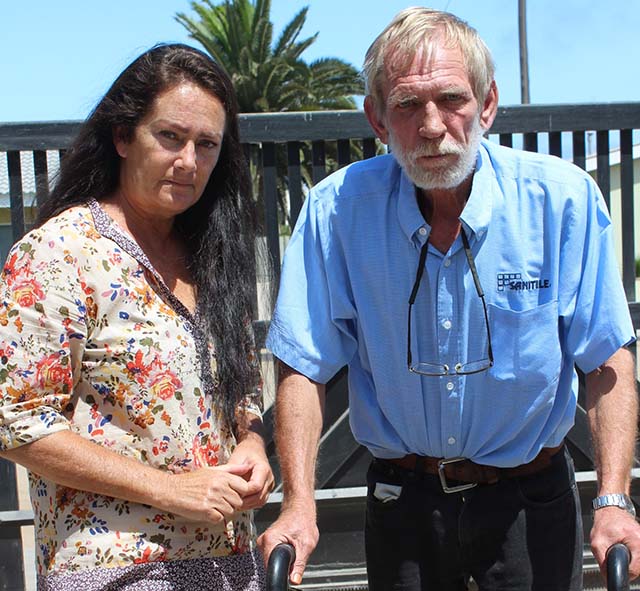
Green told at her home, which she shares with her partner, Reiner Kring (60), that: “I am a healer, and not a dealer.”
Kring has been suffering from a debilitating and painful condition called amyotrophic lateral sclerosis (ALS), which is a progressive neuro degenerative disease that affects nerve cells in the brain and the spinal cord, for the past decade.
He has no balance, and needs a walking frame to move around. Kring also suffers from much pain in his body and head. He had to stop working, and even his favourite pastime, which is carpentry, is something of the past.
Regular medication and operations did not help. The pain also robs him of his sleep.
“It’s miserable, and I was just messed up with all the medicines,” he explained.
Green, who is a herbalist, said she heard a lot of good things about cannabis oil, and began to do a lot of research, especially in light of Kring’s condition.
“I have piles and piles of documents, and all show cannabis oil helps,” she said, and this is why she is growing cannabis to make oil, with which she started treating Kring about three months ago – just a few drops a day after dinner.
According to Kring, the results were nearly instant as he was able to relax, and much of the pain was gone.
“I could get out of my bed, and walk better. There were even times I could try walking without the walker,” he said. “There is nothing high about it.”
Green said her purpose is to save her partner, and that she would do anything to do so.
“My concern for his survival overrides every other concern. I am trying to save a life. Why is saving a life a criminal offence?” she asked, adding that Kring’s quality of life improved dramatically, but since her arrest and since the plants were confiscated, his condition had deteriorated.
She said, cannabis oil should be legalised for medicinal purposes.
“Of course, it must be highly regulated,” she agreed.
Tietz told this newspaper at his mechanical motor shop at Henties Bay yesterday that he has epilepsy, and has been suffering bad fits at least once a month since he was seven.
“I started using the oil seven years ago, and have since had only two serious fits. To get an attack is not a pleasant thing. It is scary, and one lives in fear, not knowing when the next attack would happen. And if it happens, will there be help? People who do not have epilepsy don’t understand. I’ll do anything to help myself have some control of my condition, and this oil has helped,” explained the married father of two small children.
He said he did a lot of research, and learned that there were many illegal suppliers in Namibia. But they could not be trusted because they were making the oil with dangerous ingredients, such as thinners. That is why he wanted to try and produce it himself. He never has done so before, and this would have been a trial run, but he had to see.
Human rights lawyer Norman Tjombe said in Namibia, the possession of cannabis of any quantity is illegal. As a result of that, even growing cannabis – whether it is for possession or dealing – is illegal.