





Lately, I have been reading a lot about the history of our people and their food. Much has been written about our past, but very few people would read the material these days, unless they have to, I suppose.
Reading history can be difficult. Much of it is written in languages us Namibians cannot read. The material, especially the older stuff, is difficult to get hold of as it is scattered all over the globe. Many key documents have not been digitised and are available only in international depositories.
The arrival of the internet has made matters much better, but it remains a challenge even for those with internet access. But ultimately even if all of the physical constraints are added together, they would not match the biggest hindrance of all: The lack of interest.
For many the past is just not that interesting, unless of course we can manipulate it for our benefit.
One thing that stuck with me as I went through the literature, is how much things have changed. What our people had then, and what they have now. How different our food then was from what it is now.
Archaeological evidence from the Gemsbok archaeological site at the Orange River mouth provides evidence of human activity along the Namibian coast dating back 800 000 years. Archaeological remains from a site further north, the Namib IV site just south of the Kuiseb River, have been dated to between 400 000 and 700 000 years ago. Here they found the scull of an extinct elephant which may have been hunted.
Early coastal inhabitants were hunter-gatherers who survived by consuming the meat of the small animals they hunted, as well as various types of veldfood such as the now famous !Nara melon. They lived close to wherever they could find water.
Much more recently – only about about 2 000 years ago – those in close proximity of the coast started harvesting bi-valve molluscs such as mussels and clams. The remains of seals and marine birds add further evidence that access to the coast facilitated a much more varied diet.
Inland the early inhabitants lived off hunting and gathering. Their diets consisted of meats and wild fruits, nuts, bulbs and tubers and leafy vegetables.
Bantu people migrating from central Africa brought livestock with them, causing some Khoisan people – particularly the Khoekhoe (or Nama people) – to convert to pastoralism as their main mode of production. This happened between 1 000 and 2 000 years ago.
Early pastoralists remained nomadic in their quest to find food and water for their animals and for themselves. By the time European missionaries arrived the Khoekhoe owned “great herds of large-boned, long-horned cattle and flocks of fat-tailed hairy sheep”, according to Brigitte Lau’s thesis ‘The Emergence of Kommando Politics in Namaland, Southern Namibia 1800-1870’.
They may have been considered ‘rich’ due to their large livestock numbers. Reverend Barnabas Shaw observed in 1820: “Some of them may properly be called rich, as they possess immense numbers of horned cattle, besides goats and sheep. We were frequently surprised at the return of their cows and oxen from the fields: Clouds of dust, seen floating in the air on every side of the village.”
They kept hunting using assegais and the occasional musket. The missionary brothers Albrechts in 1808 described hunting with about 80 Bondelswarts men as follows: “The men were separated into two divisions and so far from each other that one division could hardly see the other. The individuals themselves were about a stone’s throw from each other and placed in the form of a crescent. At a given sign, they ran towards a point in such a manner that they surrounded the game in a circle.”
The Nama living in southern Namibia at the time did not practise much agriculture except cultivate a little tobacco and dagga.
War with Orlam groups and later on the German colonial authority destroyed much of the Namas’ original wealth as they lost control over water, pasture and probably thousands of heads of cattle. After the rebellion against the Germans the tribes were not allowed to keep ‘great stock’, that is, cattle, and only a limited number of sheep and goats, so that the old pastoral life fell more and more into decay. The once wealthy Nama became destitute.
It is doubtful that much of the food culture dating back to these early times still exists in our communities. Maybe there is enough for us to reverse engineer and revive them. Like the practice of stewing meat in milk. Or the addition of wild plants to make sour milk and yogurt-like substances which could be used for cooking and baking. Does anyone still have a traditional recipe for the making of honey-beer?
Historical sources also provide important insight about the use of plants in our culinary past. One such source, ‘Plant uses by the Topaar of the Kuiseb Valley Namib Desert, Afrika Focus’ by Van Damme, Van Den Eden, and Vernemmen (1922), lists 50 plants once known and used by the Topnaar community of the Kuiseb Delta as food, food additives, medicine or for cosmetics.
Of these, possibly only the !Nara with its ‘botterpitte’ is still utilised extensively. It is uncertain what the fate of the remaining plants is.
This is not an extensive survey of what is available to modern cooks looking to the past for inspiration. But I hope it brings across the point that unless we start caring about the past, it will disappear, and we’ll have no reference about an important element of our cultures, the food.
In fact, for some it may already be too late.
Bon Appetite!
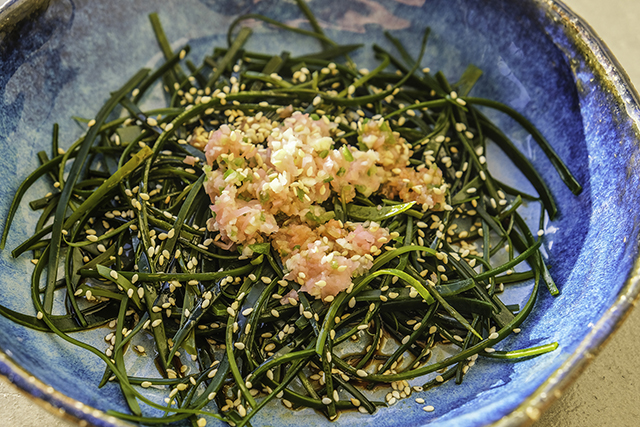
Kelp Salad
Ingredients:
• 200 grams fresh kelp or soaked dried kelp
• 2 tablespoons soy sauce
• 1 tablespoon rice wine vinegar
• 1-2 fresh chillies, cut into small pieces
• 2 teaspoons pickled ginger, finely chopped
• 1⁄4 teaspoon salt

