


•WILL DUNHAMIf there were a gold medal for cetacean diving, it undoubtedly would go to the Cuvier’s beaked whale. Scientists said on Wednesday they tracked these medium-sized whales off the coast of California using satellite-linked tags as the creatures dove down nearly 2 992 metres and spent two hours and 17 minutes underwater before resurfacing.
Those are breathtaking accomplishments for an air-breathing creature. In fact, those figures represent both the deepest and the longest dives ever documented for any marine mammal, said Greg Schorr of the Cascadia Research Collective in Olympia, Washington, who led the study published in the journal PLOS One.
“Many creatures live at the depths these whales dive to, including their likely primary prey of squid and fish. However, there is a major difference between these whales and the other creatures living deep in the ocean – the fundamental requirement to breathe air at the surface,” Schorr said.
“Taking a breath at the surface and holding it while diving to pressures over 250 times that at the surface is an astounding feat,” Schorr added.
By way of comparison, the record for a person holding his breath underwater is 22 minutes, according to the Guinness Book of World Records. A person, of course, would never survive the bone-crushing water pressure at those stupendous depths.
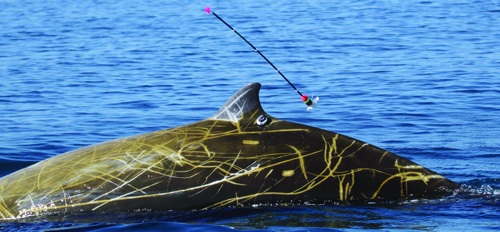
Cuvier’s beaked whales are widely distributed in many deep-water regions from the tropics to cool temperate waters, though not in polar regions. They measure up to about seven metres long, with stout bodies shaped a bit like a torpedo. Their foreheads slope into a short beak with a slightly upturned mouth – leaving them with a vaguely ‘smiling’ appearance.
Their colour ranges from grey to a reddish-brown to a pale white. Some are marked with linear white scars caused by males raking other males with their teeth, perhaps while competing for females. They feed primarily on deep-water squid and some fish near the ocean floor.
“This species is highly adapted to deep diving, spending less than two minutes at the surface between dives,” Schorr said. “These are social, warm-blooded mammals that have adapted to actively pursue their prey at astounding depths – all while up to 2 897 metres away from their most basic physiological need: air.”
To track the Cuvier’s beaked whales, the scientists used satellite-linked tags that provided data on the start and end times of a dive and the maximum depth of each dive, as well as the time between dives. The tags were attached to the dorsal fin using two small titanium darts.
The scientists tracked eight whales off the coast of Southern California, amassing more than 3 700 hours of diving data.
– Nampa-Reuters
In an age of information overload, Sunrise is The Namibian’s morning briefing, delivered at 6h00 from Monday to Friday. It offers a curated rundown of the most important stories from the past 24 hours – occasionally with a light, witty touch. It’s an essential way to stay informed. Subscribe and join our newsletter community.

The Namibian uses AI tools to assist with improved quality, accuracy and efficiency, while maintaining editorial oversight and journalistic integrity.
Stay informed with The Namibian – your source for credible journalism. Get in-depth reporting and opinions for
only N$85 a month. Invest in journalism, invest in democracy –
Subscribe Now!