Some baby girls are named after queens. They’re named after the mother of King Mandume ya Ndemufayo, the late great king of the Oukwanyama. So even when they become young ladies, deep within the walls of Swapo refugee camps in Zambia, Angola and Congo, they remember their rich heritage and rise.
Rise beyond the struggle, rise beyond borrowed childhood stories of fair-skinned damsels in distress and grow up to write about Namibian princesses. Strong and proud, dark and clever, real and resourceful.
Ndaponah Shikangalah has always been fascinated by Africa’s rich history.
She’s wanted to talk about it on screen and speak about it in the streets so she went to study film in Berlin and London before finding her first creative calling as an author of children’s books.
As the author and self-publisher of ‘The Namibian Princess Adventures’ published by Queen Ndaponah Publishing House, Shikangalah has recently harnessed her creative spirit to pen an original African tale featuring African characters for the African girl child.
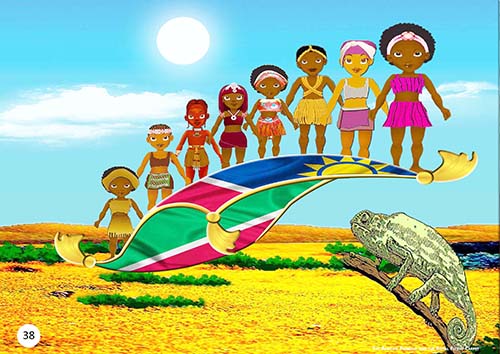
Telling the sweet story of young Princess Ndaponah, the Oshiwambo guardian and rider of the Royal Flying Carpet, ‘The Namibian Princess Adventures’ is a glossy picture book that both educates and entertains with tales of princesses from all the tribes of Namibia who join Ndaponah on her mission to visit all the famed corners of the country.
With Damara, Herero, Batswana, San, Oshiwambo and many more royals joining Princess Ndaponah on her journey to the Finger of God, the Organ Pipes, the Quiver Tree Forest, the Zambezi, Etosha, the Skeleton Coast, Fire Mountain and the Damara Living Museum, the book offers intriguing information about each tribe’s attire, special skills and enduring myths in a simple treatment that is all the more magical because it is true.
Boasting only female lead characters who wear their ondelela, musisi, otjikaiva and animal skins with pride, the book introduces young readers to stories like the making of the Otjikoto Lake and Africa’s oral tradition within a simple adventure story that aims to foster national pride and curiousity in the young African girl child.
Having struggled to find something as simple as a black doll for her niece, Shikangalah believes that, in the current climate of sugar daddies and Brazilian hair, it is important to cultivate an inspiring national identity through the recollection of our natural resources, myths and heritage.
“I am very passionate about the education and empowerment of the girl child,” says Shikangalah.
“I see how our young girls conduct themselves today, thinking men should provide cash, credit, Brazilian hair and basically everything for them and I want to help educate these girls while they are still very young and show them that they are enough. Their traditional clothes are beautiful, their hair is beautiful, their herstory is beautiful.”
Wanting to gift the contemporary Namibian youth a book she wishes she had access to as a child, Shikangalah conceived ‘The Namibian Princess Adventures’ in 2008. The book was finally self-published in March 2015 after Shikangalah researched, wrote and assisted with design before seeking out printing sponsors like the Environmental Investment Fund and Uukumwe Youth Empowerment Consortium.
Since publication, Shikangalah, in her role as publisher, has been entirely responsible for the book’s sale and promotion.
“Doing my own marketing and selling is no joke! I am solely responsible for convincing people that my book is worth them parting with their hard earned money,” says Shikangalah.
“The pros of self-publishing are that one makes more money from the sale of books and one has more control over where, when and how their work is sold and marketed. The cons are having to sell and market the book yourself. Before you sell, you might have little or no budget for marketing. One has to think outside the box. I take my box outside – I literally attend parties and pitch up at offices with my box of books!”
Despite the challenge of getting people to purchase her book, to Shikangalah, the publication of ‘The Namibian Princess Adventures’ is a dream come true.
“It was always my wish to write books about people from our very own continent – who wear our traditional outfits and whose adventures take place on home soil. Books I would want to read to my own children,” says Shikangalah.
“I believe that pride in our own cultures, legends and heroes is important. That pride should be ingrained in us from the time we are very young. It would break my heart if my nieces aspired to be Cinderella or Ariel. Why not Princess Tjawongeka or Princess Isakhoes? Why not know the legend of how the Etosha salt pans came to be?”
As for Shikangalah’s princesses, they are no dainty or dithering damsels.
Instead they are presented as smart, brave and adventurous individuals who enjoy an admirable sense of sisterhood while being deeply involved in their communities and well versed in their local folklore.
“Essentially, I wrote the book I wish I had available to me as a child,” says Shikangalah. “I feel it’s important that our children’s imaginations be fed and this be done while also educating them about themselves – their history, traditions, culture and country. I also wanted to educate those abroad on our African stories and realities.”
As a result of this endeavour, Namibian children can now read of Princess Ndaponah and her many friends flying all over the country on a carpet reminiscent of the Namibian flag.
“All the places, names and parks in the book are real,” says Shikangalah.
“During the research phase of the book, I finally saw what my family died for in the liberation struggle and I understand and appreciate them more now than ever before. They were fighting for this great land. I wanted to share as much of Namibia’s wonders as possible with our younger generations – for them to feel pride in being a Namibian and pride in our country as a whole.”
Ending with a quiz and a glossary to test the young reader’s knowledge once they’ve adventured along with the princesses, the book is truly a tool for education that begs for parent and teacher participation.
Once finished with the book, Shikangalah hopes that she will have sparked curiousity and anticipation about any tribes she did not cover and questions will buzz around young brains in the guise of: What do they wear? What do they do? What are their names and traditions?
Some baby girls are named after queens. They’re named after the mother of King Mandume ya Ndemufayo, the late great king of the Oukwanyama. So even when they become young ladies, deep within the walls of Swapo refugee camps in Zambia, Angola and Congo, they remember their rich heritage and rise.
Rise beyond the struggle, rise beyond borrowed childhood stories of fair-skinned damsels in distress and grow up to write about Namibian princesses. Strong and proud, dark and clever, real and resourceful.
Ndaponah Shikangalah has always been fascinated by Africa’s rich history.
She’s wanted to talk about it on screen and speak about it in the streets so she went to study film in Berlin and London before finding her first creative calling as an author of children’s books.
As the author and self-publisher of ‘The Namibian Princess Adventures’ published by Queen Ndaponah Publishing House, Shikangalah has recently harnessed her creative spirit to pen an original African tale featuring African characters for the African girl child.
Telling the sweet story of young Princess Ndaponah, the Oshiwambo guardian and rider of the Royal Flying Carpet, ‘The Namibian Princess Adventures’ is a glossy picture book that both educates and entertains with tales of princesses from all the tribes of Namibia who join Ndaponah on her mission to visit all the famed corners of the country.
With Damara, Herero, Batswana, San, Oshiwambo and many more royals joining Princess Ndaponah on her journey to the Finger of God, the Organ Pipes, the Quiver Tree Forest, the Zambezi, Etosha, the Skeleton Coast, Fire Mountain and the Damara Living Museum, the book offers intriguing information about each tribe’s attire, special skills and enduring myths in a simple treatment that is all the more magical because it is true.
Boasting only female lead characters who wear their ondelela, musisi, otjikaiva and animal skins with pride, the book introduces young readers to stories like the making of the Otjikoto Lake and Africa’s oral tradition within a simple adventure story that aims to foster national pride and curiousity in the young African girl child.
Having struggled to find something as simple as a black doll for her niece, Shikangalah believes that, in the current climate of sugar daddies and Brazilian hair, it is important to cultivate an inspiring national identity through the recollection of our natural resources, myths and heritage.
“I am very passionate about the education and empowerment of the girl child,” says Shikangalah.
“I see how our young girls conduct themselves today, thinking men should provide cash, credit, Brazilian hair and basically everything for them and I want to help educate these girls while they are still very young and show them that they are enough. Their traditional clothes are beautiful, their hair is beautiful, their herstory is beautiful.”
Wanting to gift the contemporary Namibian youth a book she wishes she had access to as a child, Shikangalah conceived ‘The Namibian Princess Adventures’ in 2008. The book was finally self-published in March 2015 after Shikangalah researched, wrote and assisted with design before seeking out printing sponsors like the Environmental Investment Fund and Uukumwe Youth Empowerment Consortium.
Since publication, Shikangalah, in her role as publisher, has been entirely responsible for the book’s sale and promotion.
“Doing my own marketing and selling is no joke! I am solely responsible for convincing people that my book is worth them parting with their hard earned money,” says Shikangalah.
“The pros of self-publishing are that one makes more money from the sale of books and one has more control over where, when and how their work is sold and marketed. The cons are having to sell and market the book yourself. Before you sell, you might have little or no budget for marketing. One has to think outside the box. I take my box outside – I literally attend parties and pitch up at offices with my box of books!”
Despite the challenge of getting people to purchase her book, to Shikangalah, the publication of ‘The Namibian Princess Adventures’ is a dream come true.
“It was always my wish to write books about people from our very own continent – who wear our traditional outfits and whose adventures take place on home soil. Books I would want to read to my own children,” says Shikangalah.
“I believe that pride in our own cultures, legends and heroes is important. That pride should be ingrained in us from the time we are very young. It would break my heart if my nieces aspired to be Cinderella or Ariel. Why not Princess Tjawongeka or Princess Isakhoes? Why not know the legend of how the Etosha salt pans came to be?”
As for Shikangalah’s princesses, they are no dainty or dithering damsels.
Instead they are presented as smart, brave and adventurous individuals who enjoy an admirable sense of sisterhood while being deeply involved in their communities and well versed in their local folklore.
“Essentially, I wrote the book I wish I had available to me as a child,” says Shikangalah. “I feel it’s important that our children’s imaginations be fed and this be done while also educating them about themselves – their history, traditions, culture and country. I also wanted to educate those abroad on our African stories and realities.”
As a result of this endeavour, Namibian children can now read of Princess Ndaponah and her many friends flying all over the country on a carpet reminiscent of the Namibian flag.
“All the places, names and parks in the book are real,” says Shikangalah.
“During the research phase of the book, I finally saw what my family died for in the liberation struggle and I understand and appreciate them more now than ever before. They were fighting for this great land. I wanted to share as much of Namibia’s wonders as possible with our younger generations – for them to feel pride in being a Namibian and pride in our country as a whole.”
Ending with a quiz and a glossary to test the young reader’s knowledge once they’ve adventured along with the princesses, the book is truly a tool for education that begs for parent and teacher participation.
Once finished with the book, Shikangalah hopes that she will have sparked curiousity and anticipation about any tribes she did not cover and questions will buzz around young brains in the guise of: What do they wear? What do they do? What are their names and traditions?
In an age of information overload, Sunrise is The Namibian’s morning briefing, delivered at 6h00 from Monday to Friday. It offers a curated rundown of the most important stories from the past 24 hours – occasionally with a light, witty touch. It’s an essential way to stay informed. Subscribe and join our newsletter community.

The Namibian uses AI tools to assist with improved quality, accuracy and efficiency, while maintaining editorial oversight and journalistic integrity.
Stay informed with The Namibian – your source for credible journalism. Get in-depth reporting and opinions for
only N$85 a month. Invest in journalism, invest in democracy –
Subscribe Now!