THE Namibia Airports Company was informed about the lack of fire fighting equipment at the Hosea Kutako International Airport last month, but nothing was done resulting in the chaos yesterday when all bigger aircraft were banned from landing there.
Reports seen by The Namibian show that inspections were carried out in June and this month by the airports company’s department of rescue and fire fighting services.
They found that the fire trucks were not suitable for use in the case of an emergency.
Yesterday, the Minister of Works and Transport, Erkki Nghimtina, had no answers to the problem when asked in parliament. He only said that they carried out a mock exercise about two weeks ago and everything was fine.
A source told The Namibian late yesterday that the airports company had suspended six managers and some fire officers in connection with the downgrading.
The airports company human resource manager Olavi Hamwele yesterday said the suspensions were underway, but did not say why the people would be suspended.
The Namibian could not verify names of those under fire.
The Directorate of Civil Aviation director Angeline Simana confirmed yesterday that the airport was downgraded from category eight to five according to the International Civil Aviation Organisation (ICAO) requirements in terms of accommodating big aircraft.
Simana said Hosea Kutako does not have the necessary fire fighting personnel and equipment in place to accommodate A330 Airbus.
“The airport needs to be upgraded to such a state as to be
classified as a category eight level, which allows for the landing of bigger aircraft and which also means that should something go wrong, the airport can handle it,” she said.
Nghimtina said he had no idea as to what happened when the second auditing was done. He also said only one fire truck was operational.
“They tried to repair the trucks, but we could not do anything. As a result there was only one option,” said Nghimtina. “To downgrade the airport from eight to five is a temporary thing, not permanent. We bought new vehicles which arrived yesterday (Wednesday) and now we just need to train the people how to operate them.”
According to a press statement issued by Air Namibia on Wednesday, the Directorate of Civil Aviation carried out an audit of the airports and recommended that Hosea Kutako should be downgraded from category eight to five, which means that larger aircraft like the Airbus 330 were deemed unsafe to land because of poor fire fighting equipment.
The airport rescue and fire fighting service reports show that there were three inspections done on the fire trucks at Hosea Kutako on 30 June, 7 July and 14 July.
The inspections concluded that the fire trucks at the airport were not suitable and could not contain a fire in the case of an emergency.
The first inspection done on 30 July revealed that one of the fire truck was losing air pressure, had cracked mirrors and the generator was empty.
Another inspection on the same fire truck done on 7 July, showed that the roof monitor was not working properly, the air spray was disfunctional and there was an air leakage. The last inspection on 14 July indicated that the main monitor was not going up.
Simana said when the audit was carried out, the fire trucks were not operating well and this contributed to the downgrading of the airport.
Although the airports company was aware of these reports, they did not act on them, resulting in the downgrading of the airport on Tuesday.
The downgrading forced Air Namibia flights – SW 285 and SW 286 – to be diverted to Gaborone, Botswana and from where the passengers had to be flown in smaller aircraft which can still safely land at Hosea Kutako.
In a letter to the airports company on Tuesday, Air Namibia acting managing director Rene Gsponer appealed for a speedy resolution of the problems.
“The NOTAM (Notice To Airman) released this evening states that the category five will be in place until 30 November 2014. Air Namibia does not find this situation acceptable and require immediate remedies to be put in place. In addition, Air Namibia respectively informs the Namibia Airports Company that we will only pay 25% of the costs for our operations until the issue is resolved,” Gsponer said.
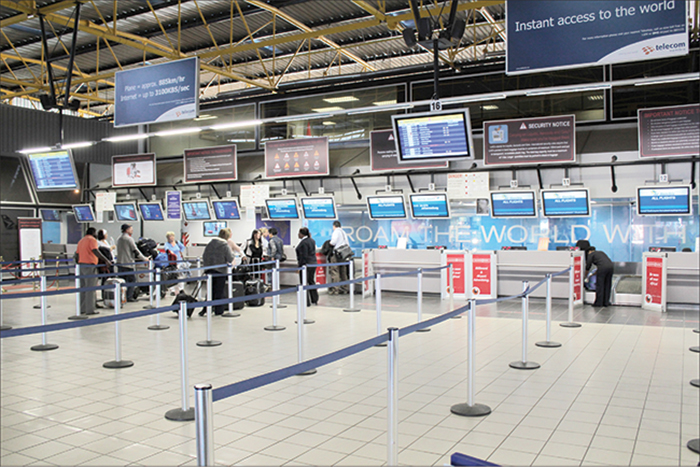
Notices on the screens at the airport yesterday stated that all flights, including the regional flights to Cape Town and domestic flights to Walvis Bay, had been put on hold, while others were delayed.
Some of the passengers who were on the flights diverted to Gaborone complained of hunger when they arrived yesterday afternoon. They said only those in the business class were given food and refreshments while the rest spent about eight hours hungry.
Among the passengers were tourists and businesspeople. They were clearly agitated when they told The Namibian that they could not buy any food in Gaborone because all the shops were closed at the airport. The tourists said they were in Namibia for a two-week safari and were disappointed that they had to experience such inconveniences.
Some tour guides waiting for the tourists said they arrived at the airport around 05h00, but were not told what was going on.
“We were here since 05h00. We had to buy own food because they failed to inform us that the flight will be delayed.”
A mother who had gone to pickup her son said, if she had known, she would have made some arrangements. “We do not just stay here because we got nothing to do. We are businesspeople and time is money,” she said, refusing to give her name.