


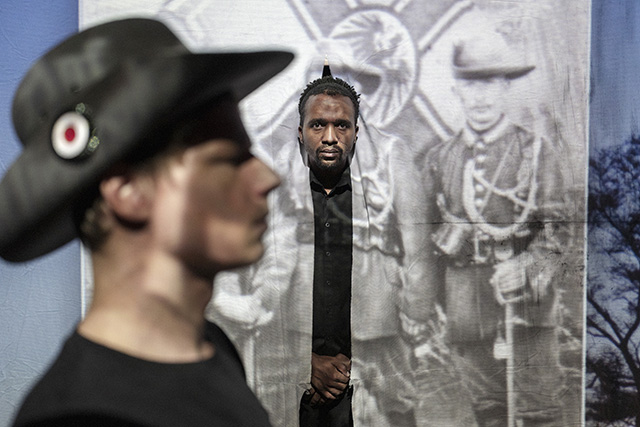
”I am a direct descendant of the affected Herero nation in the conflict between the Germans and Herero,” writes Namibian theatre director David Ndjavera during a break in ‘Hereroland’ theatre rehearsals in Hamburg.
“My great grandmother fled to Botswana at the age of five. As a result, I was born in exile and repatriated to Namibia with her in 1973 at the age of three. Together we were regarded as foreigners in our motherland and had to rebuild a new existence.”
In the extensive history of German-Herero conflict, Ndjavera’s story is one of thousands yet to be told and he considers his personal and political history distilled through a theatre piece in collaboration with German documentary theatre director Gernot Grünewald.
Simply titled ‘Hereroland’ and set to premiere at the Thalia Theatre this Sunday, the piece has been in production in Hamburg for the last two months, fine-tuning its ambitious staging.
In a bid to mimic the complexity of the subject matter which ranges from the Herero-Nama genocide to present day recognition, repatriation and reparations for colonial atrocities, ‘Hereroland’ is what Grünewald calls a “theatrical installation” incorporating a script by Aldo Behrens, costume design by Cynthia Schimming as well as interviews and archival material filtered through 19 different stations accommodating up to 20 people at a time.
“The multi-perspective dimension reflects different points of view and the different stations create intimate theatre moments to bring the audience closer to the topic,” says Grünewald.
With audience members confronted with the matter of skulls in the skull archive, German farmers’ reflections at the farmers table, historical facts, contemporary contemplations as well as the emotions and stories of the Namibian performers who are all Herero and thus the story itself, the installation features scenes without actors but with both dance and music.
“Audiences will continuously move from one set to another to view a simultaneous display of events,” says Ndjavera. “This will take the audience on a tour of history, reenactments of situations, recorded and live interviews of the frontrunners in the ongoing process of repatriation negotiations as well as theatrical interpretations by artists who stem from the two nations. Interestingly the audience will be prompted to draw their own conclusions pertaining to the denouement.”
Describing the core exercise as an attempt “to instigate a reaction and stir the emotions of the audience to become active participants in the plight of the Herero person,” Ndjavera says the installation will serve its purpose “if persons that can initiate change are in attendance”.
Speaking on what must be known and appreciated by the German people, Grünewald believes it is the fact of the genocide itself.
“Knowledge of the genocide is quite rare in Germany. German colonialism is not that important in the history lessons in school and then there is an ongoing discussion in Germany and other parts of Europe about how we should deal with our colonial past,” he says.
“The question of the repatriation of skulls as well as art and crafts items from museums like the Witbooi Bible are part of that discussion. At least it is a question about the relationship between the formerly first and the so-called third world after 600 years of globalisation and the possibility of a common future in terms of climate change refugee politics. So these kinds of question should be evoked by the production.”
Already boasting a series of sold-out Hamburg shows in a venue that fits 160 people, ‘Hereroland’ will premiere at the National Theatre of Namibia in June, featuring Namibia’s Rudolf Dantago Schimming, Glenn-Nora Zeupareje Tjipura, West Uarije, Gift Uzera, Otja Henock Kambaekua and Lizette Vezemboua Kavari.
In an age of information overload, Sunrise is The Namibian’s morning briefing, delivered at 6h00 from Monday to Friday. It offers a curated rundown of the most important stories from the past 24 hours – occasionally with a light, witty touch. It’s an essential way to stay informed. Subscribe and join our newsletter community.

The Namibian uses AI tools to assist with improved quality, accuracy and efficiency, while maintaining editorial oversight and journalistic integrity.
Stay informed with The Namibian – your source for credible journalism. Get in-depth reporting and opinions for
only N$85 a month. Invest in journalism, invest in democracy –
Subscribe Now!