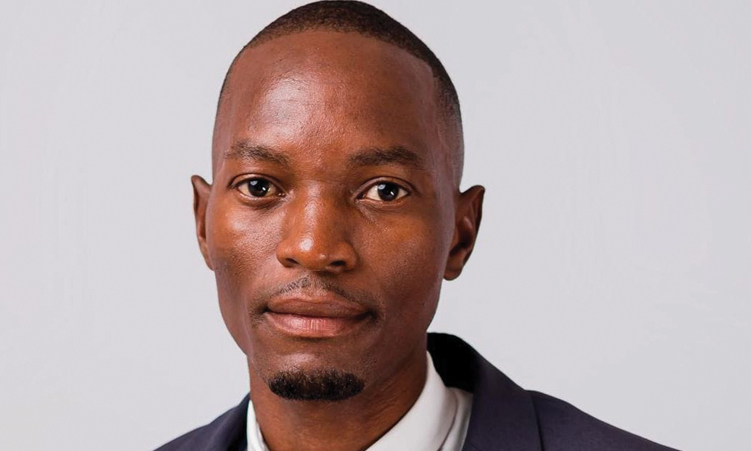





Born in Evale, a village in southern Angola, to Nelindi Shityuwete, a descendant of the Evale Royal Family, Helao was born in a large family.
His father had about five wives of which his mother was the youngest. An only child of his mother, Helao was the 19th of his father’s 22 children.’We all lived in one house – my father, his wives and children and we all shared the household responsibilities. My early childhood was characterised by looking after my father’s calves with one of my little brothers from a different mother who was almost the same age as me,’ he remembers fondly.Due to reasons unknown to him, Helao says his mother later left his father, and shortly after came to fetch him to go and live with his grandmother in another area of Oukwanyama in Angola. ‘At age 10, my aunts who were in Namibia at that time, came to fetch me to go start school. Before that, I had no idea what school was. It was very interesting to hear my aunts talking about ‘school’ and at some point I thought it was an animal. I wanted to see what this animal looked like,’, he said.Helao’s dreams of meeting ‘school’ were short-lived though when his grandmother showed up the next day and took him right back to Angola, back to his life of tending cattle, pounding Mahangu and cooking. ‘My grandmother brought me up in a way that I was able to do all kinds of domestic chores, whether it was chores meant to be done by girls or boys, I could do it all,’ he said.At age 13, Helao’s aunts came for him again with the promise of school and in 1947, he started his Sub A (currently grade one). ‘My aunts lived at Endola in Oshakati and that is where I started school. I was put at a disadvantage because at 13, I was in a class with seven-year-olds and it was difficult to keep up with them because I hadn’t at all gone to school before and they knew more than I did. If you saw see me with them, you would think that I was their teacher because I was very tall. I was so tall that amongst these kids, I was like a giraffe amongst donkeys,’ he said.To help him keep up, Helao’s aunts would give him after-school classes and in 1948, after much improvement, the teachers fast-tracked him and he later finished his education at Endola and went to St Mary’s Mission Odibo to study English.At that time, St Mary’s was the most sought-after school because it was the only place in northern Namibia where English was taught and spoken. Helao recalls that his early days at Odibo were a hurdle because learning the English alphabet and pronouncing the letters was a ‘headache’. ‘The most difficult letters to pronounce were F, H, Q, W and Y. It took me a month to conquer their pronunciation …’ he said.At that time, there were no state schools in northern Namibia. The only schools were missionary-run. ‘It was at St Mary’s Odibo where I met Andimba (Herman) Toivo Ya Toivo. As beginners at the school, those pupils who were ahead of us were given the task to teach us English and Herman Ya Toivo was one of my first teachers. We were taught under trees because there were not enough classrooms. I stayed at that school until 1954,’ he said.In 1955, Helao failed to gain entry to Standard VI, the first year of secondary school, which was closed to most black Namibian scholars. At that time, the apartheid’s ‘Bantu Education’ had been imposed in missionary-run schools and they were prohibited from teaching beyond Standard V, the last year of primary school. ‘While at home and looking after the family’s livestock, I paid close attention to the situation at St. Mary’s hoping that I would be able to resume my studies, but things never improved,’ he recalls.’In early 1956, I decided to come down south to look for employment and I landed up at Outjo Girls school. As black Namibian residents in the north, we were only allowed to work on contract, a modified form of slavery. My job was to look after the school superintendent’s house and my tasks included cleaning the house, washing dishes, looking after the chickens, tending the garden and selling flowers,’ he said.The contract at the school bound him to work for 24 months without leave. ‘When I came to Outjo, my idea was to come, work and save money so that I could go back home and study. We were getting paid 5c per day and when the time came for us to go back home after the 24 months, we were just as poor as when we had come from home. I could not even afford to buy my aunts anything,’ he said.After a brief holiday at home, Helao signed yet another work contract and this time he found himself in coastal Walvis Bay where he worked as a foreman in the ships. ‘The payment at the ships was slightly better at one shilling per day,’ he said. After yet another 24 months, Helao continued to work an extra six months at the ships. At this time, the contract labourers were feeling exploited at the hands of their bosses and in 1959 organised themselves to form the Ovamboland People’s Organisation (OPO), which later became Swapo. Helao was one of these labourers.Others included Vinia Ndadi and Peter Nanyemba. Although Andimba Toivo Ya Toivo was under house arrest in northern Namibia at the time and Kerina Mburumba was in the US, their presence in the formation of OPO was known by all and were responsible for some of the decisions taken.’At first, OPO was not a political party, it was formed with the aim of abolishing contract labour. With time, politics eventually came in. At a later stage, Kerina Mburumba was the one who proposed that OPO be turned into Swapo because he felt OPO just represented those people from the north. With the change of the name, Kerina said we should focus at not only abolishing contract labour but at freeing our country politically. Sam Nujoma was the leader of OPO,’ he said.On April 19, 1960, OPO became Swapo.After his contract expired in Walvis Bay, he returned home to his aunts in Oshakati. ‘Upon arrival, my aunts told me that Ya Toivo and Jakob Kuhangwa who was the Secretary General of Swapo at the time, were on their way to Angola with plans of later going to America. I wasted no time in contacting them and telling them that I wanted to join them,’ he said. The only mode of transport that time was bicycles which meant that most of their journey to Angola would have to be on foot with an occasional ride on a bike. Eventually, only Kuhangwa and Helao ended up making the trip to Angola as Ya Toivo later backed out. ‘Kahumba Kandola was the one who took us into Angola with his bicycle,’ he recalled. The two then journeyed on to Lobito where yet another aunt of Helao took them in. Due to the poor living conditions in Lubito Angola, Helao said that both he and Kuhangwa ended up contracting malaria.With time, the plans the two had to go to America became more difficult to attain and as a result, their money also ran out. A friend of Kuhangwa eventually sent them money which Kuhangwa then used to go to Zambia. ‘Since the money was not enough for both of us to leave Angola, I told Kuhangwa to just go ahead while I returned home to look for money. In 1961 after I had collected some, I went back to Angola. Upon arrival, I realised that there was no peace in Angola due to the war and instead decided to go back home again. On my journey back home, I was arrested in Lubango. A friend of Sam Nujoma, whom Kuhangwa and I had met earlier, came to my rescue and ensured that I arrived home safely,’ he said.Upon arrival back home and with no money, Helao found that he had to look for work again and in1962 came to Windhoek in pursuit of employment. ‘When I came to Windhoek, I found employment at a suburban house where I cleaned and tended to the garden. It wasn’t long before I had a fall-out with my boss and then went to live with my cousin in the old location (now Katutura). Due to the continuous Police patrols in the old location at that time, we had to be alert at all times. Even when you were sleeping, you had to sleep with one eye open,’ he said.He recalls that the police would patrol the old location in pursuit of those who were brewing (or drinking) ‘Otombo’ (traditional brew) to arrest them. ‘During this period, black people were not allowed to drink beer, wine or anything that was considered to belong to the whites. We could only drink Otombo but even when we drank this, we were arrested,’ he said.’In 1964, my friends and I decided to leave the country. We were arrested at the Botswana border and while being kept at the border, we escaped to a town in Botswana called Ghanzi. We were again arrested in Ghanzi and escaped and went to a village near Maun. While in Maun, Daniel Munamava, a then Swanu member, took care of us. We lived in a forest and Daniel would bring us food. There was a route in the forest that was used by trucks travelling to Francistown where Swapo had offices. Our aim in that forest was to catch one of those trucks,’ he recalled, and their chance eventually came.’While in Francistown, we had to change our names because if you did not and your name was recognised, you would be arrested and sent back to the border. I changed my name to Patrick Jackson. During this time, I was put in charge by our seniors to manage a group of 50 men from different countries who like me and my friends were also on the run. I had to find out why they were running away just like us,’ he said.During this time, Helao and his men had submitted their names to the Swapo office for a chance to get training in Zambia or Tanzania. The end result of the training was that upon completion, they would all return back to Namibia and put into action what they were taught. The goal was to free Namibia from South African rule. ‘We would organise ourselves by reading and acquainting ourselves with political news as well as learn from each other. Most of us then ended up in Tanzania. Many others were sent to other areas such as West Africa, even China and Egypt. After our military training in Tanzania, we were ready to come and liberate our country from South African rule. Unfortunately we were arrested in Nkurenkuru before we could carry out our plans of freeing Namibia and taken to a Pretoria prison for trial. We were coming back home as trained soldiers and some of us were carrying guns – that is the reason we were arrested.,’ he said.It would take another two years in Pretoria prison before Helao and his fellow comrades were tried. In September 1967, Helao and 32 other men were tried under the South African terrorism Act. In 1968, they were found guilty and sent to Robben Island prison.After his sentence, Robben Island prison was to be Helao’s home for the next 20 years.’While I got 20 years imprisonment, guys like the late Nathaniel Maxuilili and Jason Mutumbulwa got five years and some of my other friends were sentenced for life. They told us that the reason we got such stiff sentences was that because we were bad for wanting to remove the South African rule over Namibia and replacing it with a Swapo government,’ he said.At that time, Robben Island was also home to other iconic leaders such as Jerry Ekandjo, the late John Pandeni, John Otto Nankudhu, Gerson Veii, Kahumba Kandola, Nelson Mandela and Walter Sisulu to mention but a few.’The prison was made up of different sections and unfortunately our section never got to meet Mandela in person. There was a lot of admiration for Mandela in prison during that time and his group was called the ‘Leadership group’. Since we were sentenced under the Terrorism Act, our group was called the ‘terrorism group’. Our duties comprised of chopping firewood, cleaning the beach and collecting bamboo that was growing around the beach. Our conversations were mostly about politics. We were not allowed to read or find out about what was happening in the outside world but we would collect information from each other,’ he said. Helao reveals that even while in prison, Namibia and the political situation back home was on his mind and the minds of his fellow comrades. ‘We were always kept informed about what was happening back home. We were in the know about Swapo’s victories and losses. Although we were not allowed access to the news, we used to find ways to get news about events happening here in Namibia,’ he said.He reveals that their treatment in prison was not at all fair and this even applied to the food they were served. ‘We asked them continuously to send us back home so that we could come serve jail time in Namibian prisons instead of Robben Island. The white people had their food first and the black and Indian people would then eat the food left over by the whites. As for meat, we did not eat meat because when the plate arrived, you would only see the place where the meat was but it was no longer there. We Namibians did not like the food. We wanted ‘Oshifima’ (Mahangu porridge), and they told us they had none. We told them that them not having Oshifima was even more reason for them to send us back home,’ he said.Only in 1979 did the fate of Helao and his friends change. Due to intervention by the International Committee of the Red Cross, the inmates were now allowed to newspapers. ‘The Committee started visiting us in prison to hear our complaints. Round about that time, under Resolution 435, South Africa agreed to Namibian Independence, but only if it was organised by the South Africa government itself. That is also the year that the DTA was formed. Of course this did not go down well with us as Swapo and it was decided that we were not going to participate in the South African arranged independence. DTA and all the other parties at the time agreed to it. In 1984, Swapo officials,together with the South African government and other international parties were to attend a conference in Zambia. Helao and his fellow Namibian comrades in Robben Island prison were scheduled to attend that conference as well.’We left Robben Island on May 7, 1984 and we arrived in Namibia on May 8. Upon arrival here, we were confronted by many other challenges especially from the South African Administrator General at that time, Louis Pienaar, who after looking at our records made sure to put stumbling blocks in our path, including more arrests. I can remember we were at a braai at Dobra once together with Anton Lubowski, his wife and children when the police just appeared out of nowhere and arrested us. They later released us of course,’ he said.In February 1985, Helao received a scholarship to go study in the United Kingdom by the Council of Churches in Namibia (CCN). The scholarship was to go and study English. Even while overseas, politics continued to dominate Helao’s mind and conversations. ‘We were a total of 15 Swapo students at Birmingham University where I was studying. While there, we the Swapo students made sure to keep ourselves informed with what was happening back home. The likes of the late Gertrude Kandanga, Eino Ekandjo, Aida Jimmy and Elina Ndapuka made up some of the Swapo students,’ he said.While at Birmingham, Helao and his fellow Swapo compatriots led several protests demanding for Namibia’s independence and for the end of South African rule over Namibia.The international media did well in publicising these protests as they were heard and read about here in Namibia, putting more pressure on the South African government to end it’s rule over Namibia. Helao studied at the Birmingham University until 1987. He eventually moved to London where he married and had a daughter.’I came back to Namibia in 1989. Because of the unstable political situation in Namibia that time, I decided to leave my family in London. My wife and I had a two and a half year old daughter at the time and I did not want to take any chances. They only joined me on March 16, 1990, shortly before Namibia’s independence,’ he said.In 1990, Helao started working for the government as the Deputy Director of Human Resources in the Ministry of Labour. ‘We are the ones who started that Ministry together with Ponhele Ya France and Katrina Itula. I worked there for six years before I was retired in 1996,’ he said.In addition to their daughter, Helao and his wife went on to have another child, a son. A dark cloud fell over the family in 2009 when Helao was diagnosed with pancreatic cancer. As fate would have it, Helao was meant to be a fighter and he did just that and conquered the cancer. ‘I went to have the cancer removed in South Africa and to date, I am cancer-free,’ he said.In early 2010 Helao suffered a stroke. ‘As a result of the stroke, I was unable to speak English. I could only speak Oshikwanyama. After training with a Language Therapist, my English started to return and today, I am well on the path to complete recovery,’ he said.Nowadays, Helao’s time is divided between his family and being the Director of the Namibian Former Robben Island Political Prisoners Trust (NFRIPPT).To date, Helao is also a published author of his own biography titled ‘Never Follow The Wolf’, a book he said he wrote while babysitting his daughter in the years 1987 and 1988. ‘The book is sold in all southern African countries,’ he said.’To the youth of today, I would like to say that when we went into exile, it was for the purpose of liberating this country. We were not thinking about ourselves, we were thinking of our people. We had no state schools back then and when I decided to go and look for education, I was already 32, so make use of opportunities provided to you today. Pick up something with which you can help to uplift the society,’ he said.A staunch believer in democracy, Helao describes the current divide between political parties as alien to the Swapo of his time.’I am deeply irritated and saddened by the current divide in politics today. This is not what we fought for. During exile in Botswana, when my men and I escaped to find ourselves in the forest near Maun, the man who helped us (Daniel Munamava) was not a Swapo member; he belonged to the Swanu but he did not hesitate to help us. He did not see us as his enemies because we did not belong to the same political party as him; we were Namibians and that was all he could see,’ he said. He points out that a difference of opinion is something a democratic society ought to openly embrace and tolerate and hence the motto: ‘one Namibia, one nation’. ‘When you talk about democracy, you are talking about people with different views and opinions which is why I don’t believe only one party should be functional in such a society. You cannot declare someone your enemy or tell them to go away because you differ. You are bound to differ in a democratic society. What you need to do then is to sit down and debate on where you are differing,’ he advised. The former freedom fighter points out that ‘we have a lot of people currently doing what they are doing not because they care about the nation but because they are vying for praise from certain sectors. He further voices his dissatisfaction with the lack of platforms available to citizens and members of the different political parties to voice their views on the way the country is being run. ‘As it is currently, only those in the Central Committee or Politburo have a say in the decisions taken at that level, but what about what I as an ordinary member think? When will I be heard,’ he asked. ‘I would like more platforms provided for citizens of this country to express their views’.