




ONLY 1 500 of the 100 000 government employees received permission to do private jobs in spite of suggestions that many more may have been involved in private business during 2012.
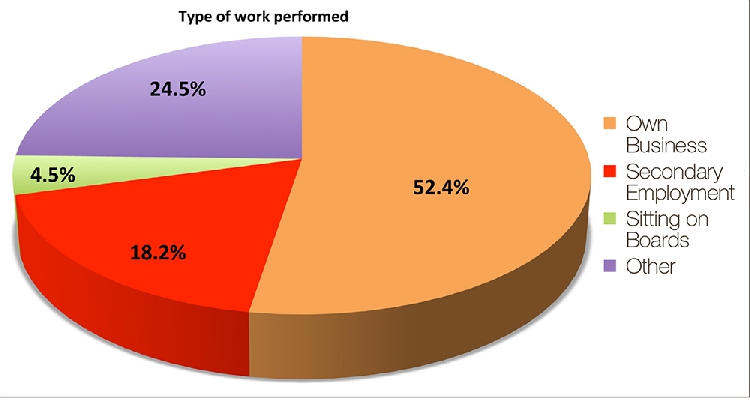
Fifty-two percent of civil servants within all ministries who applied to do private work were engaged in their own businesses; 18% had second jobs and 4% were serving on company boards while 24% could not be established.
It was found that 68% of these were women. This information is contained in a report compiled for the government by the audit firm PricewaterhouseCoopers.
The audit firm’s report titled “Audit on remunerative work outside employment in the public service” was inconclusive on the magnitude of the problem of the civil servants doing private jobs.
Using a combination of what is on file and discussions with those involved, PWC states the following in the report to the Office of the Prime Minister: “No representation or warranty is given as to the accuracy or completeness of the information captured.
Furthermore, the statistical constructs in this report are based on data gathered from historical information as a moratorium was placed on the policy approximately five years ago.”
The report further states: “Some of the reasons given for staff conducting remunerative work outside employment without approval is fear that they will not be granted approval; that the policy is not enforced by supervisors as they are also doing the very same thing, and they assume that their private business does not interfere with their official duties and therefore it is not necessary to apply for authority (for remunerative work outside employment).”
“Another reason given for remunerative work outside employment among public servants is that government employees have too much unproductive time at work and therefore engage in remunerative work outside the civil service,” stated the report.
The Public Service Commission chair, Eddie Amkongo, last week confirmed the report, saying they have taken note of the recommendations and made changes concerning civil servants’ involvement in private business.
The government ordered the investigation to establish how entrenched private work is in the civil service after a ban was placed on engaging in private work in 2012. Many reports have long suggested that a large number of civil servants perform work outside their government jobs for an income.
Of the 1 502 who sought and obtained permission according to the PWC investigation, the majority – 73% – were in the health ministry.
Others were in the ministries of agriculture, finance and works. The Prime Minister’s Office and the education ministry also had civil servants running private businesses.
The majority of those running side businesses were earning salaries ranging between N$8 300 and N$23 300 per month in government.
They either have certificates, diplomas or degrees.
The PWC survey states that most of the civil servants run private businesses to prepare for a good retirement, have a decent living, avoid bribery, for paying taxes as well as to supplement their incomes.
Some of the workers use government time to do construction work and renovations, running delivery cars as private taxis and selling houses during official working hours.
They also use government equipment and vehicles for private engagements, which has caused high levels of absenteeism, extended and fake leave.
Many in the agriculture ministry were found to own shebeens, taxis, catering businesses, farms, clearing agencies, workshops, construction companies and consulting agencies.
The report found that the tender processes within all ministries are riddled with conflict of interest, with civil servants using inside information to tender or do business with those who have obtained government contracts on tender.
“One might require that spouses and/or close family members are also required to declare interests as this would simply increase transparency. Public servants and their spouses should preferably not perform any private businesses with the departments in which they are employed, although in some cases it may be allowed,” the report recommended.
“However, in the case when potential conflict occurs, the officers, ministries and agencies should initiate the disciplinary process against or criminal action, as appropriate, against employees,” the PWC report stated.
The main responsibility of ensuring that civil servants do not run private businesses lies with the permanent secretary (PS), who in turn reports to the Secretary to Cabinet.
The PS also has the power to determine what sort of action should be taken where there is conflict of interest. It is not clear from the PWC report whether any PS has declared running businesses or having close friends and relatives doing business with government, though several news stories have reported such dealings.
The investigation recommended that civil servants disclose their real estate investments, shareholding, trusts, company directorship, partnerships, gifts and other sources of income.
According to the report, the majority of civil servants do not declare external interests, nor do they follow the existing application procedures and it is something that the agencies, ministries and offices fail to detect, suggesting that the number of moonlighters in government is much higher than the 1500 who obtained permission.
To augment the data on file, PWC used a questionnaire which was sent to 15 000 civil servants, but only 173 responded. They hoped 750 would reply.
In an age of information overload, Sunrise is The Namibian’s morning briefing, delivered at 6h00 from Monday to Friday. It offers a curated rundown of the most important stories from the past 24 hours – occasionally with a light, witty touch. It’s an essential way to stay informed. Subscribe and join our newsletter community.

The Namibian uses AI tools to assist with improved quality, accuracy and efficiency, while maintaining editorial oversight and journalistic integrity.
Stay informed with The Namibian – your source for credible journalism. Get in-depth reporting and opinions for
only N$85 a month. Invest in journalism, invest in democracy –
Subscribe Now!