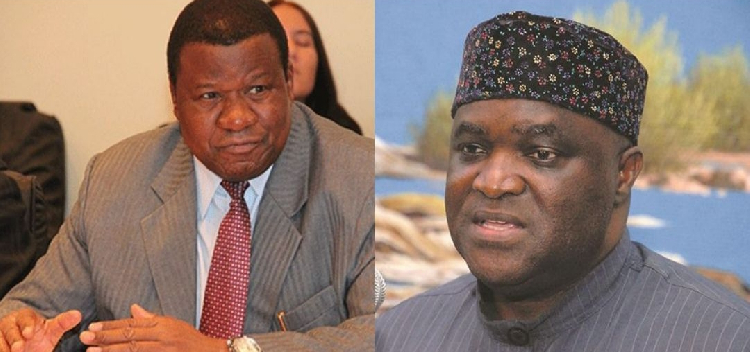
• EINO VATILENI and SOPHIE TENDANE
THE government has been criticised for its non-essential expenses, including on safety and security, while compromising key issues such as poverty eradication and job creation.
This comes at a time when different ministers are lobbying the parliament for the full approval of their proposed budgets.
Budget allocations were provisionally made by minister of finance Iipumbu Shiimi early in March.
University of Namibia senior lecturer and political analyst Ndumba Kamwanyah yesterday raised concerns over government expenditure patterns, singling out the Ministry of Home Affairs, Immigration, Safety and Security as having received an unnecessarily hefty allocation.
Kamwanyah said the government’s claim that money would be used for the safety, security and upgrading of military equipment is unconvincing.
“Currently, we do not have any security threats that are triggering our defence to get ready. Why spend so much on buying weapons?” he asked.
He said the recently inaugurated multibillion-dollar home affairs headquarters has not changed much as service delivery is still sluggish.
“The government must decentralize services offered at the headquarters to regional offices. We do not just want to see huge amounts given to the ministry, without seeing changes or progress.
“These motivational budget speeches are not evidence-based on what they are suggesting,” Kamwanyah said.
Namibian economist Omu Kakujaha-Matundu also concurred with Kamwanyah, adding that the budget allocated to the home affairs ministry, for VIP protection is not necessary while the country has a high crime rate.
“That money can be used to curb crime in informal settlements, which are always experiencing serious crime. Protecting the entire nation is better than one person. There is little danger posed towards our Namibian VIPs. We never recorded a case of a minister or member of parliament who was killed,” Kakujaha-Matundu said.
Last year, the Ministry of Works and Transport asked for the parliament’s blessing to expropriate N$2,5 billion for the upkeep and upgrading of transport infrastructure.
Minister of works and transport John Mutora requested an additional N$1,1 billion for the planning, construction and development of transport infrastructure.
“The purpose of this programme is to develop world-class transport infrastructure and to maintain it. Our national desired outcome is to develop the railway transport infrastructure and to ensure the provision of railway transport services or logistics by upgrading and developing new infrastructure that guarantees affordable, customer-friendly and environmentally responsive integrated railway transportation solutions,” he said.
Mutorwa said his ministry also needs N$1,1 billion for railway network development, maintenance and rehabilitation programmes.
“We are requesting N$43 million to be allocated to the formulation of transportation policy, regulation oversight, construction, and the maintenance of vehicle and driver testing centres, including the development of transport corridors,” he said.
The minister also requested N$157,2 million for air transport administration.
“This programme is to fulfil the ministry’s mandate and objectives, regarding safety of life and property at sea, the protection of the marine environment from pollution by ships, and to promote our national maritime interests to the international community,” he said.
The minister requested N$ 74,1 million to be allocated to the government garage’s centralised support services administration, N$26,1 million for maritime legislation administration, and N$21,2 million for meteorological services administration.
“Although the allocation to this programme is clearly inadequate, it is for my ministry to be able to maintain essential transport,” said Mutorwa.
Meanwhile, minister of home affairs, immigration, safety and security Albert Kawana proposed an allocation of N$5,8 billion.
“These programmes have been developed along the country’s long and medium-term development goals, namely Vision 2030, NDP5, and the Harambee Prosperity Plan II to ensure a conducive environment for economic development, internal security, and peace and harmony in our country,” he said.
One programme he proposed involves the establishment and regulation of a population register.
This includes the issuing of identity documents and marriage certificates, with outreach programmes intensified to reach remote areas countrywide.
“For this programme to continue to fulfil its core functions, I kindly request this august house to approve an amount of N$194,5 million,” the minister said.
He requested N$202,6 million for immigration control and citizenship.
“For this programme to continue fulfilling its core functions, I kindly request an amount of N$3,6 billion to be approved,” he said.
Another programme involves the protection of Very Important People (VIPs) and requires N$367,4 million, he said.
A further programme is on training and development, providing professional training and career development for improved service delivery.
Kawana also proposed N$79,3 million for VIP protection, and N$39,5 million for police forensic services.
In an age of information overload, Sunrise is The Namibian’s morning briefing, delivered at 6h00 from Monday to Friday. It offers a curated rundown of the most important stories from the past 24 hours – occasionally with a light, witty touch. It’s an essential way to stay informed. Subscribe and join our newsletter community.

The Namibian uses AI tools to assist with improved quality, accuracy and efficiency, while maintaining editorial oversight and journalistic integrity.
Stay informed with The Namibian – your source for credible journalism. Get in-depth reporting and opinions for
only N$85 a month. Invest in journalism, invest in democracy –
Subscribe Now!