ACCORDING to a report by Simonis Storm Securities (SSS), the Bank of Namibia (BoN) has a local and foreign sinking fund which is used to repay the capital portion of domestic (local and Johannesburg Stock Exchange-listed bonds) and foreign currency-denominated debt, respectively.
The local sinking fund has a balance of N$1,88 billion.
The sinking fund is mainly funded by incoming Southern African Customs Union (Sacu) receipts.
“Between N$200 million and N$400 million is transferred to the local sinking fund on a quarterly basis. The management of the fund is split between asset-management companies Ninety-One and Coronation (South African),” said Simonis.
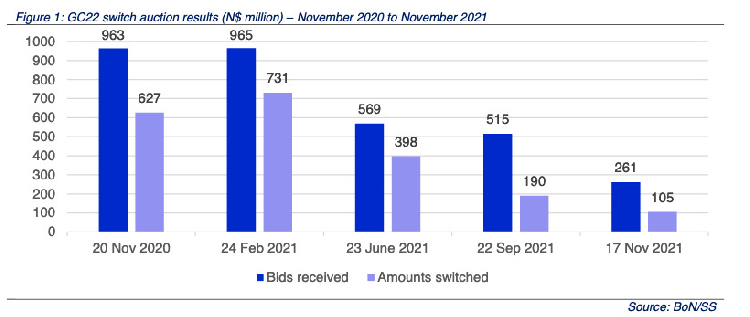
According to the report, the BoN held five GC22 switch auctions in the last two years, with the first held on 18 November 2020.
From the five switch auctions, a total of N$3,3 billion in bids was received, and only N$2,1 billion was switched.
The next maturity, the GC23 bond, currently has a total debt of N$4,8 billion and matures on 15 October 2023.
“Given the current sinking fund balance of N$1,88 billion, we are expecting between four and six switch auctions to take place during 2022 and early 2023,” the wealth management firm said.
The central bank has also indicated they would schedule switch auctions for the GC24 towards the end of 2022.
If the -5% forecast in Sacu revenue materialises for the next seven quarters (ending September 2023), the central bank can contribute between a lower and upper limit of N$1,4 billion and N$2,8 billion towards the local sinking fund.
Based on the current balance and the lower/upper limit contributions over the next seven quarters, the local sinking fund will have a shortfall of between N$1,5 billion and N$140 million, which would have to be switched into longer-term maturities, SSS said.
These calculations take into account that the GC23 will be off the run (not offered in the primary market) so that the N$4,8 billion debt remains unchanged, SSS said.
Across the yield curve, domestic debt currently stands at N$51,2 billion in fixed-rate bonds only. Short-term bonds have a total debt of N$21,3 billion, medium-term bonds N$18,3 billion, and long-term bonds N$11,6 billion.
The GC24 and GC25 are currently off the run, with the potential announcement of the GC23 and GC27 also being off the run at the next national budget presentation.
“We compare the three-month average bond yields prior to March 2020 (pandemic-outbreak point) to the latest three-month average bond yields.
“We find that short-term bonds (GC23 to GC27) are currently on average 42 basis points below their pre-pandemic levels. Medium-term bonds (GC30 to GC37) are 165 basis points higher on average, and long-term bonds (GC40 to GC50) are 168 basis points higher on average.
“Simonis believes inflation and interest-rate expectations were adjusted upwards due to supply-chain bottlenecks leading to historically high inflation rates in 2021.
“Given our expectations discussed in our economic outlook for 2022 report, we believe that bond yields in Namibia will rise in 2022, more for the medium to long end of the curve.
“Yields will rise as foreign investors sell off emerging market bonds and local investors adjust their inflation and interest-rate expectations,” SSS said.
– matthew@namibian.com.na
In an age of information overload, Sunrise is The Namibian’s morning briefing, delivered at 6h00 from Monday to Friday. It offers a curated rundown of the most important stories from the past 24 hours – occasionally with a light, witty touch. It’s an essential way to stay informed. Subscribe and join our newsletter community.

The Namibian uses AI tools to assist with improved quality, accuracy and efficiency, while maintaining editorial oversight and journalistic integrity.
Stay informed with The Namibian – your source for credible journalism. Get in-depth reporting and opinions for
only N$85 a month. Invest in journalism, invest in democracy –
Subscribe Now!