



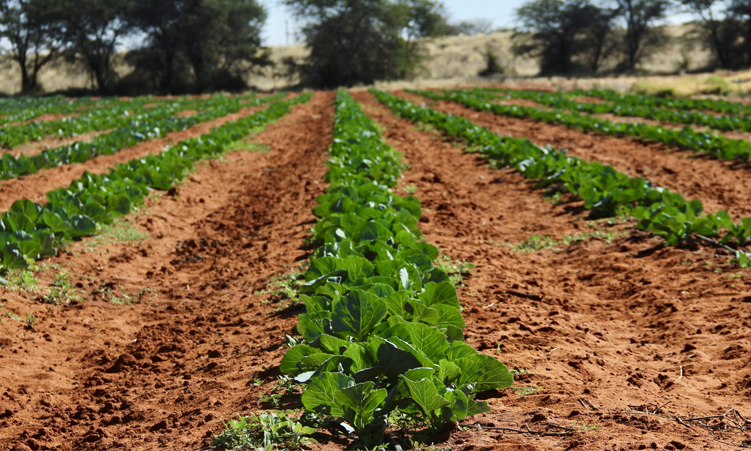
Ninety percent of irrigable land at state-run green schemes has been planted, says the Ministry of Agriculture, Fisheries, Water and Land Reform.
Felix Ndinamwene, the deputy director for agricultural engineering in the ministry, told The Namibian last week that all government-run green schemes are in good productive shape at the moment.
He said by winter this year, the ministry will make sure that all green schemes are operational. “We plan to go 100% by winter. So, there will be no idle land at government green schemes,” said Ndinamwene.
He also revealed that next month, the ministry will advertise vacant plots for medium scale farmers at government-run green schemes.
Ndinamwene explained that anyone can apply for medium plots at green schemes, not like small-scale farmer plots which are earmarked for young people.
He said the difference between small-scale farmer plots and medium plots is that those who receive the former receive resources like chemicals, fertilizers and ploughing services for their plots from the government at no cost.
Those who receive medium plots, however, do not receive government assistance.
State-run green schemes include Ndonga Linena and Shadikongoro in the Kavango East region, Sikondo in the Kavango East region, Etunda in the Omusati region, and the Hardap Irrigation Green Scheme in the Hardap region.
Green scheme projects are large commercial production farms operated and managed in accordance with the models outlined in the government’s Green Scheme Policy.
However, greens schemes in Namibia have not lived up to expectations, suffering from many years of under-performance due to financial constraints, mismanagement and reported political interference.
Janno Rentel, the manager for the Ndonga Linena Green Scheme, says they have commercially planted 18 plots with maize (with two centre pivots) and 16 plots with sunflowers (which are being irrigated with 2 centre pivots).
He explains that small-scale farmers at his green scheme have planted 150 hectares of land.
“We are about 95% fully operational,” says Rentel.
In February this year, the manager for the Hardap Green Scheme, Lima Kativa, said this year the green scheme will revitalise its lucerne production as the Namibia Water Corporation has approved an increase in irrigation water supply in the region, which signals a boost for the local economy and employment creation.
In an age of information overload, Sunrise is The Namibian’s morning briefing, delivered at 6h00 from Monday to Friday. It offers a curated rundown of the most important stories from the past 24 hours – occasionally with a light, witty touch. It’s an essential way to stay informed. Subscribe and join our newsletter community.

The Namibian uses AI tools to assist with improved quality, accuracy and efficiency, while maintaining editorial oversight and journalistic integrity.
Stay informed with The Namibian – your source for credible journalism. Get in-depth reporting and opinions for
only N$85 a month. Invest in journalism, invest in democracy –
Subscribe Now!