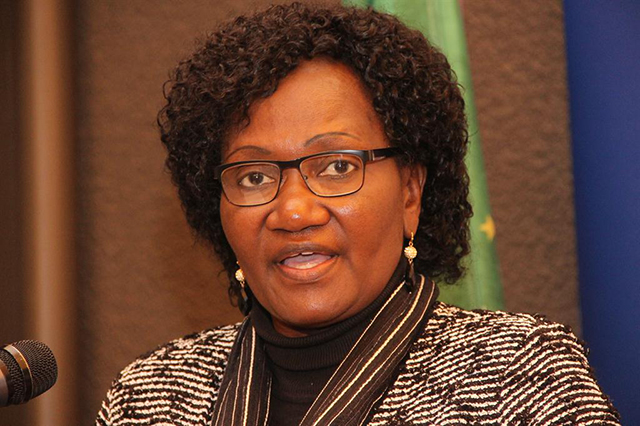
HIGHER education minister Iitah Kandjii-Murangi says pupils who obtained C symbols or better in Grade 11 qualify for admission to tertiary education institutions.
Kandjii-Murangi said this at a press briefing held in Windhoek on Thursday.
She clarified confusion over the progression of pupils who finished their National Senior Secondary Certificate (NSSC) ordinary level as part of the new curriculum last year.
The minister said although some universities may require higher levels for admission to some disciplines, such as engineering and medicine, pupils who passed their Grade 11 under the new curriculum can still be admitted to tertiary institutions for undergraduate degrees and diplomas.
“ . . . some programmes will allow admission with an NSSC ordinary level qualification, whereas others dictate that pupils should have attained higher level or AS level qualifications, the highest exit level in senior secondary education,” she said.
Kandjii-Murangi said the changes in the school curriculum means there are two exit levels to tertiary education institutions, namely the NSSCO, “which until this year was only achievable after 12 years of formal basic education” and the new Advanced Subsidiary (AS) level, an upgrade from the former higher level.
Last year, about 113 300 pupils registered for the national examinations.
Of these, 23 wrote the higher-level examination, which has now been upgraded to Advanced Subsidiary level.
Over 68 500 wrote the old ordinary level (Grade 12) and 21 640 wrote the new ordinary level (Grade 11).
The minister said 6 448 full-time pupils, “excluding part-time”, achieved a C symbol or better grade at ordinary level, and grade three or better at higher level.
This means that 6 448 pupils qualify for admission to tertiary education institutions.
“Very important to note is that specific institutions and different levels of qualifications have minimum requirements and quotas aimed at ensuring the allowed capacity,” the minister said.
Pupils who wrote Grade 11 last year and wish to go into technical fields such as engineering and medicine would, however, be required to do an Advanced Subsidiary level, which is the former Grade 12 higher level.
Sanet Steenkamp, the executive director of education, arts and culture, said the certificate obtained by pupils for Grade 11 ordinary level this year is equivalent to that obtained by pupils in Grade 12 two years ago.
This, she said, is because of the changes in the curriculum which merged Grade 10 and 11 into a two-year course, “accredited at NQA at Level 3”.
“It has the same level as the previous Grade 12 ordinary level. The Advanced Subsidiary (AS) level is for those who truly aspire to go to university for a specific degree which may require the previous higher level subjects . . . if you want to go into arts, drama, entrepreneurship, or to the College of the Arts, or any other field that does not require an AS level, you can do that with the Grade 11 certificate,” she said.