




JUDIT FIGUERASWHILE observing her mother’s grave, Flora pulls aside the children who, unintentionally, fall and step on it.
“Her name was Maria Claudia,” says the 10-year-old girl, after pointing to the inscription on the cross.
The others, looking for attention, laugh and, at the same time, indicate the other niches of the cemetery.
“This is my mother’s, and right next to it is my grandfather’s,” says one of the youngest of the children. Behind Flora, a group of children break out laughing, as they comment on the empty glass bottle that heads the tomb of the girl’s mother.
Maria Claudia was an alcoholic, like most of the adults living at Gochas, a village with only 500 inhabitants, mostly from the Nama ethnic group, which is located in the Hardap region in south-eastern Namibia.
Flora’s mother died of AIDS a few months ago. Her father passed away five years ago after hanging himself in the shack where they lived. After becoming an orphan, Flora’s grandmother, also an alcoholic, refused to take care of Flora and her young sister Michelle. Now, the two minors live in the shack belonging to a 60-year-old couple they refer to as “grandparents”.
In her new home, made of materials such as pieces of zinc, plastic and wood, Flora is the one who tidies, brings firewood, cooks and washes Michelle and the elderly couple’s two grandchildren. Sometimes, she cannot cope with all this work.
Occasionally, when she returns from school, she finds the door to the shack fastened with a padlock. Her adoptive grandmother locks the shack when she goes to one of the shacks where a cheap alcoholic beverage is brewed.
At times, Flora and her sister stay awake deep into the night, walking aimlessly as they wait for the woman to return and open the door. These days she barely eats.
Flora is one of the many children who wait in the streets until their parents, uncles or grandparents return from the shack that acts as a distillery or, as the youngest call it, “the lying-down school”. During weekends, she also cooks for other children living in the neighbourhood.
On lucky days, she prepares porridge, a mixture of water, milk and maize meal. On other occasions, she goes out to hunt birds, which she roasts on the fire.
“I give food to the others because I feel sorry for them. From Monday to Friday they can have lunch in the school canteen, but on weekends the school closes and the adults, instead of taking care of them, prefer to pass the hours drinking in the brewery,” she says.
Although she is only 10, Flora knows exactly what the main problem in her community is. “What I like least about Gochas is the alcohol and the violence it causes among the adults. At home, when my grandparents get drunk, they yell at me and beat me for no reason,” she said.
Alcoholism, colonial heritage
According to the World Health Organisation (WHO), Namibia is the African country with the sixth highest alcohol consumption rates per capita. Each Namibian drinks an average of 9,8 litres of pure alcohol per year. Namibian men, surpassed only by their counterparts from Nigeria, Gabon and Seychelles, consume the largest amounts of alcohol in the continent – about 17,3 litres each annually.
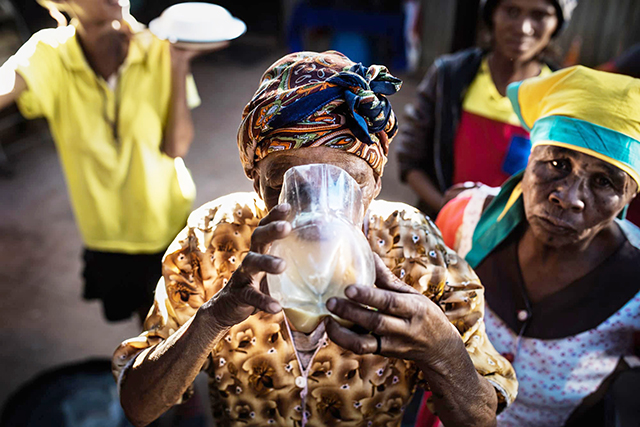
Right in front of the brewery, an unconscious boy lies on the ground. People entering the establishment ignore the minor devastated by the alcohol intake and stand in line, where a dozen people wait to refill their glasses.
“On average, each client drinks between 10 and 20 portions a day,” explains the business owner. Helped by her son and her husband, the woman produces this beverage by fermenting a mixture of sugar, water, yeast and ginger.
Artisanal breweries in Namibia are part of a historical and colonial legacy. After the German defeat in World War I, the League of Nations handed over Namibia, then called German South-West Africa and controlled by the Germans since 1840, to the South African Union, the current South Africa.
The agreement of this new mandate was signed in Geneva, Switzerland, in December 1920. The document contained an article that explicitly banned the supply of alcoholic beverages to the native community. This rule led to the setting up of stores where the local population produced, in a traditional and clandestine way, substances such as wine and beer. Today, the sale of alcohol to people over 18, regardless of ethnicity, is legal and there are licenced premises where it can be consumed.
In addition, home-made methods are still the most common. “We come here because we can’t afford a beer in the village bar,” says one of the women waiting to be served in this “tavern”.
“I drink to relieve myself of misery and because I have nothing better to do. I don’t have a job,” she adds. Like this woman, most of the inhabitants of Gochas do not work.
According to data from the Namibia Statistics Agency, in 2018, the unemployment rate reached 34,49% in the Hardap region. Among those under the age of 24, the figure exceeded 46%.
In Gochas, the only people who get a salary are those who work on the farms around the village. These lands, which are used for agricultural production and livestock, are managed by the whites who live in the area. Some of them are descendants of German settlers, but the majority are Afrikaners, an ethnic group with Dutch roots that arrived in Namibia after the country fell under South African hegemony.
The Afrikaners imposed an apartheid system in South Africa in 1948 and, therefore, also in South-West Africa (Namibia today). The apartheid system, which means “separation” in Afrikaans, implemented segregation between the different racial groups for the political benefit of the white population.
In 1966, the South West African People’s Organisation (Swapo), an insurgent guerrilla group, declared war on the South African regime and in 1990 became independent Namibia’s first ruling party. It still runs the country’s government today.
After holding democratic elections and approving a new constitution, the new executive abolished the apartheid system. To this day, white Africans represent only six percent of the total population in Namibia. However, they remain the most economically privileged group.
In fact, according to the United Nations Development Programme (UNDP), Namibia is the second most unequal country in the world in terms of GDP, surpassed only by South Africa. In other words, the white minority still has a much higher income than the black majority.
Almost all farm labourers belong to local ethnic groups and have seasonal contracts. The southern African country is facing one of the worst droughts in its history. Since late 2018, there has been little to no rain and last May, the government declared a state of emergency.
According to the country’s administration, almost 500 000 citizens, or 25% of the population, do not have access to basic nourishment.