



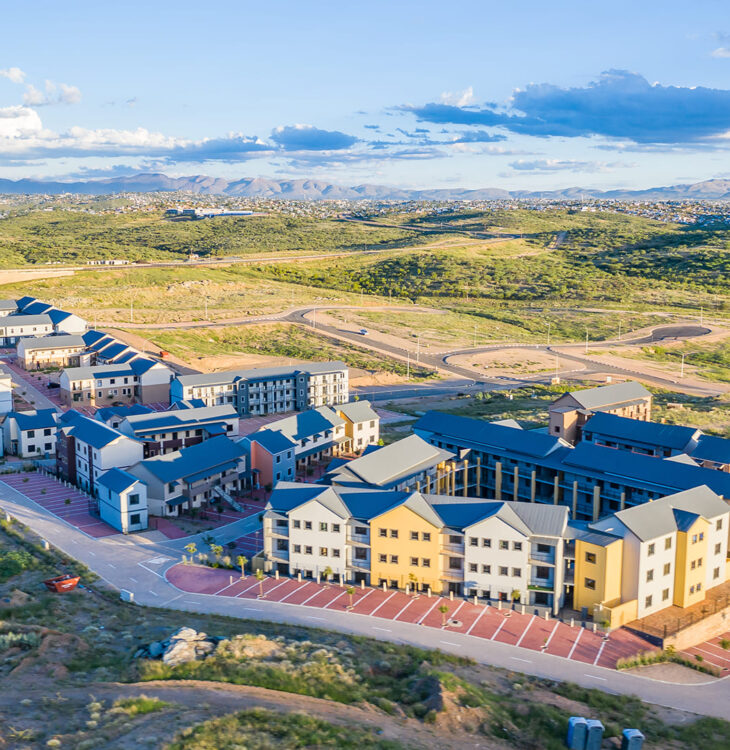
The City of Windhoek’s admission that it may have to build more apartments instead of freestanding houses seems realistic and pragmatic.
Weakened by years of corruption and cronyism on land allocation, the municipality is running out of land and funding.
More than 200 000 people are now squeezed into informal settlements on the outskirts of the capital.
Last Friday, city housing engineer Theunis Heunis said the municipality would need N$1 billion a year over the next four years to address a 60 000-unit housing backlog.
Heunis said Windhoek would need to build apartment blocks, as land for single homes would no longer be viable given the capital’s fast-growing population.
Although it would be an unpopular decision for some, the move towards flats seems a realistic alternative.
Frankly, the expectation that every citizen deserves a single-family home is a fiction Windhoek can no longer afford.
But the strategy for apartments in Windhoek might have a blind spot that ignores the social architecture that makes housing work.
Most apartment developments in the city prioritise density over liveability.
Developers in Windhoek often sacrifice playgrounds, community spaces and gathering places that help transform buildings into neighbourhoods.
They often maximise unit counts at the expense of community functions.
As a result, families are squeezed into small units with nowhere to learn how to live among each other.
Singapore’s founding prime minister Lee Kuan Yew understood this when he transformed his country from slums. The housing and development board he established in 1960 built 55 000 apartments in five years.
At the time, he said: “We’re going to build taller buildings, but we can’t build them closely together. There must be a sense of playing fields, recreational areas for children and old people – a sense that this is a full country with all the facilities you expect of a large country, but in a confined space.”
Singapore’s housing authority also understood that apartment living requires teaching.
For instance, it made clear that it was the duty of parents to teach children to play quietly and not cause mischief. Problems like noise, vandalism and littering could only be tackled if residents exercised consideration for the feelings and rights of their neighbours.
Singapore’s founding leader would later launch a greening programme in 1967, convinced that a city of concrete without trees degrades the human spirit.
The City of Windhoek can use such an approach as a blueprint. Before that it should, however, look inwards and fix what is broken internally.
Council leaders cannot be raking in millions in perks and allowances while housing is neglected.
It should also review past common-age farm deals, measuring 22 000 hectares on the outskirts of the city, which were leased to a few business people for as little as N$10 000 a month.
It cannot be business as usual, especially for highly paid executives.
In 2023, state-owned newspaper New Era reported that the city was set to pay chief executive Moses Matyayi a salary of N$3.3million a year (N$300 000 a month).
This places him among the highest-paid municipal chief executives, comparable to counterparts in Johannesburg where the city manager earns approximately N$3.4 million a year.
The future of a thriving municipality rests on leaders who deliver, not on those who sell residents dreams year after year.
It is time the City of Windhoek proves it is in the business of housing people, not just paying the people at the top.
Conservation is Sustainable
THE GOVERNMENT’S DECISION to formally recognise three nature reserves as protected conservation areas is a step in the right direction.
This week, the environment ministry handed over recognition certificates to NamibRand Nature Reserve, ProNamib Nature Reserve, and Canyon Nature Park as areas that are managed to deliver long-term biodiversity conservation.
This milestone expands conservation beyond protected areas and strengthens Namibia’s progress towards the 30 x 30 global biodiversity target, which aims to formally conserve at least 30% of the earth’s land and sea areas by 2030.
At a time when so much focus is being put on short-term ambitions such as fossil fuels (mining and petroleum), which offer short-term benefits, this is a milestone worth celebrating.
In an age of information overload, Sunrise is The Namibian’s morning briefing, delivered at 6h00 from Monday to Friday. It offers a curated rundown of the most important stories from the past 24 hours – occasionally with a light, witty touch. It’s an essential way to stay informed. Subscribe and join our newsletter community.

The Namibian uses AI tools to assist with improved quality, accuracy and efficiency, while maintaining editorial oversight and journalistic integrity.
Stay informed with The Namibian – your source for credible journalism. Get in-depth reporting and opinions for
only N$85 a month. Invest in journalism, invest in democracy –
Subscribe Now!