



Since she decided to go into farming seven years ago, Ingrid Heigan’s goat herd has exploded from seven to 100 animals.
This is despite a severe drought that has devastated many livestock farms.
Heigan’s farm is in the Kunene region, about 30km from Khorixas, where she shares a corrugated-iron, two-bedroom house with her family.
“I started farming and moved to Tsaurob Ganeb Pos at Fransfontein about seven years ago,” she says.
Heigan is one of the beneficiaries of a government assistance programme for small farmers supported by the Environmental Investment Fund (EIF).
The farmer applied for assistance in 2020 and received 21 goats – 20 female and one male.
The initiative, which started with a seed capital of N$164 million, lends goats to farmers who already farm with the animals.
After five years, they are expected to have grown their herd and are required to return 20 female goats that were born during the period to the initiative.
Those goats are then given to another farmer to follow the same process. A total of nine farmers have benefited from the goat loan rotation programme.
“As a woman farmer, and someone that has no husband and no loans, the initiative has helped me a lot to grow my farm,” she says.
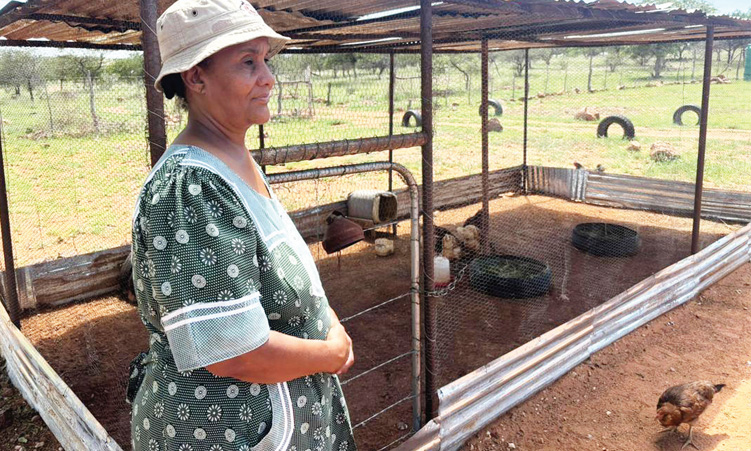
Heigan says she will soon venture into poultry farming, having received training from the Agricultural Bank of Namibia last week.
“I will apply for the poultry farming subsidy and hopefully I can start this year,” she notes.
Heigan’s daughter, Mutagos Heigan, says she is proud of what her mother has achieved. “She’s my role model.”
Heigan says the drought had killed many animals. “But since it started raining, the goats are fine and growing.”
The EIF programme has come to an end. However, the goats will continue to rotate among farmers and be monitored by the agriculture ministry.
EIF project portfolio manager Charity Sihope says the project was implemented over a period of six years.
She says the goat rotation scheme was done to help communities adapt and thrive even with climate change.
“We had to choose a goat breed that will survive within this climate and not procure just any goat,” says Sihope.
According to her, the scheme will be replicated in the southern part of the country.
In an age of information overload, Sunrise is The Namibian’s morning briefing, delivered at 6h00 from Monday to Friday. It offers a curated rundown of the most important stories from the past 24 hours – occasionally with a light, witty touch. It’s an essential way to stay informed. Subscribe and join our newsletter community.

The Namibian uses AI tools to assist with improved quality, accuracy and efficiency, while maintaining editorial oversight and journalistic integrity.
Stay informed with The Namibian – your source for credible journalism. Get in-depth reporting and opinions for
only N$85 a month. Invest in journalism, invest in democracy –
Subscribe Now!