



Although campaigns for Zambia’s August general election officially begin in May, education has already emerged as one of the race’s topical issues.
In 2022, President Hakainde Hichilema’s United Party for National Development (UPND) rolled out free education from primary to secondary school, abolishing tuition and examination fees.
The move marked one of the most ambitious social policy shifts and has since become the government’s flagship achievement.
According to the Ministry of Education, the policy has driven a surge in enrolment, with more than 2.3 million additional learners entering the school system over the past four years.
More than 40 000 teachers have been hired, 3 000 classrooms constructed, 1.4 million desks delivered and the school feeding programme expanded. “Imagine where those children would have been without free education,” said Education Minister Douglas Syakalima.

In late January, Syakalima beamed as he announced the 2025 Grade 12 examination results, which recorded a 70% pass rate, the highest in the country’s history. He described the results as evidence that government investment was beginning to yield dividends.
For education specialists, the results tell a longer story that began not in the examination hall but at the household level. “By removing the financial barrier, the government has fundamentally changed the psychology of the Zambian household,” said Farrelli Hambulo, an education expert at the University of Zambia (UNZA).
“Previously, many Grade 12 students were perpetual absentees, missing weeks of instruction because of unpaid balances. In 2025, we saw the fruit of consistency; students were in class [from] January to November without the threat of being sent home.”
Syakalima will this month be tabling legislation to entrench the free education policy into law, a move aimed at insulating it from possible reversal by future administrations.
The amendment of the Education Act will make free education a legal right from early childhood to secondary school. Beyond primary and secondary education, the UPND has also sought to boost support among college and university students, a constituency that played a decisive role in Hichilema’s 2021 victory.
His government reinstated meal allowances for university students, which had been scrapped in 2019 by the previous Patriotic Front administration – a decision widely blamed for alienating young voters.
Student bursaries have been increased substantially. Last week, the Higher Education Loans and Scholarships Board signed off 13 000 bursaries for 2026, bringing the total to 56 000 since 2021.
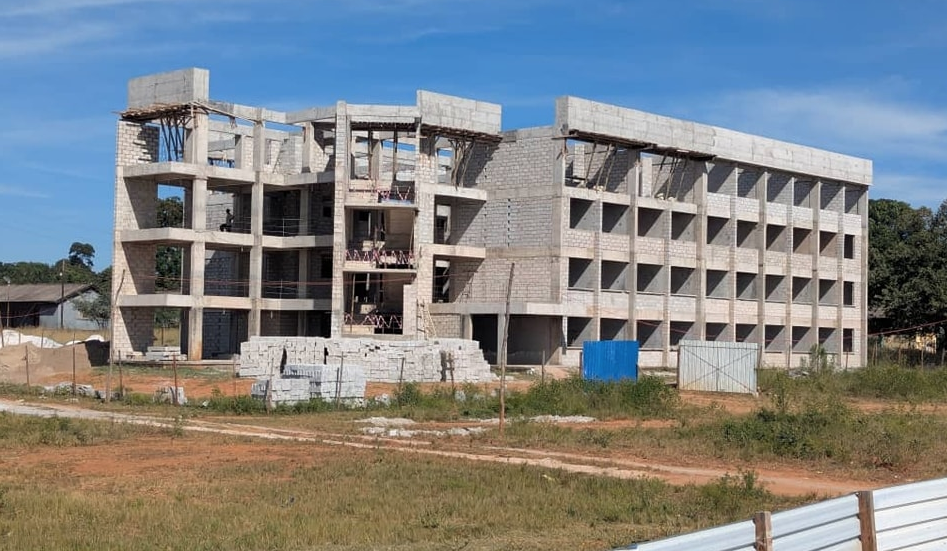
At UNZA and other public institutions, new student hostels are under construction. For Hichilema, free education is not just policy, but a personal crusade.
Throughout his 15 years in opposition, he frequently recounted growing up in rural southern Zambia herding cattle and how free education under founding president Kenneth Kaunda gave him his first real opportunity.
Through a government bursary, Hichilema studied business and economics at UNZA in the 1980s before embarking on a successful private sector career. Over the years, he has personally sponsored thousands of students from primary school through university.
“Education is the best equaliser,” he often said while in opposition, a slogan now repackaged as national policy.
The opposition has struggled to counter both the numbers and the narrative. Visits to public schools reveal crowded classrooms. Teacher unions report increased membership, while student leaders have publicly welcomed improved government support.
In principle, opposition parties are not opposed to free education although they do not explicitly say so. Abolishing it would be politically costly. Instead, they have focused on its implementation challenges and strains on infrastructure.
“In many public schools, class sizes now exceed what any teacher can reasonably manage, with some handling over 100 pupils in a single classroom,” said Harry Kalaba, the leader of the opposition Citizens First Party. “In these conditions, meaningful learning becomes impossible.
“This situation stems from a rushed approach to fulfilling so called election promises without proper planning to protect education quality.”
Syakalima acknowledges that overcrowding is a serious problem. However, he sees it as a temporary and necessary consequence of success. “It is a good problem to have,” the education minister said. “That is why we are building more classrooms and hiring more teachers. We would rather have children in congested classes than on the streets.”
As the election approaches, the UPND is expected to lean heavily on education as proof of delivery in its first term, particularly in its appeal to young voters. For the opposition, the task will be to offer a credible alternative or at least a convincing plan to improve what appears to be one of the government’s most popular policies. – Mail & Guardian
In an age of information overload, Sunrise is The Namibian’s morning briefing, delivered at 6h00 from Monday to Friday. It offers a curated rundown of the most important stories from the past 24 hours – occasionally with a light, witty touch. It’s an essential way to stay informed. Subscribe and join our newsletter community.

The Namibian uses AI tools to assist with improved quality, accuracy and efficiency, while maintaining editorial oversight and journalistic integrity.
Stay informed with The Namibian – your source for credible journalism. Get in-depth reporting and opinions for
only N$85 a month. Invest in journalism, invest in democracy –
Subscribe Now!