





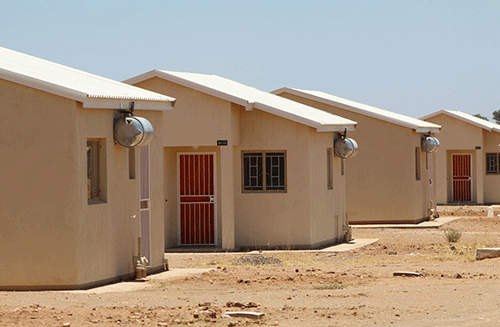
12 friends can now buy a house together
Homeownership in Namibia is a bitter discussion for many, but FNB Namibia last week launched a product aiming to make homeownership more accessible amid the country’s housing crisis.
Namibia currently has a housing backlog of 300 000 units.
The bank’s new ‘collective buying’ product, however, allows up to 12 people to jointly buy property.
“This product allows families, friends, or groups of people to come together to pool their resources and afford properties they might otherwise not be able to purchase individually,” FNB Namibia spokesperson Kirsty Watermeyer says.
LOWER PAYMENTS, SHARED COSTS
The product will offer more flexible mortgage repayments to suit the group’s arrangement, she says.
“Mortgage repayments can either be shared equally among participants or split on a ratio based on their agreed-upon contributions,” she says.
Repayments will be made via automatic deductions from each participant’s account, ensuring an easy and transparent process.
Watermeyer says this shared financial responsibility is a key benefit.
RISKS
She says risks, however, include disputes among participants, defaulting on payments, and exit strategies.
“We encourage customers entering a shared ownership arrangement to ensure they have a legal shared ownership agreement in place that clearly defines each participant’s rights and obligations,” Watermeyer says.
HOW IT WORKS
Each participant will be responsible for their portion of the monthly mortgage repayment.
Customers can opt for registering their property in their individual names or, alternatively, through a close corporation (CC), a proprietary limited (Pty Ltd) company or trust.
“The legal structure should include a shared ownership agreement that clearly defines each participant’s rights and obligations.”
Watermeyer says the mortgage bond will be registered in the names of all participants, and everyone’s contribution will be based on their financial capacity.
MIXED REACTION
Former minister of urban and rural development Erastus Uutoni says the new product would only be suited to commercial properties.
“It’s for those who will be using the property for commercial purposes and do not need accommodation. Then they can rent it and share the income,” he says.
Uutoni says the product is a good initiative, but is not a solution to the country’s housing crisis.
Heinrich Amushila, the director of Namibia Housing Action Group, says the product does not help low-income earners.
“They will not be able to afford the bank loan because of the bank’s requirements,” he says.
Former member of parliament Maximalliant Katjimune says such an arrangement is not sustainable or practical for the majority.
“We must rather look at the root causes of why the average Namibian cannot afford property,” he says.
‘BAD NEWS FOR PROPERTY INDUSTRY’
Property agent Gabriel Heita says the product will make housing more affordable, but is not good news for the property industry.
“Because there will be fewer buyers and more properties,” he says.
HOUSING CRISIS
The Shack Dwellers Federation of Namibia says 89% of the population does not qualify for conventional home loans and cannot access commercial housing.
The National Housing Policy 2023 report shows that only 1.7% of people can afford a N$1-million house.
This has forced 67% of the urban population to live in informal settlements.
Statistics by High Economic Intelligence Investments indicate that young professionals and middle- to low-income earners in Namibia cannot afford to buy a house.
This is because they earn less than the N$30 000 needed to be able to buy a N$1-million house in Windhoek.
The average three-bedroom house in the capital costs roughly N$1.2 million in areas of high and medium density.
The average size of a standard house is 300 square metres, the City of Windhoek says.
The average cost of a house per square metre in Windhoek’s affluent suburbs is no less than N$8 184, while Katutura is priced at N$3 708 per square metre.
According to these statistics, an average 300-square metre house in Katutura would cost roughly N$1.1 million, while a similar house in Klein Windhoek would cost about N$2.5 million.
To qualify for a N$1-million bond, an individual needs a gross salary of N$36 123.
The monthly instalment on a N$1-million house before construction is N$10 664, N$8 678 during construction, and N$11 361 afterwards.
This is unaffordable in a country where only 3% of employed Namibians make more than N$40 000 per month.
Meanwhile, at least 34.1% of Namibia’s workforce earn less than N$2 000 per month, the 2023 Labour Force Report says.