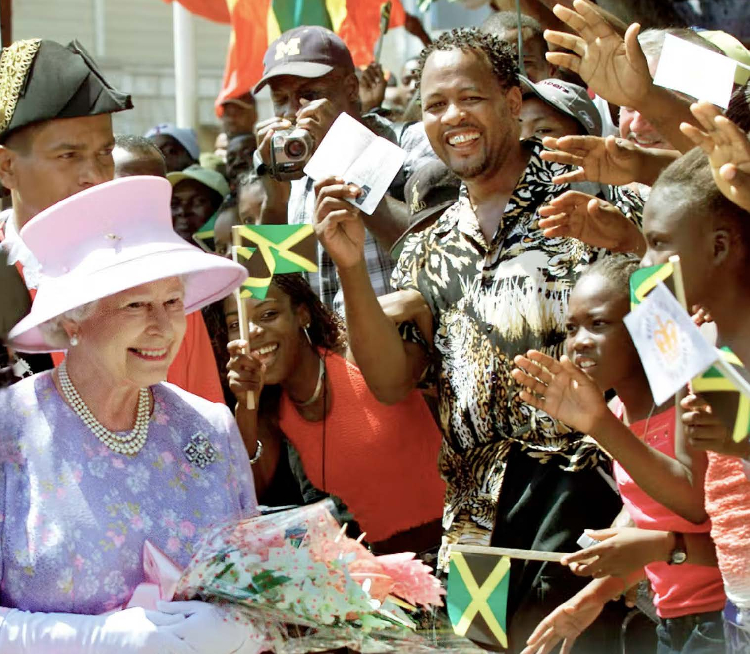
LAURA CLANCYTHE DUKE AND duchess of Cambridge’s tour of the Caribbean for the queen’s Platinum Jubilee has been criticised over the royals ‘ connection to colonialism and slavery.
An open letter by Jamaican public figures says: “We see no reason to celebrate 70 years of the ascension of your grandmother to the British throne, because her leadership, and that of her predecessors, perpetuated the greatest human rights tragedy in the history of humankind.”
But what has the monarchy got to do with slavery and colonialism? How has it benefited from these systems of exploitation and expropriation?
The British monarchy was central to the establishment, expansion, and maintenance of the British empire and the transatlantic slave trade.
The declaration of the English empire was first made by Henry VIII in 1532. Elizabeth I granted a royal charter (an instrument of incorporation) to sir John Hawkins, widely considered one of the first English traders to profit from the slave trade.
She also granted a charter to the British East India Company in 1600.
After Elizabeth’s death, Charles II formed the Royal African Company in 1660, led by the Duke of York (later James II), which extracted goods such as gold and ivory from the Gold Coast, and transported over 3 000 Africans to Barbados.
Many of these people had the initials ‘DY ‘ burned into their skin to signify their belonging to the Duke of York. Both men invested private funds in the company.
Queen Victoria assumed the title of empress of India in 1877, and by 1920 the empire was 13,71 million square miles.
The British monarch’s global significance and power stemmed directly from the enslavement of people of colour.
The Commonwealth is an organisation of 52 ‘independent and equal ‘ member states. Despite this ‘independent ‘ claim, the Commonwealth has imperial origins. Many of the member states are former colonies of the British empire, and Commonwealth expert Philip Murphy describes the way imperial became Commonwealth as “haphazard”.
The Commonwealth emerged from post-World War II decolonisation, as a means of reassuring the British public that the demise of the empire would not diminish Britain’s global prestige.
The queen is the head of the Commonwealth, and Prince Charles was appointed as her successor in 2018. But the position is not hereditary, and there is no constitutional or statutory reason why Charles would take this role. The role of head of the Commonwealth allows the monarch to continue their position of international privilege and influence, which stems from colonial history.
The London Declaration of 1949, which addressed India’s position in the Commonwealth as a republic, set the precedent for Commonwealth countries to adopt republicanism.
But today, 15 remain constitutional monarchies with Elizabeth II as head of state, including Caribbean islands like Jamaica, South American countries like Belize, African states like Ghana, and Canada and Australia.
Since 1842, each country has nominated a local governor general as the queen’s representative, with the power to propose legislation, (dis)prove bills and dissolve the parliament.
Although the queen has no ‘direct ‘ political control in these realms, governor generals could be interpreted as ongoing monarchical administrative power.
Many of these countries, including Australia, Jamaica, Grenada, Saint Lucia and Tuvalu still use ‘God Save the Queen/King ‘ as the national or royal anthem.
As sociologist Ty Salandy argues, such cultural texts were used to instil British values and subservience to colonial authority, and their continued use suggests a similar system of values.
In 2021, Barbados removed the queen as head of state, officially becoming a republic, but remaining part of the Commonwealth. There are reports that Jamaica is planning to do the same after the royal visit.
Following the National Trust’s report on histories of slavery and colonialism in its properties, the chief curator of historic royal palaces, Lucy Worsley, announced a similar investigation into royal palaces in 2020.
Worsley said all properties used by the Stuart dynasty in the 17th century were “going to have an element of money derived from slavery” within them. This includes Kensington Palace and Hampton Court Palace, which have connections to King William III, another part owner of the Royal African Company.
This is not to mention goods now owned by the monarchy that were stolen during colonisation, such as the Koh-i-Noor diamond from India used in the crown jewels, which Pakistan and India have repeatedly asked to be returned.
The lack of transparency regarding what the crown owns versus the queen’s personal effects makes it even harder to trace these histories.
In a speech in 1947 in South Africa, then Princess Elizabeth declared she would devote her life to “the service of our great imperial family to which we all belong”.
In an age of information overload, Sunrise is The Namibian’s morning briefing, delivered at 6h00 from Monday to Friday. It offers a curated rundown of the most important stories from the past 24 hours – occasionally with a light, witty touch. It’s an essential way to stay informed. Subscribe and join our newsletter community.

The Namibian uses AI tools to assist with improved quality, accuracy and efficiency, while maintaining editorial oversight and journalistic integrity.
Stay informed with The Namibian – your source for credible journalism. Get in-depth reporting and opinions for
only N$85 a month. Invest in journalism, invest in democracy –
Subscribe Now!