





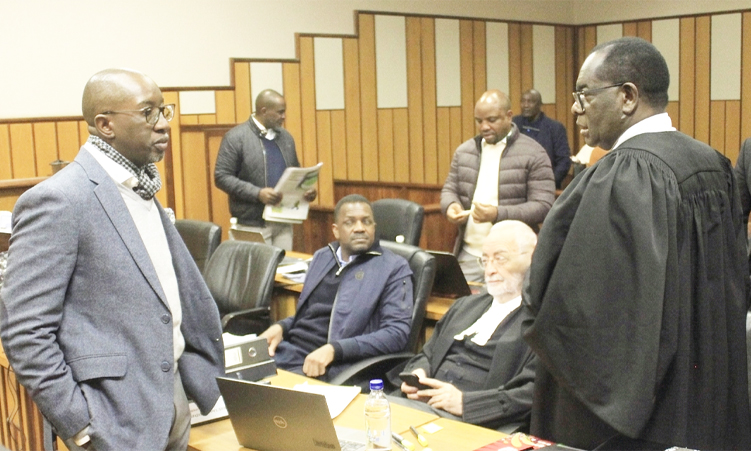
A hearing of a wide-ranging application by four of the individuals charged in the Fishrot fraud, corruption and racketeering case could not proceed as scheduled in the Windhoek High Court yesterday after the judge assigned to the matter recused himself from the case.
Judge Boas Usiku informed the four accused – former attorney general and minister of justice Sacky Shanghala, James Hatuikulipi, Otneel Shuudifonya and Pius Mwatelulo – and lawyers representing the respondents in the matter that he decided not to hear the case assigned to him because he and the second respondent cited in the matter, ACC director general Paulus Noa, are friends.
Their friendship could create a view that he would be biased in the matter, Usiku said before he postponed the application to 9 July, when it should appear again on the case management roll of deputy judge president Shafimana Ueitele.
Shanghala, Hatuikulipi, Shuudifonya and Mwatelulo are asking the court to restrain the prosecutor general from continuing to prosecute them in their criminal case, in which they face charges over the alleged illegal allocation and use of Namibian fishing quotas, until the civil case that they filed last November has been decided.
They are also applying for an interdict permanently stopping their prosecution in the Fishrot case “based on any evidential information obtained and gathered from the unconstitutional, unlawful, unprocedural and ultra vires investigations” allegedly conducted by the Anti-Corruption Commission (ACC).
The ACC’s investigations were done contrary to provisions of Namibia’s Constitution, the Anti-Corruption Act, the Prevention of Organised Crime Act and the International Cooperation in Criminal Matters Act, they are claiming.
They are further asking the court to make a wide range of declarations and to review and set aside numerous actions taken during the investigation of the Fishrot case.
They are also requesting the court to issue an interdict that would prohibit the use of a range of evidence gathered during the investigation, including evidence obtained through the use of search warrants issued by magistrates in Windhoek and at Gobabis and evidence obtained by the auditing firm Deloitte, which was involved in the investigation of the Fishrot case.
The respondents that are opposing the application include the ACC, the prosecutor general, the ACC’s director general and deputy director general, the prime minister, the attorney general and the inspector general of the Namibian Police.
In an affidavit filed at the court, prosecutor general Martha Imalwa alleges that the application of Shanghala and his three co-accused “is part of a sustained strategy of obstruction and delay”, which she says should not be allowed by the court.
Imalwa alleges that Shanghala and the other applicants have launched multiple applications aimed at delaying the start and continuation of their criminal trial, and the application filed last November was launched with the same aim.
The issues they are raising in their application should most appropriately be decided by the judge who conducts their criminal trial and who would be able to adequately protect the accused persons’ right to a fair trial, Imalwa says.
Shanghala and the other applicants do not have legal representation in their application.
The ACC and other respondents opposing the application are represented by senior counsel Geoff Budlender, assisted by Danie Small and Dennis Khama, on instructions from government lawyer Ndamonau Ilovu.