

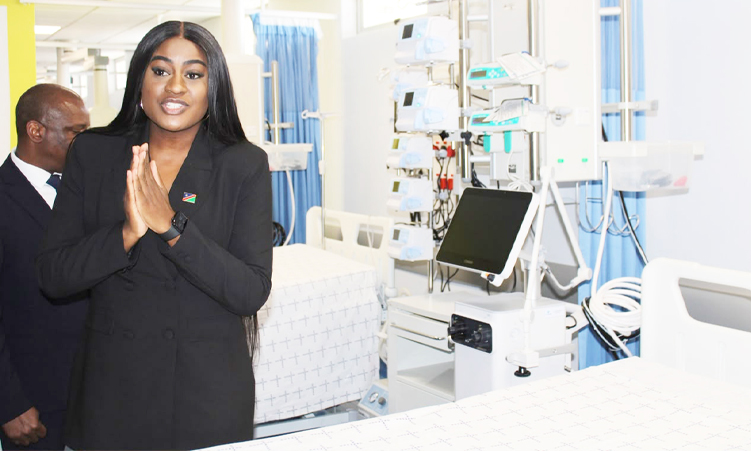
Health minister Esperance Luvindao inaugurated Namibia’s first dedicated public paediatric intensive care unit at Windhoek Central Hospital on Monday.
The facility forms part of a government investment of about N$28 million aimed at strengthening specialised care for critically ill children, the minister of health and social services said at the event.
Luvindao said the investment includes N$ 17.87 million for medical equipment and N$9.6 million for infrastructure upgrades.
“This is not merely about increasing bed capacity; it is distinctively and urgently about saving lives,” she said.
The new facility has expanded capacity, dedicated isolation units, advanced oxygen-flow systems, cardiac monitors and modern ventilators.
Luvindao said the previous six-bed paediatric intensive-care arrangement at Windhoek Central Hospital had served the country but lacked the capacity and modern equipment required to meet growing healthcare demands.
“Consequently, critically ill children sometimes had to be transferred to private facilities, a costly measure that exposed fragile patients to additional clinical risks,” she said.
Between 2022 and 2026, the previous setup admitted about 1 090 children, with 929 successfully discharged, resulting in an overall death rate of about 14.5%.
Luvindao said the ministry was aiming to improve these outcomes through the new facility, with a strategic target of reducing paediatric intensive care unit (ICU) deaths to below 2.5%.
She said the facility was not only about equipment and infrastructure, but also the healthcare professionals responsible for providing care.
“A state-of-the-art ICU does not heal patients through technology alone. The true creators of value are our healthcare professionals,” the minister said.
She said the ministry had invested in the training of paediatricians, critical care doctors and specialised nurses to ensure the facility operates as a centre of clinical excellence.
Luvindao stressed the importance of accountability and patient safety, referring to the complaints management standard operating procedure launched on 12 June.
“This system is not designed to create a culture of fear, but rather a culture of learning, accountability, and continuous clinical improvement,” she said.
The minister said modern paediatric healthcare should also be family-centred, with parents playing an important role in their children’s recovery.
“Parents are not visitors; they are essential partners in a child’s recovery,” she said.
Although the unit is located in the Khomas region, Luvindao said it would serve as a national facility through the country’s referral system.
She said the government’s vision extends beyond Windhoek, with plans to strengthen dedicated specialist intensive care for children at other regional and intermediate hospitals.
Luvindao thanked private-sector partners, including the Bank of Namibia and TotalEnergies, for their contributions to the unit.
She urged the ministry and hospital management to maintain the facility and its equipment, continuously train staff and protect the investment.
“The true measure of this facility will not be the N$28 million spent, nor the number of monitors humming in these rooms,” she said.